

By Pradeep Kumar
ITANAGAR, Oct 24: As India is taking part in 16th session of United Nations Conference of Parties (COP-16) on Convention on Biological Diversity (CBD), which begun at Cali, Colombia on October 21 and continue till November 1, Arunachal PCCF (wildlife & biodiversity) N Tam, conservator of forests (HQs) Millo Tasser, conservator of forests (W&B) Dr. Damodhar A.T., EWS range forest officer Yachang Kani, , SBVCR community representatives Naresh Glow and Shaleena Phinya, are part of the team.
The team was selected in consultation with Union Ministry of Environment, Forest & Climate Change and National Biodiversity Authority, Chief Secretrar Kaling Tayeng said in the order.
Arunachal Pradesh having 80% of its total geographical area under forest cover, constitutes a major portion of two ‘Global Biodiversity Hotspot’ of the world viz. Eastern Himalayan Biodiversity Hotspot and Indo-Burnma Biodiversity Hotspot with immensely rich floral and faunal species, Chief Secretary Kaling Tayeng said in the order.
The GoAP has been giving topmost priority to preserve, protect and conserve its biological diversity, including its rich wildlife and its natural habitat.
Thus, the GoAP nominates the above team of officers and local community representatives, who are working and contributing to the successful conservation and management of state’s wildlife & biodiversity.
The above team shall take part in COP-16 to showcase success stories and best practices, including biodiversity conservation by Singchung Bugun Village Community Reserve (SBVCR), snow leopard conservation initiatives in Tawang in global platform in consultation with the Ministry of Environment, Forest & Climate Change, Govt. of India and National Biodiversity Authority, Chennai. All officers/individuals concerned Sd/ (Kaling Tayeng, IAS) Chief Secretary Govt. of Arunachal Pradesh.
Bugun liocichla or Liocichla bugunorum, a tiny bird, found only Eaglenest Wildlife Sanctuary (EWS) in West Kameng district, first a pair spotted by professional astronomer Ramana Athreya in January 1995 while working for his PhD thesis and touring in Singchung Bugun Village Community Reserve (SBVCR) with his wife, a wildlife biologist doing research in Arunachal Pradesh and some forest officers.
This was the first bird named after the Bugun tribe, also known as Khowa. It was one of the first bird species to be discovered in India since independence in 1947 and found only in Buguns’ community lands.
The bird is a critically endangered species with only 14 to 20 individuals believed to exist in the world. Nearly all of the birds live within a tiny area of SBVCR just outside the sanctuary sharing their home, and name, with a local indigenous tribe. The bird was recognized as a new species in 2006 while International Union for the Conservation of Nature (IUCN) classified it as Critically Endangered.
Bugun Liocichla, a small babbler 20 cm (7.9 in) with olive-grey plumage, a black cap, face marked with prominent orange-yellow lores, wings have yellow, red and white patches, with fluty and distinctive voice. It is capable of living in degraded forests, and possibility of its discovery in other areas of Arunachal or neighbouring Bhutan cannot be ruled out.
The bird had turned politician-cum-social activist Naresh Glow of Tenga, who had served as MLA of Thrizino-Buragaon Assembly seat, into a film maker in collaboration with his friend noted film maker Dorjee K Thongun.
True to its distinction as nature’s trove, Arunachal Pradesh, one of the 12 bio-diversity hotspots in the world, had surprised ornithologists with the discovery of a rare bird and nature lovers and researchers started making beeline for which Glow had engaged local girl Shaleena Phinya as a patrol staff of Forest Protection Squad of SBVCR, to help the visitors see the bird.
Phinya, a Bugun and wildlife filmmaker, with deep cultural roots of the tribe entwined with that of the forest for always worshipping the biodiversity. The Buguns never looked at their forest through the lens of nature conservation.
However, on learning about “Green Hub Video Documentary Centre,” she had applied for a fellowship and has been selected for a course on photography and videography.
While informing this daily over telephone, Glow said that she deserved it as she has been working for the protection of the rare birds for decades.
Phinya was interviewed by this daily umpteen times, particularly during tourist season.
However, Glow’s first documentary – The Incredible Buguns – with Thungon as director had won NE best film award and best Tribal Film award of MP Govt. His second, a 29-minute documentary film –Wildlife-Our Lifeblood – broke many a records.
It highlights contributions of Bugun tribe to wildlife conservation by establishing SBVCR, a 17-sqkm biodiversity hotspot in 2017, next to the Eaglenest Wildlife Sanctuary (EWS) home to rare species Bugun Liocichla.
“As the bird derives its name from Bugun community, efforts to protect it are on and I decided to make this film within only one week as a producer,” said Glow, who is also one of the founders and chief patrons of SBVRC who tried to capture the entire process in his documentary film.
The 15th edition of International Wildlife Conservation Documentary Film Festival (IWCDFF) 2020 was conducted during December 1 to 7, 2021 at Café de la Gare in Paris in association with European Film Council (EFC), World Documentary Forum (WDF) and Cultural affairs of Paris, he said, adding the KLEFF 2020 during October 8 to 11, 200 had screened 53 films via its digital screening platform, including his films.
His first feature film The Land of Bugun Liocichla (LoBL) was released in 2019 while Molan reflecting life of monks and nuns of Mahayana Buddhism was complete in 2020.
“Shooting documentaries was quite simple process since all Buguns took active part. The Incredible Buguns, is based entirely on this tribe, – from their historical migration from central Asia to their present dwellings, their culture and traditions. However, covering all major nine scattered Bugun villages poised tough challenges for lack of road communication and hostile climatic conditions besides few less enthusiastic villagers. The Buguns divide their community land among individual members. A piece of land, called Lama Camp, as HH Dalai Lama’s entourage had stopped for a night there while fleeing from Tibet in 1959, was used to set up basic tourism infrastructure,” Thougun said responding to questions.
“The documentary on SBVCR showcases conservation efforts of an NGO of villagers to protect and preserve wildlife, spearheaded by Naresh Glow. Covering the idea from the village to famous Eaglenest Wildlife Sanctuary was a hard work as the wildlife and forest pose difficulties along with bad weather but their efforts won award. Shooting solely depends on weather conditions and dense fog takes the toll on time.
“I have never come across a producer, like Glow, who was very clear that his objective was not profit but conservation and highlighting our rich cultural heritage. His responsible attitude as a public leader would be cherished by the Buguns for generations”, Thongun had said with conviction.
2nd songbird named after Lisu tribe
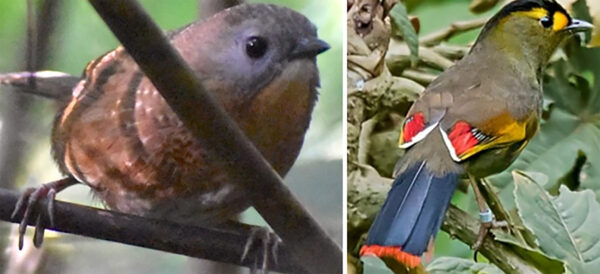
Lisu Wren Babbler Bugun liocichla
Interestingly, a rare but songbird Grey-bellied Wren Babbler by six birdwatchers from Bengaluru, Chennai, and Thiruvananthapuram (in picture) was discovered in state’s Mugaphi peak in Changlang district in March 2022.
The team had named the bird as Lisu Wren Babbler, after local Lisu community, which was recently published by Indian BIRDS, a peer-reviewed journal of south Asian ornithology.


 20