
- Protect Zemithang wintering site: Locals
By A O News Service
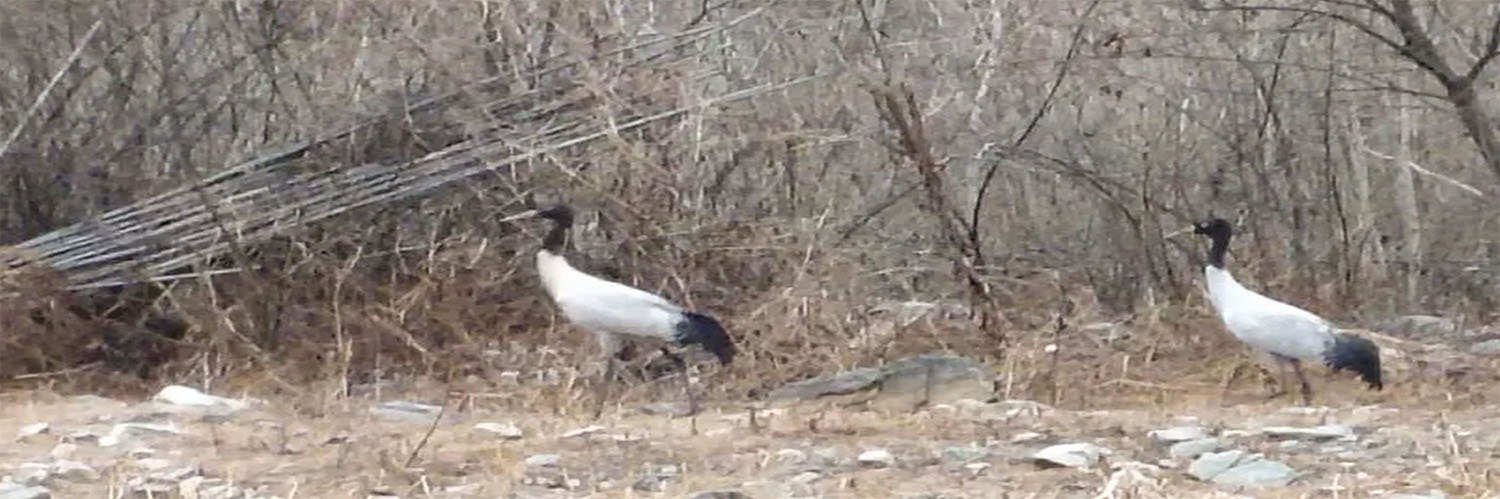
ITANAGAR, Feb 02: A pair of black-necked cranes was spotted for the first time at a place in between Morshing and Domkho villages in West Kameng district on Saturday afternoon. “Earlier there was no report of black-necked cranes’ arrival in these villages. This afternoon, our teachers Tenzin Phuntsok, Rinchin Wangdi, Sangey Tenzin and others spotted a pair of black-necked cranes.” Morshing village Kunphen Residential School secretary Lobjang Nima said.
“This is for the first time that these auspicious cranes have been spotted. I have alerted all the villagers about these rare birds and asked them not to disturb their stay,” he said, adding Sangti Valley people of also confirmed that two cranes were in Sangti Valley for a month but not been seen for last two days.
Eaglenest Wildlife Sanctuary range forest officer Yachang Kani said there is a possibility that the cranes have shifted to a more suitable location and hinted about his plan to visit Morshing and Domkho villages to conduct preliminary investigation to confirm whether these are the ones that had been staying at Sangti.
The highly endangered black-necked crane(Grus nigricollis), which visits its wintering sites at Zemithang in Tawang and Sangti Valley in West Kameng, now faces an uncertain future due to growing human activities in these areas.
The arrival of two black-necked cranes at their wintering site along Nyamjang Chhu River in Zemithang was reported on 14.11.24. This short 3-km stretch of the river, between Brokenthang and Zemithang, is one of only two regular, long-term wintering sites for this revered bird in India, as reported by this daily on 19.11.24.
However, according to local residents, the pair of cranes has left, while another single crane landed at the site the following day.
The black-necked crane is a medium-sized crane in Asia that breeds in Tibetan Plateau and remote parts of India and Bhutan. It is 139 cm long with a 235 cm wingspan and weighs 5.5 kg. It is whitish-gray, with a black head, red crown patch, black upper neck and legs, and white patch to the rear of the eye. It has black primaries and secondaries. Both sexes are similar. Some populations are known to make seasonal movements. It is revered in Buddhist traditions and culturally protected across much of its range. A festival in Bhutan celebrates the bird while Ladakh has designated it as the state bird.
Zemithang home to rich Himalayan biodiversity, known for its rich cultural and religious heritage, has also been a top tourist destination and vibrant village. Expressing concern, local environmental enthusiasts said, “We need development, which it should not be at the cost of our rich biodiversity, especially involving the black-necked cranes.”
They are worried about protection of the cranes during their stay during mid-November to mid-March and said, “All activities related to mineral extraction or any other activities that disturb these birds should immediately be banned.”
To ensure the safety of the cranes, Zemithang EAC Deewan Mara had said, “The Zemithang administration has a standing order to shut down quarries and crusher units along banks of Nyamjang Chhu. Any violations will invite a penalty of Rs. 10,000, along with legal action.”
“While steps have been taken for coordination with World Wide Fund (WWF) for conservation of the cranes, I am personally monitoring the situation and believe that timely intervention has led to visit of the cranes,” he added.
Confirming arrival of the cranes, WWF India field assistant Pemba Tsering Romo said that their number and stay is being actively monitored. Locals said that, a single crane usually arrives first, followed by a pair after 2-3 days, and then the pair brings a juvenile after another 3-4 days. The black-necked cranes are highly revered by the Monpas, who believe the birds are the embodiment of 6th Dalai Lama and view them as an auspicious sign.
In Sangti Valley of West Kameng district, residents reported that no cranes arrived this year so far. However, they are concerned that increasing human habitation and activities near the cranes’ wintering site could discourage them from staying. If these activities continue, they fear that the cranes may not visit the area in future.
Environmental enthusiasts from both Tawang and West Kameng districts are calling on the authorities to designate these wintering sites as protected areas, where no human activities should be allowed during the cranes’ stay.
The estimated population of black-necked crane was between 10,070 and 10,970 individuals in 2013. These birds are legally protected in China, India and Bhutan. However, habitat modification, drying of lakes and agriculture are threats to the populations. In many areas, dogs belonging to herders are a major threat to young birds. An incident of leopards preying on the roosting cranes during the night has been recorded from Phobjika Valley of Bhutan. Despite protections, hunting continues to be a problem in parts of China and India. In Bhutan, collisions with power lines have been another cause of mortality in some areas.
Eggs may also be preyed on by ravens that may use the opportunity provided when humans disturb the parents. The drying of wetlands can cause increased accessibility of the nests leading to predation while a rise in the water level can submerge nests. Loss and degradation of habitat are the main threats facing the black-necked cranes.
The problems are most serious in the wintering areas, where wetlands are extensively affected by human activity including irrigation, dam construction, draining, and grazing pressure.
In Tibet, widespread changes in traditional agricultural practices have reduced the availability of waste barley and spring wheat while populations in Bhutan are well protected both culturally and legally although some disturbance from tourism exists.
This crane is evaluated as near threatened on ICUN Red List of Threatened Species and listed on Appendix I of CITES.


 20
