
Beyond the Horizon
By Pradeep Kumar
Global ‘Festival of Colours’ was celebrated across India beginning with Dolo Purnima (March 14) and concluded with Holi next day.
But Balsore or Baleswara city, about 186-km from Kolkata and about 18-km from Bay of Bengal shore Chandipur, where Indian Missile Defence programme’s integrated test range of DRDO is located and the Britishers had landed first in India and attached lot of importance after discovering its strategic importance, celebrated Holi with great enthusiasm and fun fare.
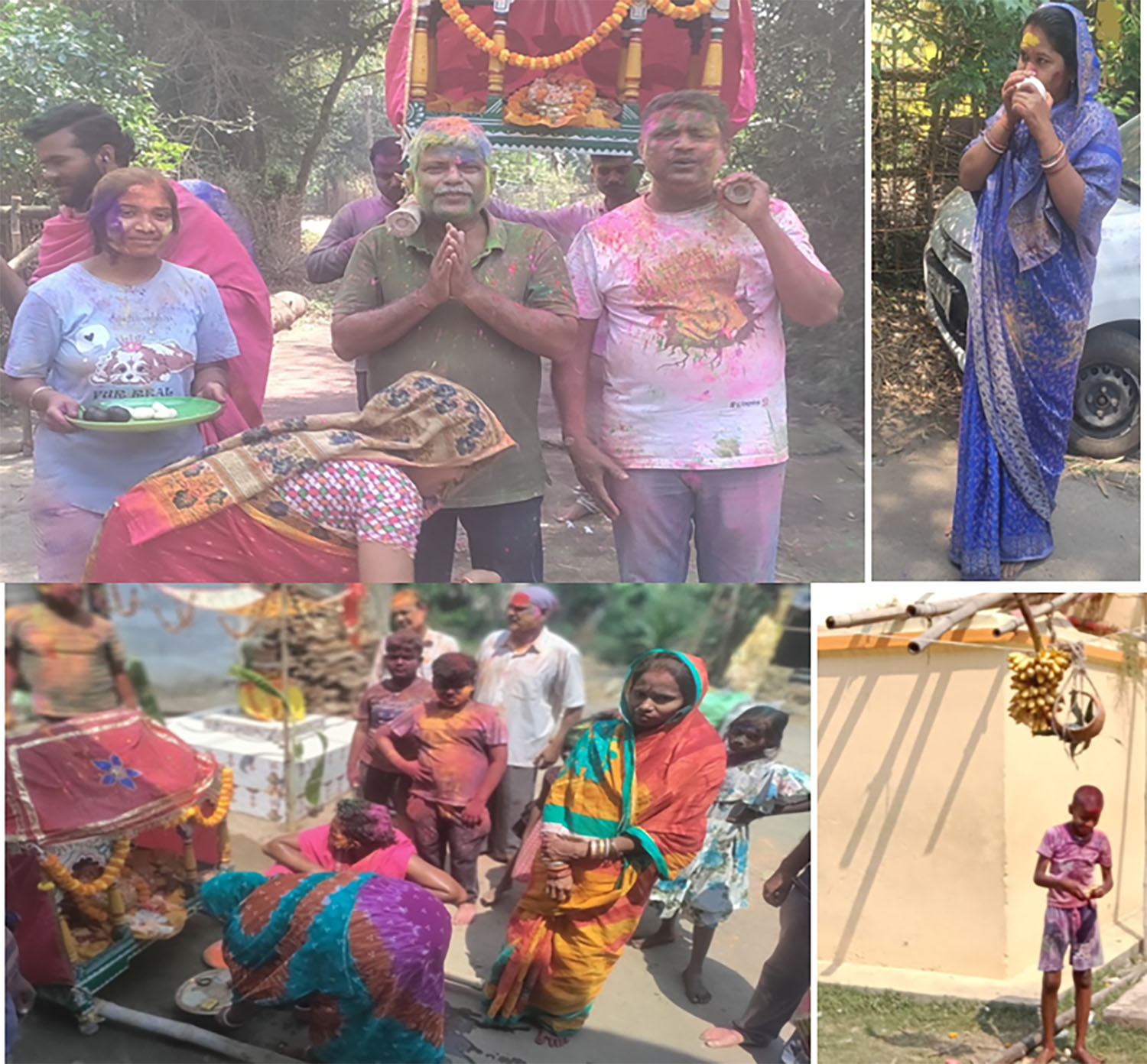
Lord Krishna and Devi Rdha idols kept in a decorated pendal was carried in a procession from Bhimpura Radha Krishan temple with sankirtan by a group across few villages, arranged by Rashtrirya Swyamsevak Sangh (RSS) Ratri Milan branch in-charge Nityananda Rout. Volunteers of Chandmai Padia RSS Bhimrao Ambedkar Prabhat branch led by in-charge Pradeep Kumar Sahoo actively took part.
Women along the route blew conches while many came forward to worship to halt the pendal for the priest to perform the rituals. The pandal was taken to various temples, but halted at residence of Shrikanta Barik, a Gauda by caste, where both deities were offered prasad made of pure milk and all participants served curd milk drink.
All along the route, podwer colours were sprinkled on the pandal and the precisionists by the onlookers and devotees waiting with colour to play Holi.
After return to the temple, the organizers replicated Vridabn scene, as all participants competed to break a wooden pot filled with many rich food stuff in liquid form along with a bunch of banana hanging atop of tall bamboo.
As a health youth jumped and broke the pot, the participants in chorus shouted Radha Krishna.. Radha Krishan. Holi ayi re Holi aao kehle sang sang. (It is Holi again, let us play colours together).
Lord Krishna, 8th incarnation of Lord Vishnu in Dwapara Yuga to establish dharma, had eloped Rukmini, princess of Bhismak kingdom, and rode to Dwarika in his chariot. The ruins of Bhismak Nagar, near Lower Dibang Valley district HQs Roing, Malinithn at Likabali in Lower Siang district and Ashwaklanta Temple, near Guwahati, are testimony of Krishna lila.
According to Shaivism and Shaktism, the significance of Holi is linked to deeply meditation Lord Shiva when. Goddess Parvati wished to bring Shiva back into the world and sought help of Love god Kamadeva on Vasant Panchami. Kamadev shot arrows at Shiva, who opened his third eye that turned Kamadeva into ashes. This upset Goddess Parvati and Kamadevi’s’s wife Rati.
Rati meditated for 40 days to please Lord Shiva, who with compassion restored life of God of Love, which is celebrated as Holi on 40th day after Vasant Panchami.
Balasore: The Britishers had attached lot of importance to Balasore for its strategic importance during the East India Company (EIC)’s rule.
In fact, motivated by successful business stories of the Portuguese, a group of English merchants -Merchant Adventurers – formed a company (the ECI) in 1599 AD after receiving royal charter from Queen Elizabeth-I on 31.12.1600 AD authorizing it to trade in the East. Queen was herself a share holder of the EIC. The EIC, an English and later British joint-stock company, was formed to trade in Indian Ocean region, initially with Mughal India and the East Indies, and later with Qing China. The company ended up seizing control of large parts of Indian subcontinent, colonized parts of Southeast Asia, and colonized Hong Kong after a war with Qing China.
General Fred Roberts & ordnance factories director Alexander walker had proposed the British Govt that Chandipur within the river outfall area of Budhabalanga was tailor-made for testing arsenals. Then Balasore collector C H Bompas had acquired land for the test range towards the end of 1894 and that was how the foundation of ordnance factory was laid at Chandipur. There was no rail link to Orissa then and the British used to reach Chandipur on trucks. The rest is an unending history.
Interestingly, Persian had Balasore or Baleshwar, which means “Bala-e-shore” or “town in the sea”, but changed during Mughal rule to be named after the Hindu deity Baneshwar (Shiva), the presiding deity of the city. Kolkata, which is original name of one of the three villages Kalikata or Kalikshetra (Ground of Goddess Kali), was Anglicized by the British as Calcutta. West Bengal Govt in 2001 renamed as Kolkata.


 20

