By Pradeep Kumar
Illegal poppy cultivation
destroyed first time: SP
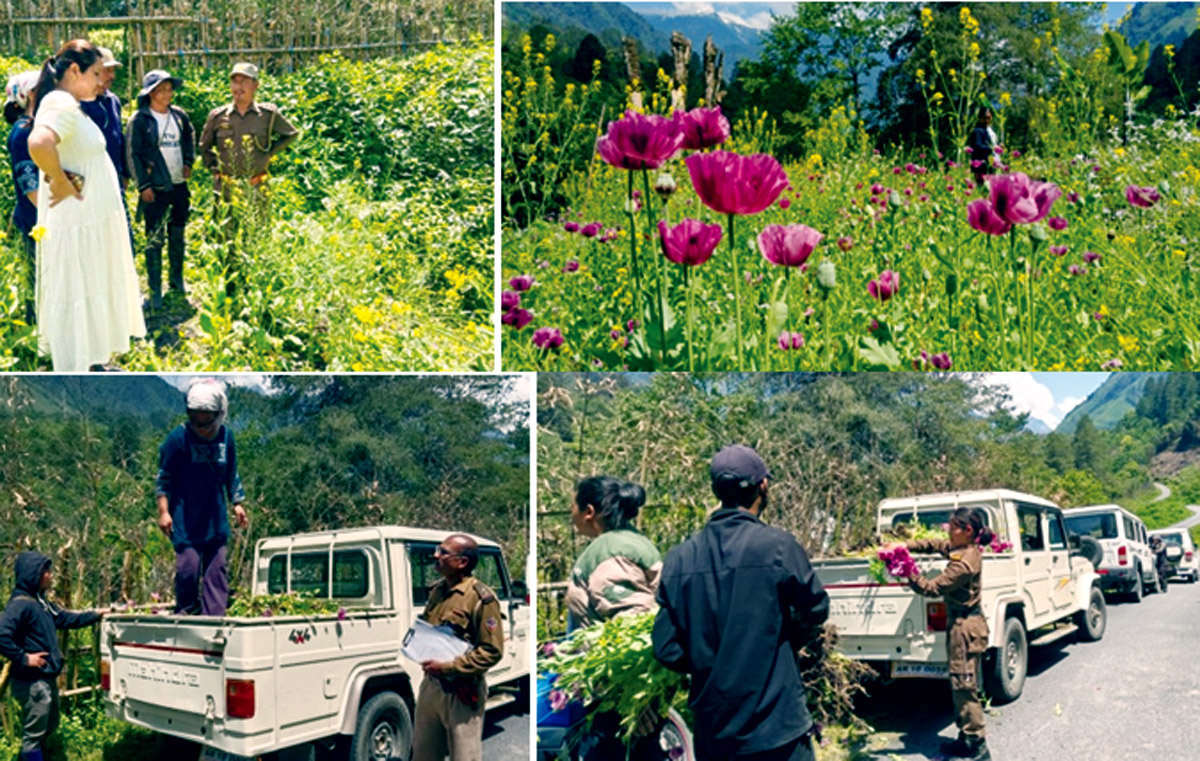
ANINI, May 12: Dibang Valley district police in coordination with district administration, in a landmark initiative under Operation Dawn-2, carried out the first-ever destruction of illegal poppy cultivation in the district on Saturday last, according to an official release.
Acting on credible intelligence inputs about illicit poppy cultivation near Angrim Valley, a joint team led by SI Chote Lal Sahani and executive magistrate Dr. Kajum Mara, conducted an operation at the site, located between Anini–Dumbuen road and Dri River, where approximately 110 square meters of standing poppy plants were illegally cultivated.
Video graph and photograph of the site taken and poppy straw seized in presence of independent witnesses. The illicit crop was uprooted and destroyed in the presence of all officials, a major step in district’s efforts against narcotics and illegal drug cultivation.
Approximately 1kg raw poppy plant was seized based on the complaint as evidence. A suo moto criminal case (No 2 U/S 18(a)/25 of the NDPS Act, 1985) was registered at Anini police station and SI Lokmey Boluk was entrusted with the responsibility of investigation. The past NDPS cases registered in this district were mostly related to drug consumption or illegal sale. But, this is first instance involving illegal poppy cultivation.
Dibang Valley SP Manish Shaurya appreciated the joint team for its prompt and coordinated action and directed to trace those involved and also identify other illegally poppy cultivated locations, the release added.
AONS adds: In fact, Shaurya, a 2020 batch AGMUT cadre IPS officer, has not only succeeded in discovering and destroying the plants, but the district police under his command remains firmly committed to eliminate drug menace by strictly enforcing the NDPS Act.
Highest ever Rs.1.33 cr
cannabis seized: SP
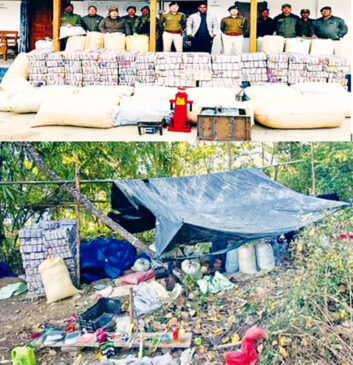
It may be recalled here that the state had created a record with seizure of highest ever suspected cannabis weighing 1.654.22 kg worth rs. 1.33 crore as reported in 21.01.25 edition of this daily.
A Kalaktang police station team led by OC Padi Payang and SI David Tagi, under Operation Dawn 2, had conducted raid as per credible intelligence input in and around Betchilling village around 2 pm on January 18 under supervision of Bhalukpong ASP-cum-Kalaktan SDPO Pawan Yadav to achieve success, West Kameng SP Sudhansu Dhama had told this daily over telephone.
On seeing approaching police team from great distance, two unknown persons had fled away from the spot leaving behind huge consignment in interior of jungle area surrounding the village. Even after thorough search of the area, both suspects were untraced. Accordingly, information regarding the same was sent to nearby PS and Assam police for coordination.
After conducting all legal formalities with audio-visual recording in presence of executive magistrate, a case was registered at the PS under relevant sections of NDPS, the SP had said.
Total seizures included crushed rectangular suspected cannabis in 108 packets weighing 1080-kg each and 33 gunny bags containing 574-kg, total 1654.22-kg; 50 ton hydraulic piston jack for crushing; modified iron trunk, one iron frame and modified weighing machine. These subsidiary materials were used to press the cannabis and make them convenient to hide for movement.
Seizure rings alarm bell: Such large quality drug discovery in western parts of the state, particularly in West Kameng district, inhabited mostly by religious Monpa tribe, is a matter of concern. It is enough to ring alarm bell for officers involved in anti-drug operations to zero down to the source to nip the bud before the menace grips the GenNext.
Trade replaced tradition
for earning quick bucks
Arunachal Pradesh, geographically 14th largest state of India spread in 83,743 sqkm bordering Bhutan in the west, Myanmar in the east and disputed 1,129-km border with China’s Tibet Autonomous Region, is inhabited by 26 major tribes and about 110 sub-tribes.
But, older Mishmi men used to grow opium in the past only for personal consumption, according to records, but soon youngsters and even women started growing it and many people from outside hired large plots of land to commercially grow opium illegally, especially in the plains.
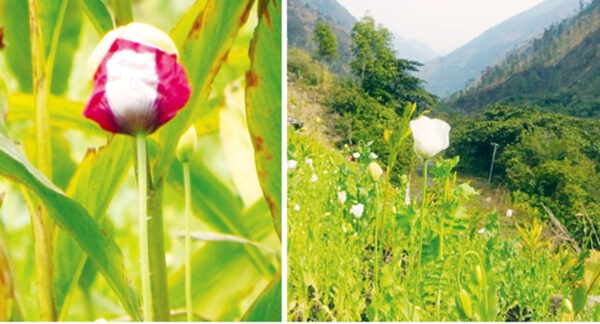
The Mishmi Hills, part of the eastern Himalayas, became notorious for illegal opium cultivation, locally called kaani, during past few decades.
The transition from centuries-old tradition of growing opium for ritual purposes changed only after the Supreme Court in 1996 banned felling of trees for timber mills. By 2000 agricultural land was interspersed with commercial opium cultivation, which slowly increased year by year as growing opium, like cash crop, become major source of income in the poor region.
People have been cultivating poppy illegally in Anjaw, Lohit, Upper Siang, Lower Dibang Valley, Tirap, Changlang and Longding districts as cash crops, like oranges, pineapples and ginger to make fast and easy money as per 2019 records. Under development, no job opportunity, poor education penetration and limited infrastructure were attributed to such phenomenon in the past.
Anjaw, Lohit and Namsai districts once had India’s densest forests. Large tracts of opium poppies have replaced jhum cultivation in the hills or biodiverse rich forests in the plains. Lot of cross-border trade as people from outside, mostly rich traders from other parts of India, buy opium poppy in various forms, take it to Assam’s towns and sell it to insurgents, who in turn use it to buy arms. Some of it reportedly winds up in Myanmar.
India’s NE has had a series of long running insurgencies since the independence of India. Although casualty levels have fallen across the decades, sporadic violence is still common in the region, with militant factions using any means at their disposal – including shadow taxes on businesses in the region – to continue their operations.
The best example is state chief information commiisiner (Retd) Y D Thongchi, who while serving as Changlang district EAC (1986-87), had seized 95-kg hashish sending a shock wave across the country. Hashish per kg was Rs one lakh in global market then. The Central Bureau of Narcotics (CBN) continues to destroy illicit cultivated opium areas, like approximately 3,600 hectares in 2022, but the cultivation continues.
While a major tribe has lost a generation to opium, every leader, including Chief Minister Pema Khandu and DCM Chowna Mein, in their public addresses, invariably makes a fervent plea to GenNext to refrain from drug abuse.
“Say No to Drugs! Spreading awareness against drug addiction is key to eliminating the drug menace,” CM’s message in X is a clear indicator of the intensity odf drug menace in the state.
Union Home Affairs Minister in 2017 had admitted in Lok Sabha) that “there are some cases where India has been used as a transit point for drug trafficking. Situated between Golden Crescent and Golden Triangle, major opium producing regions in the world, India is used as a transit country.”
The UN Conventions envisage state-to-state cooperation when it comes to the illegal opium trade. India has signed agreements with 37 countries to work together regulate drugs and combat drug trafficking as defined by the United Nations International Drug Control Conventions.
Anjaw, Lohit, Tirap, Changlang and Longding all share porous border with Myanmar, part of the Golden Crescent of Myanmar, Laos and Thailand, Golden Crescent, located along confluence of Ruak and Mekong Rivers, spread in approximately 950,000 sqkm area, is second largest opium-producing areas of the world, after Afghanistan.


 20