
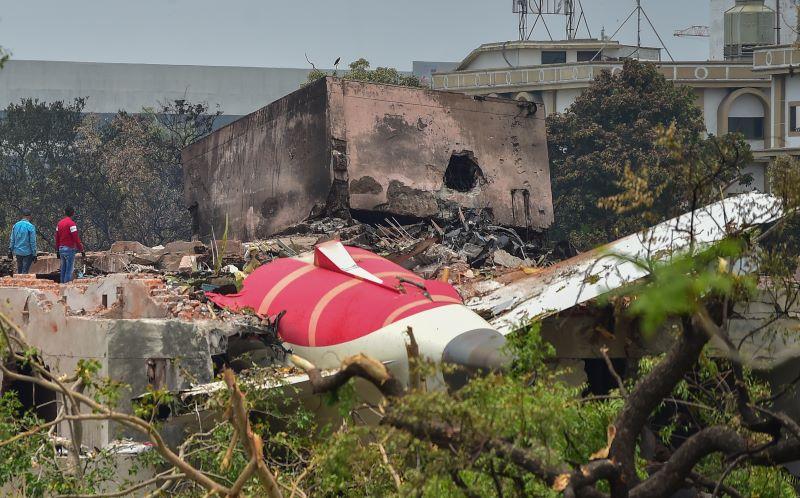
Remains of the crashed Air India plane after hitting the BJMC hostel building
By Pradeep Kumar
ITANAGAR, Jun 14: An 11-year-old double-engine Air India (Boeing 787-8) aircraft took off from Sardar Vallabhbhai Patel International Airport, Ahmadabad at 1:38 pm on 12.06.25 for London with 242 passengers and crew and after climbing barely 425 feet in five minutes, plummeted into B.J. Medical College (BJMC) hostel mess, 5-km from the airport, as over 100 students were gathered for lunch.
The crash killed 241 on board except, including 169 Indians, 53 British, one Canadian and seven Portuguese nationals, apart from 12 crew members, while one passenger Vishwaskumar Ramesh (travelling in A11 seat to London with his brother) had a narrow escape, besides 24 others on ground (20 in the BJMC complex where the doomed flight crashed). mounting the toll to 265, making it India’s deadliest air crash.
In the first press briefing in New Delhi on Saturday, civil aviation secretary Samir Kumar Sinha said, “The Air India aircraft that crashed in Ahmedabad on June 12, killing at least 260 people, had climbed to just 650 feet and began to lose height. The pilot at 1:39 PM gave a Mayday call to the ATC, which tried to contact the pilot but then there was no response.
“The aircraft crashed into a medical hostel complex in Meghaninagar exactly one minute after takeoff,” Sinha said, adding prior to Thursday’s accident, the aircraft had completed Paris-Delhi-Ahmedabad sector flight without any trouble.
Union Civil Aviation Minister Ram Mohan Naidu Kinjarapu, who was also present during the briefing, said that that eight B787 aircrafts have been inspected since the crash. A surveillance of Air India’s Boeing 787 fleet has started as per direction of Civil Aviation Directorate General. “Of the 34 Dreamliners in India, eight have already undergone inspection,” he said.
“The accident near Ahmedabad airport shook the entire nation. My deepest condolences are with family members who have lost their loved ones. I have also lost my father in a road accident. So, to a certain extent, I can understand the pain and anguish that the family members are feeling,” he added.
Air India CEO-cum-MD Campbell Wilson also visited the plane crash site and Tata Group has announced to provide ₹ one crore to the families of each person who lost their beloved ones in the crash.
The Civil Aviation Ministry has appointed a committee to probe the Air India crash to ascertain the exact cause of the shocking tragedy and submit report in three months.
Aviation experts have told the Hindustan Times that the aircraft’s flight profile — descending while maintaining a nose-up attitude — might suggest a sudden and severe power loss. They cautioned, however, that while such a descent profile is consistent with engine failure, the exact cause cannot be confirmed until later after investigation.
But, the media – electronic, print and social – is agog with numerous questions, particularly by those who have through knowledge of aviation industry and the ability of pilots in dealing with unforeseen situations.
1) It is presumed that the aircraft failed to take off and plummeted to fall like a rock as trainer pilot Sumeet Sabharwal with 8,500-hour flying experience had sounded M-Day. Regrettably, Sumeet failed to fulfill his last promise given to ailing father: ‘Wanted to quit flying and come home’
2) It is believed that both engines failed to cause the tragedy.
3) The 11-year age of the aircraft is not old in aviation industry.
4) Boeing 787-8 is considered one of the safest aircrafts globally.
They how and why the aircraft crashed? Was it due to human errors or mechanical failure? The khan purti of all such major tragedies is a foregone conclusion in India. But responsibilities are fixed in rare cases.
The investigators after thorough analysis of the Black Box record, conversation of pilot with ATC, flight movement data, video footage, chemical examination of fuselage and eyewitnesses accounts would zero down to the cause.


 20
