
By A O News Service
ITANAGAR | Nov 10 | Demonitisation being a bold historic steps its impacts are slow but steady on Indian economy whose multiple benefits would be reaped in the long run, said DNGC economic HoD Dr A Imbotomi Singh.
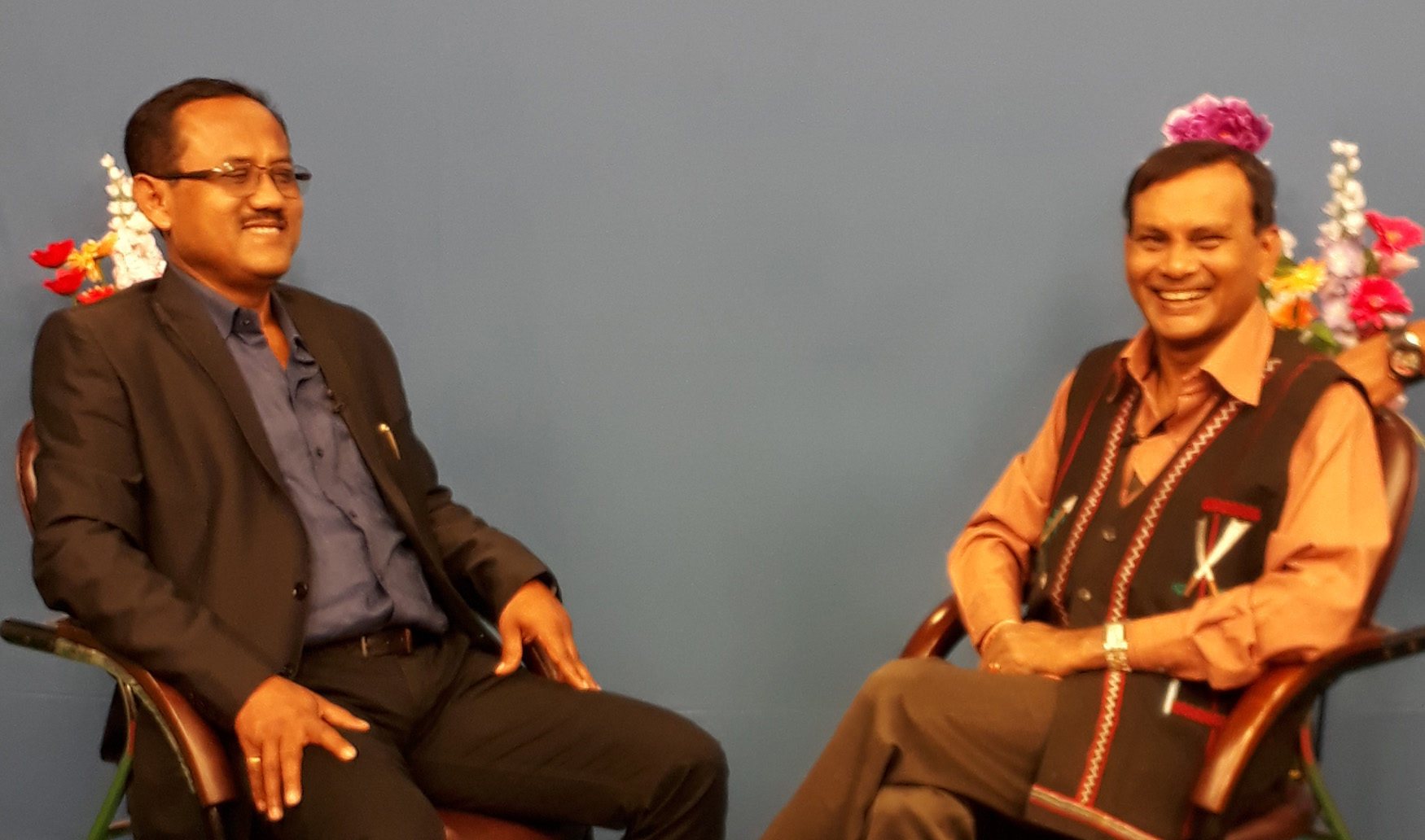
Taking part in DDK discussion on ‘Demonitisation – a novel experiment’, introduced by Prime Minister Modi on 08.11.16 here today, responding to anchor senior journalists Pradeep Kumar’s question what does demonitisation means, Dr Singh said withdrawal of currencies from circulation.
Giving a clear picture of traditional Indian economy divided into agriculture, industrial and services sectors or broadly formal and non-formal, he said that large amount of money was in informal or unorganized sector and excluded from official economic jurisdiction for being circulated as black money. Though India entered liberalized economy in 1991, but black money continued to sway the system.
When asked if Rs three lakh crore black money reportedly were injected into total Rs 17 lakh core in circulation, he said it has either been deposited in the banks or destroyed.
If the step any impact of hawala transactions, insurgency, particularly in Jammu & Kashmir and NE India, he nodded in confirmation, saying benami transaction or hawala deals are things of past now while disappearance of black money has broken the skeleton of insurgency.
When Kumar pointed out that financial inclusion of the masses to make them part of India’s growth process has remained a mirage despite RBI direction, he said many steps including opening of accounts under PM’s Jan Dhan Yojna (PMJDY) were initiated to achieve the goal. When pointed out that the banks were imposing fine for not maintaining minimum balance, he said when zero balance account opening has been permitted, the banks should relax their rules to accelerate financial inclusion.
On being hinted about non-availability of small currency notes and non-existence of internet facility in various parts of this hilly state making Digital India a dream and evoking negative reactions against demonitisation from traditional Arunachal society still using currency notes use practice, Dr Singh admitted that the such situation was prevailing. He advocated that small currency notes should be made available till newly designed ATMs and internet facility are given.
When he hinted that the gross domestic product (GDP), barometer of Indian economy, had come down, Kumar questioned if the process to calculate GDP was right or wrong. Union MoS (Finance) Jayant Sinha at Itanagar on 02.11.15 and economist Prof Atul Sharma had admitted that though the GDP was a global process but not inclusive and while Bhutan’s national gross happiness index was approved by the UNO, Dr Singh said India is the most diversified sub-continent nation where bringing a change involving its populace is a herculean task.
Demonitaisation takes
India to cleaner economy
Meanwhile, an agency report added demonetisation led to highest ever unearthing of black money giving a formidable push to cleanse India’s financial system.
About 17.73 lakh suspicious cases identified did not match the tax profile; deposits worth Rs 3.68 lakh crore under suspicion; 2.24 lakh shell companies faced the axe. and stone-pelting incidents in Kashmir came down by 75% from the previous year.
In an event on ‘India’s Business Reforms and Ease Of Doing Business’ which had World Bank CEO Kristalina Georgieva’s presence, PM Modi had expressed confidence on the nation continuing to perform progressively well on ‘Ease of Doing Business’ due to the slew of reforms initiated in the last three years. Modi said reform, perform and transform are our mantra.
Speaking during the 75th anniversary of Tamil daily Dina Thanthi in Chennai, PM Modi had highlighted the role of vernacular press in dissemination of critical information on the ground. Elucidating the importance of factual reporting by the media, he said that media must make an extra effort to maintain credibility.
During a discussion, CEOs of global food processing giants hailed the vision of PM’s vision of doubling farm incomes and the progress of structural reforms and bold initiatives such as GST and the liberalization of the FDI regime, unleashed under his leadership. PM also addressed the first World Food India, a mega international event to showcase India’s capabilities in food processing.


 20
