Historic Riga decision positive: DC
DC P.N. Thungon, responding to question as to why Riga village is in news for the last few months, said that the villagers a week ago had signed a MoU with the GoAP to allow PFR and in a meeting here today again they unanimously declared their support.
Riga is a historic village being the second largest in the state with around 3,000 population, 1,800 quarters and four polling stations, after Hong village of Lower Siang district. There are 26 major tribes in the state, including Adi besides over 100 sub-tribes, like Padam, Miyong, Bokar and Pasi, but Riga is the original hub of Miyong with historical importance.
“A decision taken by such a large village sends a louder positive message, which neutralised all rumours doing rounds that consents of 2/3 villagers were taken by making payment. Villagers have done it willingly without any pressure. Riga is one of the eight affected villages and its decision is a positive development which would spread across the district. The media would send the right message about this positive development,” the DC said with conviction.
From Our Correspondent
RIGA, Aug 05: The people’s opinion is seemingly tilting in favour of 11,500-MW Siang Upper Multipurpose Project (SUMP), proposed on Siang River in Siang district to neutralize impacts of Medog Hydropower Project, whose construction China started on July 19 last in presence of Premier Li Qiang on Yarlung Tsangpo River in Tibet, known as Brahmaputra in India.
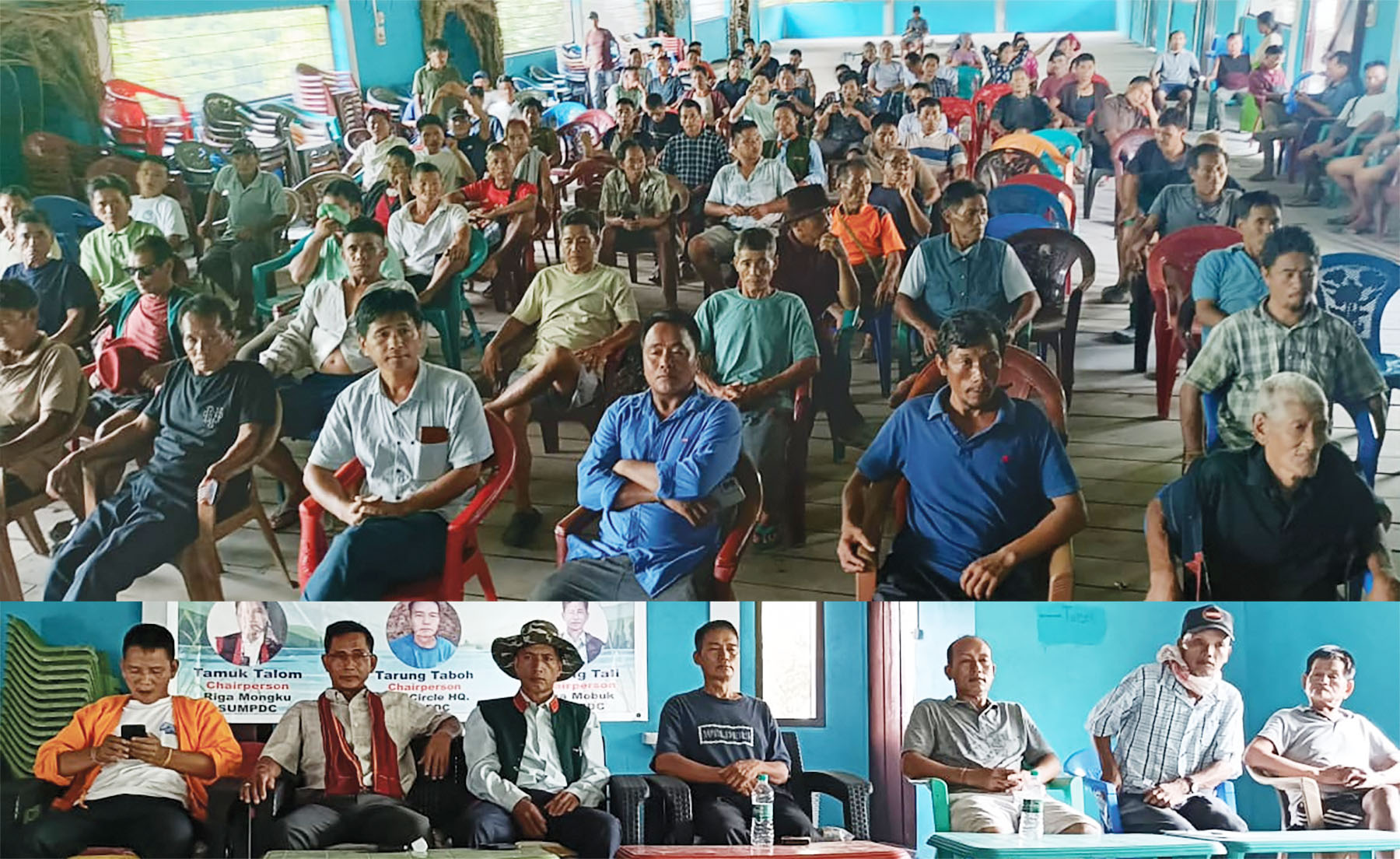
Riga, the largest village in the Adi belt, which has taken pioneering role for execution of the project, saw a huge public gathering, organized by Riga Village Siang Upper Multipurpose Project Development Committee (SUMPDC), saw presence of Riga Monku SUMPDC chairperson Tamuk Talom, Riga circle chairperson Tarung Taboh, chairperson Riga Mobuk and Taping Tali here on Tuesday.
The villagers, convinced with the persuasion of Chief Minister Pema Khandu and local legislator-cum-Panchayati Raj Minister Ojing Tasing, signed a memorandum of understanding (MoU) with the state Govt to facilitate conduct of survey for pre-feasibility report (PFR) of the SUMP in presence.
The Medog project, expected to be the world’s largest hydropower facility, has raised serious concern due to its potential impacts on water resources and regional stability in downstream countries, like India and Bangladesh, a prominent local leader earlier said, adding that the community extends full support to the SUMP, which evoked support in chorus in Adi language.
Thus, the proposed SUMP would involve construction of a strategically designed 300-meter-high dam on Siang River, a major tributary of the Brahmaputra which on completion would be one of the largest hydroelectric projects in the world, the local leader added.
AONS adds: Pangkang (Kumku) villagers under Riga circle of Siang district had signed a MoU with the GoAP at Boleng on May 23 last to allow conduct of PFS of the SUMP. Siang DC P.N. Thungon, on behalf of the GoAP and Pangkang leaders Taba Tamut and Bakin Tali, on behalf of villagers, had signed the MoU in presence of Panchayati Raj, State Transport and Cooperation Minister Ojing Tasing, Hydropower joint secretary Hage Lailang & CE Atek Miyu and state BJP general secretary Nalong Mize.
According to the MoU, a development package of Rs five crore for infrastructure improvement, health services and livelihood programs would be given in next three years, to be implemented by a newly formed village development committee (VDC), comprising of project-affected families for their benefits.
However, after China begun construction of the Medog Hydropower Project triggering fresh concerns in India and Bangladesh, people realized the ground realities and support for SUMP started swelling.
On July 12, 300 Riga villagers were first to sign a MoU with the GoAP to support conduct of the PFR after a meeting at Itanagar in presence of Chief Minister Pema Khandu, Minister Ojing Tasing and Chief Secretary Manish Kumar Gupta.
Khandu had said that more than 80% of the residents had pledged their support and reiterated to hold deliberations with all likely project affected families after conduct of the PFR. He had also assured that the GoAP remains committed to seeking and acting upon public opinion and seeking public consent at every stage of pre-construction activities for the SUMP.
Tasing, who hails from Siang, had informed that the MoU has been signed after more than six months of detailed deliberations held with all households of Riga village.
He also spoke about the fact that Riga is the maternal village for most of the Minyong tribes, and that migrants from Riga village had in the past established 47 other villages, while continuing to maintain close familial and emotional ties with Riga village. He expressed hope that other villages, including those sharing a common past, would also support in the conduct of the PFR for this national project.
On July 25, 98 households of Riew village had given their consent for the PFR by singing a MoU) at Itanagar in presence of Deputy Chief Minister Chowna Mein, Minister Ojing Tasing, chief secretary Manish Kumar Gupta, Siang DC P N Thungon and villagers of Riew.
Riew is the second-largest village in the Siang belt and the consenting households constitute nearly 62% of the population, marking a turning point in public response to the mega-dam project that once faced stiff resistance in the area.
Welcoming the development, Mein, who also holds the power portfolio, said the development marks another important milestone in the GoAP’s transformative hydropower initiative, a journey which he termed is rooted in “dialogue, understanding and mutual respect.”
“Being a democratic country with a people-friendly government, we believe in taking the people’s confidence and making them equal partners in development. Through awareness, technical education and trust-building, we’ve brought communities onboard,” he said, adding SUMP reflected the GoAP’s broader commitment to sustainable and inclusive development.


 20