‘Our traditional attires surprised Malaysians’
By Pradeep Kumar
“Our traditional attires were surprising for Malaysians, who wondered about the diversity of Indian dresses because they had idea about South Indians only,” Dr Monju told this daily over telephone. Prof. Padu said, “I am extremely happy to highlight various aspects of this remote state in a global platform.”
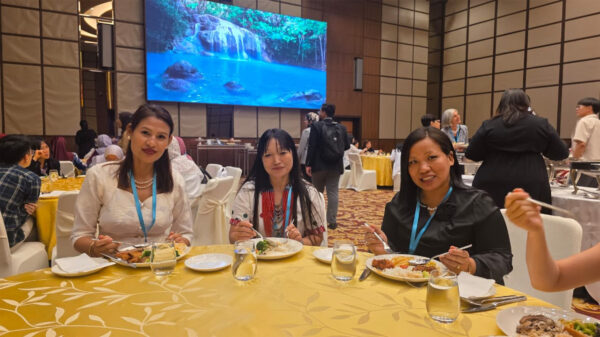
RONO HILLS, Sept 02: Showcasing rich cultural and academic heritage of Arunachal Pradesh on a global platform, three distinguished academicians of the state presented their research papers at 13thMalaysia International Conference on ‘Languages, Literatures and Cultures (MICOLLAC-2025)’ held from August 26 to 28 at St. Giles Wembley Hotel, Penang.
The prestigious conference was organized by University of Putra Malaysia, drawing scholars and researchers from across the world.
Rajiv Gandhi University (RGU) Prof.(Education) Anga Padu, presented her paper titled “The Role of Mopin in Preserving the Cultural Heritage of Arunachal Pradesh.” Her research highlighted how traditional Mopin Festival serves as a vital instrument in sustaining the indigenous identity and customs of Galo community.
Bini Yanga Govt Women’s CollegeAssistant Prof. Dr. Minu Sono, paper “Echoes of Identity: The Role of Nyokum in Preserving Nyishi Culture of Arunachal Pradesh” delved into how Nyokum Festival acts as a cultural anchor for Nyishi people, fostering community solidarity and intergenerational knowledge transfer.
RGU assistant Prof. (Education)Dr. Tage Monju, presented a distinctive socio-cultural study titled “The Psycho-Social Experiences of Tattooed Apatani Women in Arunachal Pradesh, India.” Her research explored lived experiences and cultural significance of traditional facial tattooing among Apatani women.
Through the conference, she highlighted to global audience that Apatani women practised facial tattooing as a form of adornment, an expression of beauty and cultural identity, contrary to external narratives that often misinterpret the practice.
Galo, Nyish and Apatani are three of the 26 major tribes of the state.These presentations not only brought international attention to the rich and diverse tribal cultures of this tribal state, but also emphasized the state’s growing contribution to global academic discourse in the fields of language, literature and cultural studies.
The participation of these scholars underscores importance of preserving indigenous knowledge systems and role of academia in documenting and promoting cultural heritage at a time when rich indigenous cultures and traditions are facing onslaught of impacts of modernity.


 20