
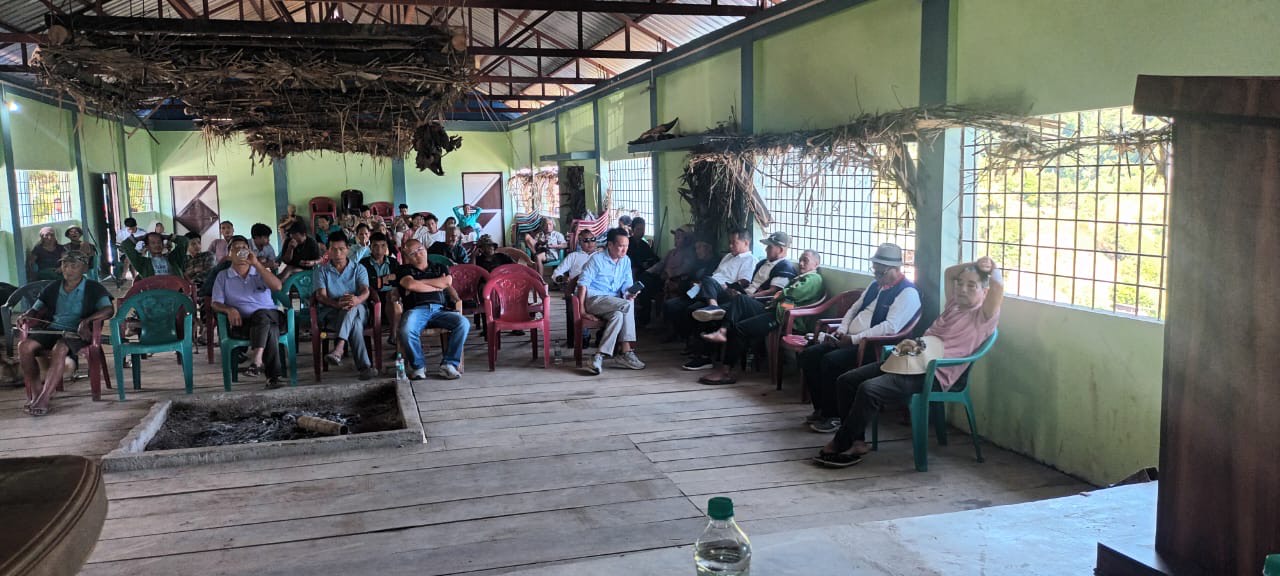
SITANG, Oct 14: A community consultation meeting over pre-feasibility Report (PFR) of Siang Upper Multipurpose Project (SUMP) was conducted at here on Tuesday under chairmanship of SiangDC Tayi Taggu, according to a NHPC release.
State Govt officers gave detailed insights into the SUMP’s objectives, potential benefits and long-term socio-economic impact on Siang region during the interactive session followed by responnding to queries and concerns raised by the local community to esnure transparency, inclusivity and informed participation.
DC said that community-level consultations are vital to ensure that developmental projects, like SUMP, are executee with collective understanding and local support.
The meeting saw open and respectful dialogue, fostering a constructive exchange of ideas, where NHPC reaffirmed its commitment to collaborate closely with community organizations.
AONS adds: It is worth mentioning here that the Union Govt has prepared a ₹6.4 trillion transmission plan to transfer more than 76 GW of hydroelectric capacity from Brahmaputra basin by 2047 to meet rising electricity demand, the Central Electricity Authority (CEA) said.
In a report released on Monday, the CEA said the plan includes 208 large hydro projects across 12 sub-basins in the northeastern states, with 64.9 GW of potential capacity and an additional 11.1 GW from pumped-storage plants. “In view of the substantial hydroelectric potential identified within the Brahmaputra basin, it was felt to have a comprehensive transmission system plan for evacuation of power from this assessed potential.
Consequently, a transmission system master plan has been formulated for the evacuation of 65 GW of hydroelectric generation capacity from 12 sub-basins of the Brahmaputra basin,” the CEA said in the report.
The basin’s transboundary nature and proximity to China make water management and infrastructure planning a strategic issue, amid the Govt’s concerns that a Chinese dam on the Yarlung Zangbo (the Tibetan name for the Brahmaputra River) could reduce dry-season flows on the Indian side by up to 85%.


 20
