
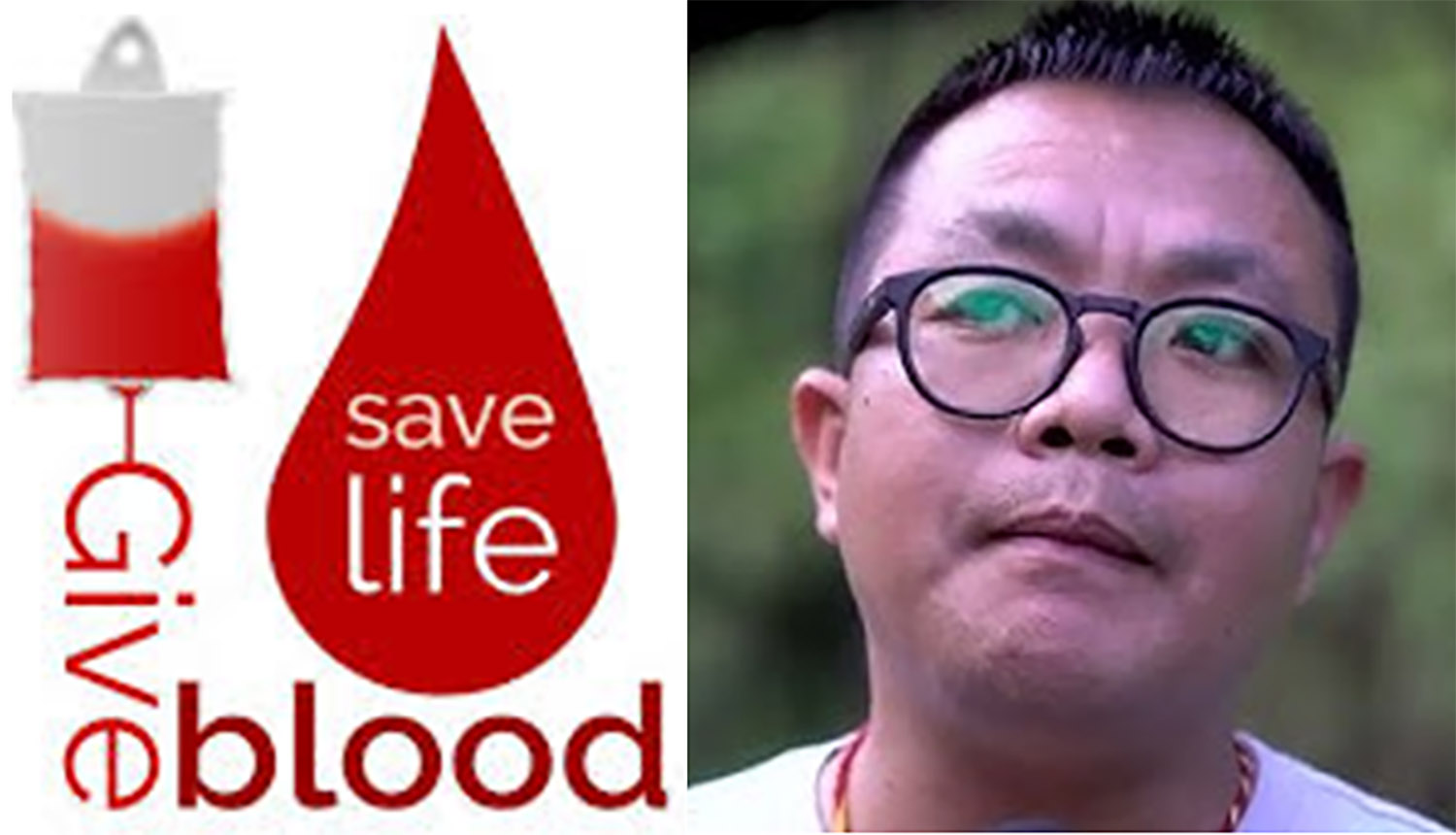
Rare blood donors wait for recipients!
The most unique service is, Jeke maintains a list of voluntary blood donors, particularly of rare AB, B- and O-groups. The donor comes forward, when any of these blood groups is needed to save someone’s life to justify his NGO’s name Arunachal Life Saving Foundation.
By Special Correspondent
ITANAGAR, Nov 19: When someone loses hope for want of blood in Arunachal Pradesh, Ramesh Jeke, justifying the adage, Jiska koi nehi hota, Bhagwan saath deta (God is there for those who have no one), appears from nowhere to say “don’t worry you will get blood”.
It is estimated that around 12,000 people die every day in India due to the lack of timely access to safe blood. This tragic situation stems from a chronic shortage where the country’s blood supply falls short of its demand, with a deficit of approximately 4 to 1 million units annually.
Arunachal Pradesh decadesago, used to have shortage of 15,000 units of blood daily, but it has come downto below 4,000 units now. This miracle happened due to wholehearted efforts of Ramesh with his “never say die spirit” at a time when people used to go out for better treatment. However, correct data of deaths daily or annually for want of blood is not available as the state legs far behind in data keeping.
In 2008, Ramesh had gone to General Hospital, present Tomo Riba Institute of Health & Medical Sciences (TRIHMS), at Naharlagun to attend a patient, but saw acrying mother searching for voluntary blood donation to save his ailing son as she was incapable of paying ₹10,000 demanded by unscrupulous blood donors. He searched and got desired blood but the child was gone by then.
Moved by the tragic incident, he, though selected to joinNational Defence Service, formed Arunachal Vivekananada Yuva Shakti (AVYS), a unit of Arunachal Voluntary Blood Donor Organization, to promote voluntary blood donation, which not only received support from State Blood Transfusion Council deputy director Dr Nabam Budh but from Arunachal Pradesh State AIDS Control Society (APSACS) while state youth pitched in to join the humanitarian mission and its members swelled to 350 soon.
The AVYS was not affiliated to Federations of India Blood Donor Organisation (FIBDO) then. Senior journalist Pradeep Kumar influenced by attitudinal change of local youth joined AVYS as its adviser to give a major thrust to its activities. He organized the 7th AVYS foundation day on 14.06.15 (World Blood Donor Day) that drew state’s attention, organised an interaction camp to enthuse young volunteers to accelerate their activities.
The mission continued with AVYS conducting 53 voluntary blood donation camp in festivals, religious institutions, while receiving dozens of calls from different hospitals of the state in odd hours for blood. As transportation was a problem, Minister Jomde Kena on Kumar’s request gifted a bike to facilitate transportation of blood donors in night hours. Former chief minister late Kalikho Pul then gifted a scooty to him.
Ramesh, a great motivator, through his endeavours pushed Arunachal Pradesh up in national voluntary blood donation canvas by collecting about 17,500 blood units with support from APSACS, RKM Hospital and TRIMHS, facilitated blood donation to change the narrow mentality of caste-community divide and saved about 7,500 lives, including 1,662 on calls from hospitals.
It was a sheer coincidence that on 14.06.15, Union Health Minister JP Nadda, on behalf of NACO, handed over Award of Excellence to Arunachal Govt, received by health commissioner Hage Kojeen and APSACS project director Dr. Riken Rina, for 100% cent voluntary donation. State Chef Minister Pema Khandu and then Chief Secretary Shakuntala D Gamlin had all praises for the humanitarian services of AVYS and assured support.
The AVYS was renamed Arunachal Life Saving Foundation in 2019, continued its mission and organised numerous blood-donation camps to build a state-wide network of volunteers.
Chairman Rameshdonated blood 86 times that turnedhim into a ‘jack’ for thousands across the state, like Jack Preger, known for his lifelong commitment to serve Kolkata’s poorest residents, often called the “pavement doctor.”
His works earned state and national honours, including Gold Medal by state Govt, National Youth Award and Gold Donor Card.
Known as one of the most tireless blood-donation champions across the state, Ramesh’s social work goes beyond health sector. Over the years, he adopted orphaned children, sheltered abandoned seniors and performed last rites of more than a hundred unclaimed bodies in hospitals, an act he believes “restores dignity to those forgotten by society.”
It seems he was not satisfied with his service and went beyond to pledge to donate his mortal remains to anatomy department of TRIMHS for trainee doctors to learn to save lives.His long association with hospitals, morgues and distressed families motivated himto take this uncommon decision, he says.
TRIHMS, the state’s only medical college, has periodically suffered from acute shortage of cadavers for anatomy teaching. With just a handful available, the institute has repeatedly urged citizens to sign up for whole-body donation to improve medical training.
Responding to the call, Ramesh says,“If my body could help even one student become a better doctor, that is the greatest honour I can receive after death. Ifervently appealto citizens to consider body donation as asocial responsibility”.
“We donate blood when someone is alive. Why not donate our bodies when we are gone? Service should not stop with our last breath,”he said with conviction.
TRIHMS, state’s lone medical college, needs at least 10 bodies in a year for anatomy and if that is not met there are chances that its licence could be cancelled.He has urged families to discuss organ and body donation openly and to register in advance so that medical institutions could benefit.
Ramesh hopes his decision will spark a conversation in the state that normalises the idea of giving even after death.“We are remembered not for how long we lived, but for how deeply we served,” Ramesh added. (With inputs of Damien Lepcha)


 20

