
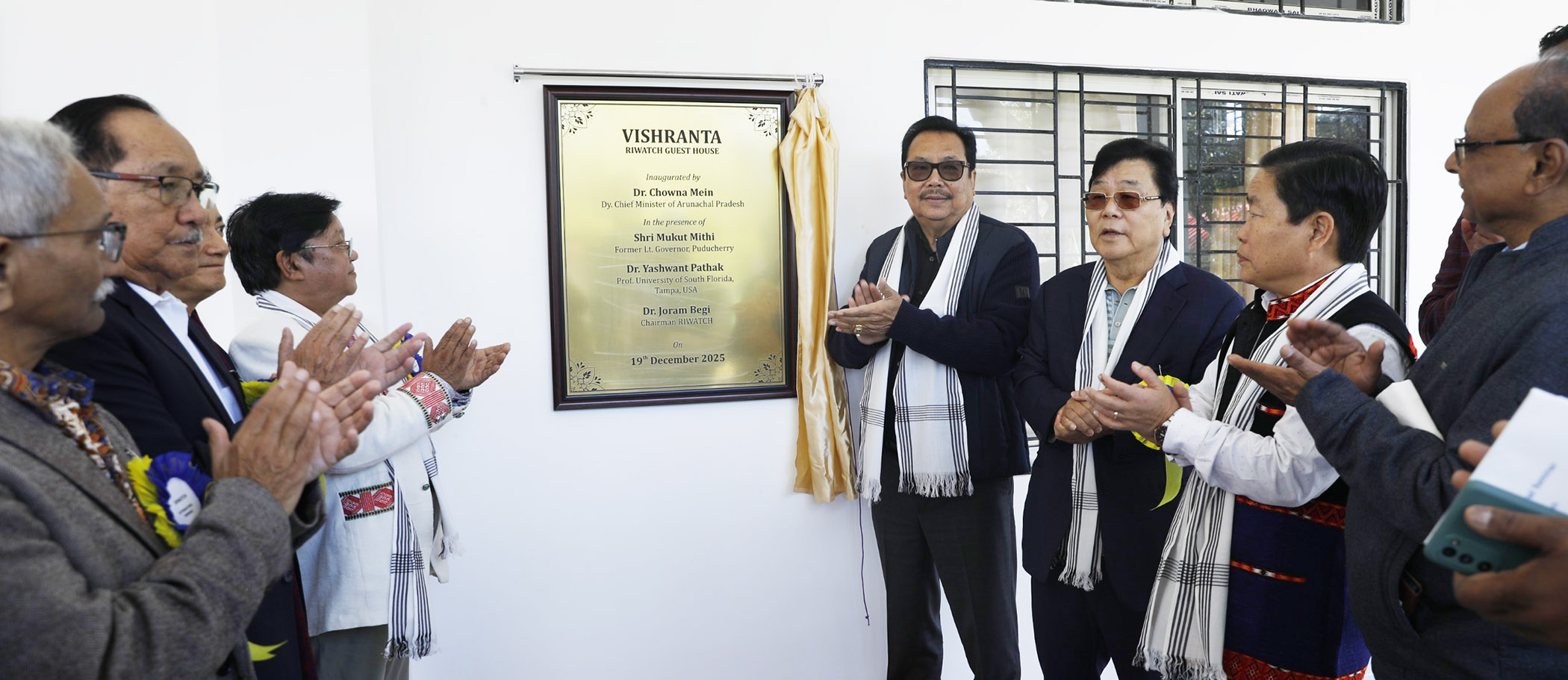
ROING, Dec 19: Celebration of various indigenous festivals may incorporate modern elements, but fundamentally adhere to indigenous customs and traditions, said Deputy Chief Minister Dr. Chowna Mein.
In his inaugural address to a three-day international seminar on “Interpreting Cultures and Traditions: Shifting the Lens” in RIWATCH campus at Khinjili here on Friday as chief guest, he advocated critical need to preserve ancient manuscripts through proper documentation and digitalisation.
RIWATCH could play a pivotal role in this preservation effort, he said and stressed that the cultural history of state’s indigenous should be comprehensively written and made accessible to wider audiences, both within and outside the state. Events like this seminar can contribute immensely toward this goal, he said and called for positive narratives around indigenous cultures and traditions that celebrate their richness and resilience.
Even after 50 years of receiving the nomenclature “Arunachal Pradesh,” the state still lacks its own comprehensive cultural and political history, he said and stressed on urgent need to develop such a narrative. He called for serious thought and immediate action on declining animal and bird species in the state, emphasising that it is high time to conserve the biodiversity that once formed an inseparable part of the natives’ culture and tradition.
Mein warned that without concerted efforts by present generation, future generations would be deprived of the opportunity to experience these species and the cultural practices associated with them.
Arunachal Pradesh University Vice Chancellor Prof. Tomo Riba, speaking as guest of honour, gave a sobering assessment of current state of indigenous knowledge systems. He observed that native traditional culture and knowledge are vanishing at an alarming rate with rural depopulation being primary reason for the loss of cultures, traditions and indigenous knowledge systems.
Citing specific examples, he said that traditional knowledge of agriculture and house construction is gradually disappearing due to easy accessibility of modern, sophisticated materials and technologies. He advocated urgent need to preserve rich indigenous terms and terminologies and ensure their continuity for future generations.
However, Prof. Riba strongly warned against commercialisation of traditional practices, particularly festivals and said that indigenous celebrations should serve as platforms for celebrating and showcasing cultural identity rather than becoming barriers to participation or being reduced to mere commercial spectacles.
University of South FloridaDean (faculty affairs) Prof. Yashwant Pathak, in his Keynote address, gave historical analysis of how colonial infrastructure systematically dismantled indigenous cultures and traditions worldwide. Drawing from the devastating example of Native American experience, he explained how colonial invasion led to the vanishing of millions of indigenous population.
Prof. Pathak elaborated on how imposition of new narratives and thought processes derived from Western ideologies resulted in extinction of ancient traditions globally. He argued that at this critical juncture, where Western and Eurocentric influences continue to dominate global discourse, there is an urgent need for a fundamental shift in the lens.
This shift must enable us to view indigenous cultures from our own perspectives and empower native communities to build and preserve their ancient cultures and traditions through their own sustained efforts, free from external imposition or interpretation, he added.
RIWATCHExecutive DirectorVijay Swami, in his address earlier, stressed on the objective to interpret cultures and traditions from the natives’ perspectives, marking a crucial shift in how indigenous knowledge systems are understood and documented.
RIWATCH patron Mukut Mithi gave a philosophical framework for understanding the seminar’s significance. He described conducting such an academic event as timely and profound, given the existential threats facing indigenous cultures globally. He emphasised that culture must be studied with empathy, suggesting that academic rigour alone is insufficient without a genuine emotional and ethical commitment to communities being studied.
Mithi argued that beyond research and documentation, the protection of cultures and heritage through active involvement of native communities should be a primary aim of institutions, like RIWATCH. However, Mithi asserted that development of any native culture should not be measured by its technological advancement rather by its cultural wisdom and depth of its traditional knowledge systems.
The seminar, organised by RIWATCH in association with Kolkata’s Maulana Abul Kalam Azad Institute of Asian Studies (MAKAIAS), Rajiv Gandhi University, International Centre for Cultural Studies (ICCS), Arunachal Pradesh University and Indigenous Faith & Cultural Society of Arunachal Pradesh, to deliberate on indigenous perspectives and the preservation of ancient traditions.
Total 44 research papers would be presented by academicians and scholars while the deliberations would generate meaningful dialogue and actionable insights for preservation and promotion of indigenous cultures.


 20
