
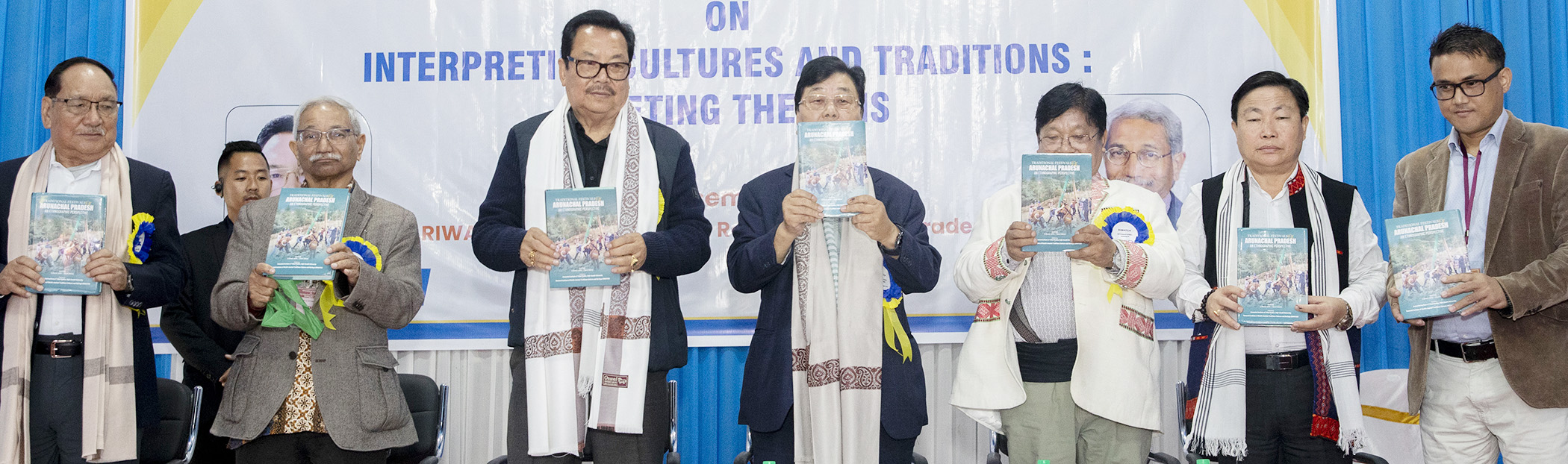
ROING, Dec 20: A book – Traditional Festivals of Arunachal Pradesh: An Ethnographic Perspective, – edited by Prof. S. Simon John and Dr. Tarun Mene and jointly published by AITS, RGU and RIWATCH, was unfurled by Deputy Chief Minister Chowna Mein, during inauguration of three-day International Conference (19th -21st Dec’ 2025) on “Interpreting Cultures and Traditions: Shifting the Lens”, organized by RIWATCH in association with the Maulana Azad Institute of Asian Studies, the International Centre of Cultural Studies, Rajiv Gandhi University, Arunachal Pradesh University, and IFCSAP, in its Khinjili campus on Friday.
The book makes a significant contribution to ongoing scholarly debates on tradition versus modernity, change and continuity, and emic versus etic perspectives. It emphasizes that traditional festivals are vibrant expressions of cultural identity and vital repositories of intangible cultural heritage. In an era marked by rapid modernization, these festivals face unprecedented challenges, making it increasingly important to document, analyze, and reflect upon them. Responding to these concerns, the book systematically records and interprets the traditional festivals of the indigenous communities of Arunachal Pradesh.
The book brings together diverse scholarly contributions and comprises 23 research papers, along with an introductory chapter by the editors. Each contribution offers a detailed examination of how traditional festivals function as living expressions of cultural identity, spiritual ecology, communal solidarity, and resilience within tribal societies. Collectively, the papers deepen the understanding of indigenous worldviews and highlight the complexity embedded in ritual and festive practices.
The editors have collaborated with scholars, cultural practitioners, and local communities to present a comprehensive ethnographic portrayal of these traditions. The objective is not only to contribute to the preservation of the intangible cultural heritage of Arunachal Pradesh but also to serve as a valuable resource for policymakers, researchers, and others interested in the ethnographic study of traditional festivals.
Through this collective effort, the book seeks to deepen understanding, stimulate scholarly engagement, enhance cultural appreciation and affirm enduring significance of traditional festivals while encouraging ongoing dialogue, documentation, and preservation.


 20

