
Mayodia recorded India’s 22nd tiger death
Widow refuses ex-gratia, seeks
long-term support for children
Late Manpang’s wife Khyoda Mary has accused the EFCC department of gross negligence. She alleged that repeated warnings about the tiger’s presence in Mayudia area were ignored for weeks before the fatal attack on February 2. Refusing the ₹10 lakh ex-gratia, Mary demanded long-term support for her children’s education and welfare, while holding authorities accountable for inadequate safety measures in human-wildlife conflict zones, reports India Today NE.
Holding the FECC directly accountable, many have questioned preparedness of wildlife authorities in areas prone to human-animal conflict and called for stronger safety protocols to protect residents and personnel working in vulnerable zones. The incident has once again brought the issue of rising human-wildlife conflict and administrative accountability into sharp focus in the region.
By Pradeep Kumar
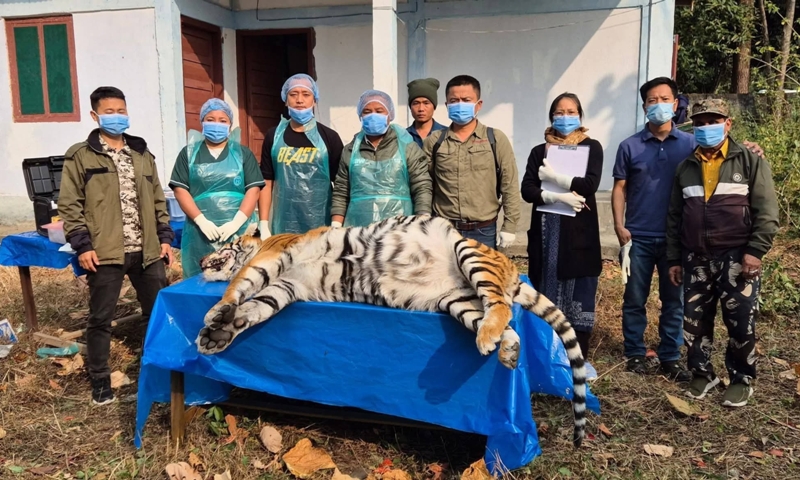
ITANAGAR, Feb 08: Environment, Forest and Climate Change (EFCC) department authorities recovered the carcass of an adult tigress, with a gunshot wound near Mayodia in Arunachal Pradesh on Thursday, three days after a tiger fatally mauled head constable (WT) Chikseng Manpang in the same area on February 2 last.
The tiger was found along the forested Mayodia stretch on the Roing-Anini road (NH-313), the same area where the attack took place when Manpang was returning on his bike from Anini to his home at Roing in Lower Dibang Valley district.Some reports indicated this was 22ndtiger death in India within the first few weeks of 2026.
The sub-adult tigress was believed to be around two years old and part of a family that included her mother and another sub-adult tiger, but both sub-adult tigers had gone independent in recent months which were sighted in Mehao Wildlife Sanctuary (MWS),” according to official sources.
The death of the tigress by a gunshot prompted investigations into potential retaliatory action, with reports indicating a locally used gun might have been used.
This incident has highlighted increasing human-wildlife conflict in the region, with authorities implementing safety measures, including a ban on two-wheelers on the Roing-Anini road at night.
The EFCC department has formed multiple teams and making effort on the ground to capture the tigers.
Meanwhile, the team,formed to oversee necropsy (postmortem) and disposal of the carcass as per the SOP of National Tiger Conservation Authority (NTCA), includes MWS DFO Mito Rumi (chairman), and Itanagar Biological Park veterinary officer Dr Tadap Sorang, WTI CRBC senior veterinary surgeon Dr Panjit Basumatary, RoingSVO Dr Subi Migri, Roing veterinary officer Dr Techi Ana, and honorary wildlife warden Ipra Mekola as members.
DFO Rumi could not be reached contacted to know the outcome of the post mortem report though some startling information has been doing rounds in social media.
However, accidental encounter could make a tiger learn that humans are easy prey, causing it to develop a habit of preying on them, an environmentalist said, adding that it is sole responsibility of theEFCC Department to safely capture these big cats and relocate them to safer zone far away from inhabited areas.
Tigers are intelligent and boast a remarkable memory. Tigers’ short-term memory is significantly better than that of humans, and other animals, according to research.
Tigers become active at night and set out to hunt, patrol their territories.Their environmental adaptations, including exceptional night vision, acute hearing and an acute sense of smell, make them formidable hunters under darkness. Tigers’ eyesight is six times better than humans in the dark.
With stealth and precision, tigers embark on their prowling behavior. Using the element of surprise to their advantage, they stalk their prey, relying on their muscular bodies and powerful limbs for a sudden burst of speed and a lethal pounce.
Tigers hunt about once a week and eat as much as 34 kgs of food in one night. In addition to hunting, tigers in night assert their dominance and defend their territories. Tigers lead solitary lifestyle, and each individual has a defined home range they patrol regularly. At night, a tiger may embark on territorial patrols, marking its boundaries with scent markings (urine and feces) and scratches on trees.
The urine scent can last up to 40 days and serves as a warning to potential rivals and a signal to potential mates. And their deep, resonant roars can carry over long distances, acting as an audible declaration of their presence in the darkness.
But, communication along the EFCC passing through the MWS cannot be stopped, rather it would increase with rise in tourism and development activities. Thus, it is advisable to construct elevated corridor like Kaziranga for safety of commuters as well as wild animal.


 20
