
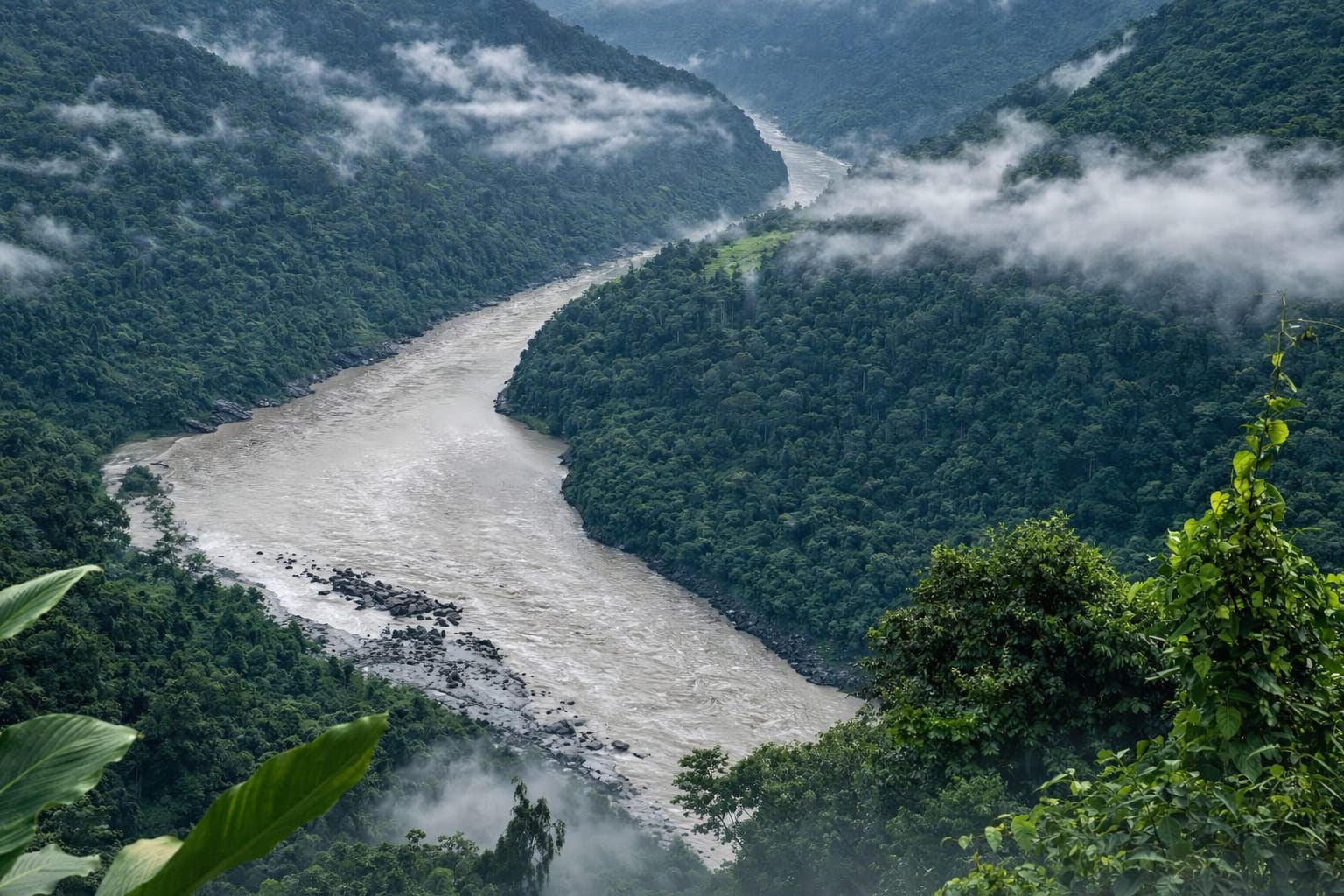
Mighty Siang, a high-velocity tributary of the Brahmaputra, flowing 1,600-km from Tibet (as Yarlung Tsangpo) into Arunachal Pradesh, serves as a sacred lifeline and, offers immense scope for rafting and fishing despite erosion
By Tayi Taggu
Arunachal is a land of Rivers, with highest potential for hydropower. How to harness and convert that potential into power energy lingers in the minds of the people.
Whenever opportunities knock at the door, people see it as a problem rather than an opportunity. Any change in the status quo is viewed with suspicion and resistance to change, but constant change is inevitable in our lives.
Seen in the larger perspective across India, there are many examples where large and well-planned multipurpose projects have played a decisive role in transforming entire regions. The Sardar Sarovar Dam on Narmada River, for instance, helped bring water to dry and semi-desert areas of Kutch, Saurashtra and North Gujarat, a major boost to agriculture due to irrigation and hydropower, supported industrial growth and ensured drinking water for millions.
Such projects have not only supported states and cities but have also changed the lives and futures of surrounding communities. Experience shows that when development is guided by a long-term vision and proper planning, it becomes a powerful engine of progress rather than a cause for concern.
Seen in this wider national context, a well-planned multipurpose project in Siang district also represents an opportunity to strengthen the foundations of long-term development. The purpose of such initiatives is not merely to build infrastructure, but to create lasting benefits for people, especially farmers, youth and rural communities. With the right approach, these efforts can transform the region’s economic and social landscape, opening new doors for future generations. Of course, there will be lot of ifs and buts, yet we cannot move backwards. The mankind has to move forward, no matter what hurdles the evolution process needed.
One of the most important pillars of this transformation is availability of reliable and affordable electricity. In any region, power acts as a catalyst for growth. When electricity is easily available at reasonable rate, it does far more than light homes. It supports schools and hospitals, enables industries and encourages entrepreneurship.
Small and large businesses such as workshops, food processing units, cold storage facilities, service enterprises, and local industries can grow with confidence. Affordable power makes it possible for people to start new ventures, expand existing ones, and create jobs within their own district instead of looking for opportunities elsewhere. Moreover, the amount of power consumption in cities, towns and villages is a development index of that area.
Along with power generation, agriculture and irrigation will improve significantly. No doubt, better water management and irrigation facilities will enable farmers to adopt modern farming methods, more than one crop per year, which can increase overall productivity. Higher and more stable production leads to better and more secure incomes for farming families. At the same time, agriculture-based industries, storage facilities and processing units can develop around this strengthened farm sector while reinforcing rural economy.
In this broader development journey, multipurpose initiatives, like Siang Upper Multipurpose Project (SUMP), when implemented with care and foresight, can act as important enablers of positive change. The SUMP can be a game-changer in future.
There will be pros and cons, but infrastructure development in a key area will give long-term benefits to the people. The improvement of roads, bridges and communication networks enhance connectivity between villages, towns and markets to open a floodgate of opportunities. Better connectivity means a lot to farmers and traders. It would facilitate transporting their produce an on time to sell at fair and competitive prices.
It would also help local traders reach a wider network of markets and attract new investment into the region. Over time, such improvements not only strengthen economy but also improve access to services and opportunities for people living in remote areas.
Good education and skill development are central to any sustainable vision of progress. As the region develops, scope would widen to set up new schools, colleges, training centres and technical institutions to benefit the people. Better educational facilities ensure children and young people gain knowledge and skills they need to become self-reliant and confident contributors to society. A skilled and educated generation becomes the strongest foundation for long-term inclusive growth.
Large development efforts also generate employment in many ways. But people shoul be ready by skilling themselves. Construction and related activities create thousands of direct and indirect jobs. Moreover, transportation, hospitality, small trade and local services sectors s would benefit from increased economic activities.
Over time, a more vibrant local economy shall emerge to offer diverse opportunities across agriculture, industry, services and entrepreneurship. The most sensitive area in any development is rehabilitation and resettlement efforts. How and when carried out with sensitivity and care, they could ensure development remains people-centric and inclusive.
When looked ahead to next 10 to 25 years, the combined impact of better power supply, stronger agriculture, improved connectivity, quality education, and growing local businesses have potential to transform Siang and Upper districts completely beyond present people’s imagination. Such progress will not only benefit the state, but also contribute to national goals of sustainable growth and energy security.
Ultimately, development initiatives of this nature are not about short-term gains but about building a stable, self-reliant, and prosperous future for our people. When guided by long-term vision, careful planning, and a commitment to public welfare. They could become foundation of lasting change, benefitting farmers, youth, rural communities of the region while ensuring benefits reaches every section of society.
If our actions of development are shaped by courage, foresight and responsibility, hydropower could transform and redefine quality of life in Arunachal for the better. The river that once symbolized distance and remoteness could be a force of strength, prosperity and national contribution and integration. When its energy lights homes, powers industries, uplifts farmers and empowers youth, development cases become a promise, it becomes transformation. The true measure of progress lies in confidence restored, opportunities created and futures secured. History favours regions that dare to act with vision. As Nelson Mandela said, “It always seems impossible until it’s done.” Let Arunachal rise, self-reliant and unstoppable in future. (The author is Siang district deputy commissioner)


 20

