
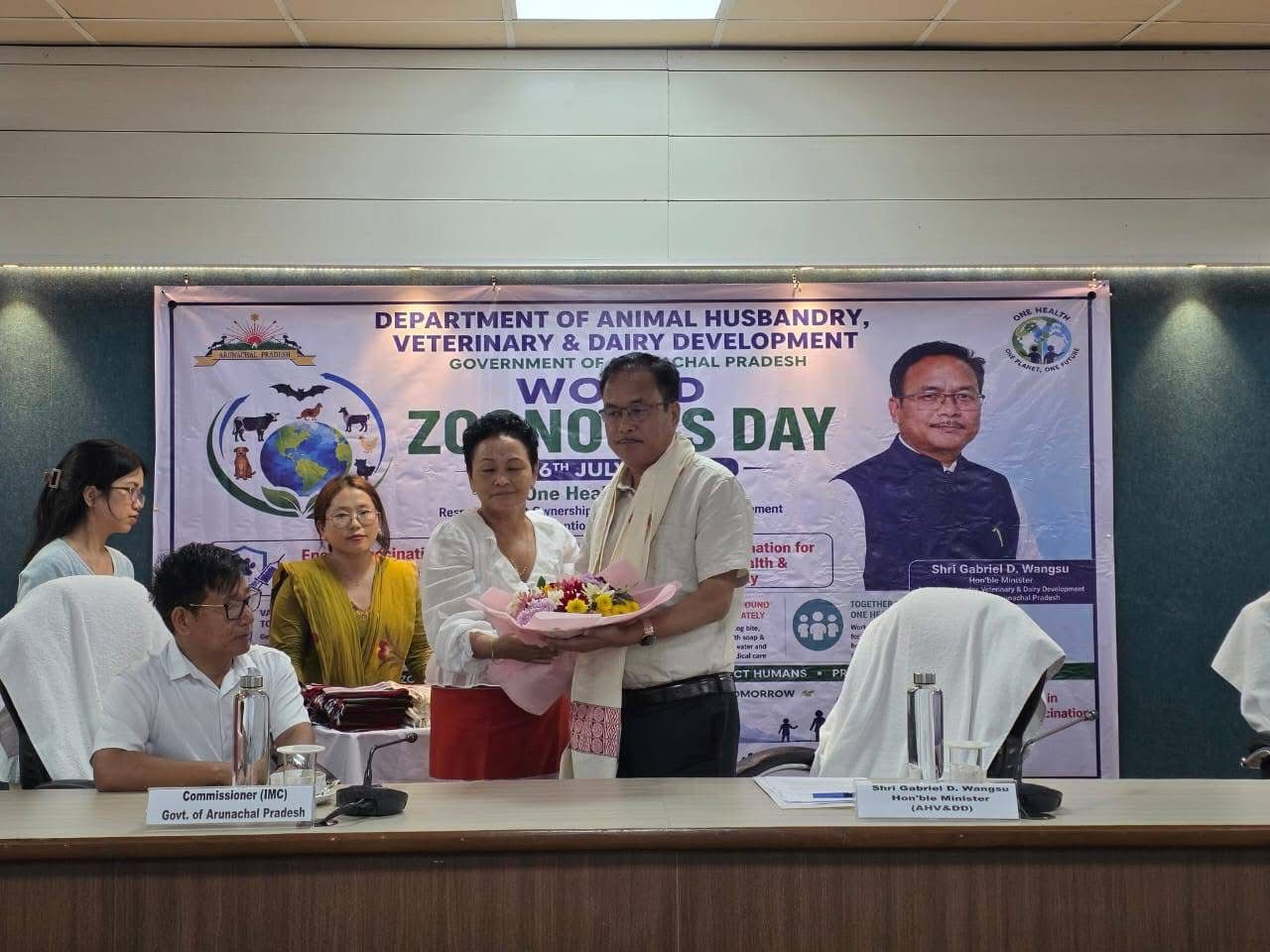
ITANAGAR, July 06: Animal Husbandry, Veterinary & Dairy Development Minister Gabriel D. Wangsu called for a united and sustained effort by Govt agencies, healthcare professionals, local bodies and citizens to strengthen ‘One Health’ approach for preventing zoonotic diseases to ensure a healthier and safer Arunachal Pradesh.
He was addressing a state-level event to observe World Zoonoses Day-2026, organisedby his department at DK Convention Centre here on Monday.
He earlier inaugurated Animal Birth Control (ABC) Centre at Ganga, which will play a crucial role in scientific stray animal population management, rabies prevention and promotion of animal welfare in the capital region. He also virtually inaugurated newly set up ABC Centre at Namsai, extending similar facilities to eastern Arunachal Pradesh.
He also released IEC materials and launched a week-long anti-rabies vaccination and animal birth control awareness campaign, administered pledge on responsible pet ownership, urged citizens to vaccinate their pets regularly, avoid abandonment of animals and actively participate in building rabies-free communities.
Wangsu highlighted historical significance of the Day that commemorates successful administration of world’s first rabies vaccine by Louis Pasteur on 06.07.1885, which revolutionised disease prevention and continues to save millions of lives worldwide.
“Good health does not begin in hospitals alone, but in our homes, farms, villages and forests—where people, animals and environment coexist. Protecting animal health is, therefore, protecting human health,” he said.
Referring to growing threat of zoonotic diseases, he observed that nearly 60% of infectious diseases affecting humans originate from animals, while about 75% of emerging infectious diseases have an animal source. He said COVID-19 pandemic had demonstrated the urgent need for stronger collaboration among all sectors to prevent future public health crises.
“The lessons of COVID-19 remind us that diseases know no boundaries. No single department can tackle these challenges alone. The future lies in ‘One Health’ approach, where veterinarians, doctors, environmental experts, municipal authorities and communities work together with a common purpose,” he said.
He also acknowledged the silent yet vital contribution of veterinarians, para-veterinary professionals and field workers in safeguarding public health through vaccination, disease surveillance, food safety, emergency response and livestock healthcare.
“Every time a veterinarian vaccinates a dog against rabies, an entire neighbourhood becomes safer. Their service goes far beyond treating animals as they protect lives, strengthen food security and contribute to the economic well-being of our farmers,” Wangsu remarked.
Calling upon citizens to become active partners in disease prevention, he urged every pet owner to ensure annual vaccination of dogs and cats, never abandon pets, and seek immediate medical treatment in the event of an animal bite. He also urged farmers to promptly report unusual illnesses in livestock and encouraged communities to support humane management of stray animals through scientific ABC and anti-rabies vaccination.
“Govt initiatives alone cannot eliminate rabies or other zoonotic diseases. Every citizen has a responsibility. Let us build a society where every pet is vaccinated, every livestock farmer is aware, every child understands how to prevent dog bites and every community supports humane animal management,” he added.
The function, attended by AHVDD Secretary YVVJ Rajshekhar and other senior officers, included technical presentations by experts on rabies prevention, zoonotic disease surveillance, implementation of the ABC, Supreme Court guidelines on stray dog management and integrated strategies for breaking the chain of rabies transmission through coordinated action. (PRO)


 20
