
*Former Guv JJ had questioned authenticity
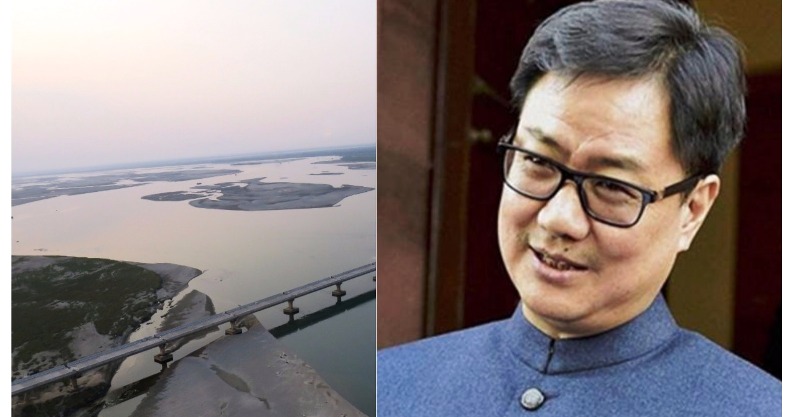
NEW DELHI | Dec 07 | Union MoS for Home Affairs Kiren Rijiju today ruled out any feasibility of construction of canals over Tsangpo by China to divert Brahmaputra water.
“Brahmaputra is not a drain; it’s a big river; so constructing canal over Tsangpo by China to divert Brahmaputra water is not feasible,” Rijiju said, adding that such humongous project cannot be built secretly in short duration.
On the adulteration of Brahmaputra water, he said no one should comment without duly diligence. There can be ample of reasons of dirty water and government is looking into it, he added.
AONS adds: It may be recalled that Rijiju’s statement matches the view of retired army chief J J. Singh, who as state governor on 04.10.12, had said that “It is vital to check if China is indeed building a dam on the Brahmaputra before indulging in speculation.
China’s moves would divert the river water into Chinese arid provinces should be corroborated with facts at the ground. “We must not be carried away by information which is not based on facts on the ground,” he had told Editor of this daily by showing map.
“Today, the government is in a position to know whether it is a dam or a run-off river project. It can all be studied by satellites, and it should be conveyed to people in a logical manner and there should be no cause for speculative reporting,” Singh had said.
According to reports then, China is building a dam in Tibet to divert the Tsangpo river, source of the Brahmaputra, which originates from the Himalayas. Other experts say that if the project is commissioned, it would almost certainly have devastating consequences on lives of millions in India and Bangladesh. Apart from the dam, China is reportedly planning to divert 200 billion cubic metres of water to feed the Yellow river in an attempt to ease the acute water shortage in Shaanxi, Hebel, Beijing and Tianjin. The “South-to-North Water Diversion” project is reportedly being debated in Beijing for its technical feasibility. India and China do not have a water-sharing agreement.


 20

