
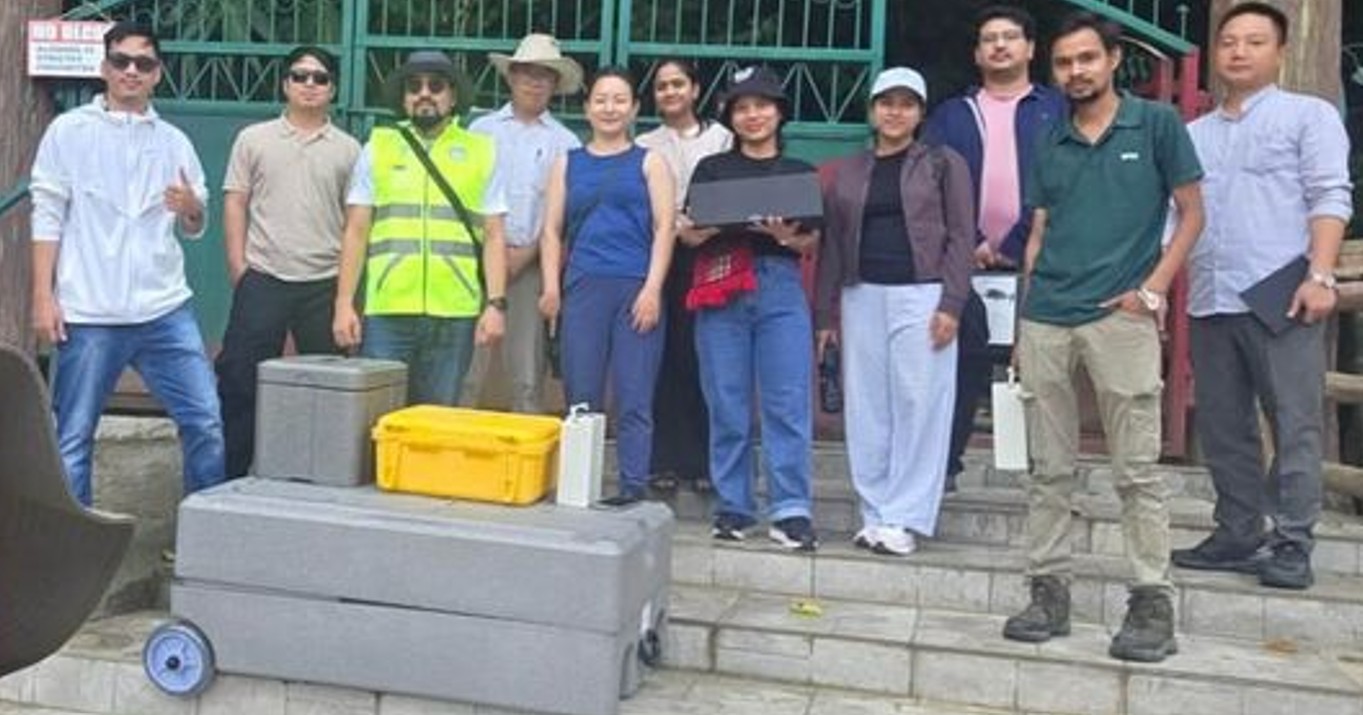
By Special Correspondent
ITANAGAR, Sept 17: Scientists and engineers of Centre for Earth Sciences and Himalayan Studies (CESHS) have launched a comprehensive scientific study of Ganga Lake, locally known as Gekar Sinying.
The study, being carried out under the guidance of experts and academicians from IITs, will examine the lake’s hydrology, geomorphology, morphometry and catchment dynamics amid growing concerns over ecological degradation, sedimentation, hydrological changes and the impact of climate change.
Ganga Lake is an important freshwater body in the capital region and is considered a potential indicator of changes in local environmental and climatic conditions. Scientists said increasing human activity, disturbance in the catchment area, sedimentation and possible pollution are placing growing pressure on the lake’s ecological health, water quality and biodiversity.
The lake also supports regional biodiversity, including aquatic organisms, phytoplankton and documented butterfly species, some of which are of conservation significance.
As part of the study, researchers will assess changes in water levels, lake volume, shoreline configuration, sedimentation patterns and watershed processes.
Advanced unmanned aerial vehicle (UAV)-based photogrammetry and remote sensing techniques will be combined with field measurements, hydrochemical investigations and stable-isotope analysis to develop a detailed understanding of the relationship between the lake and its surrounding catchment.
The researchers will integrate morphometric, hydrological, hydrochemical, isotopic, ecological and climatic data to identify the major environmental stressors affecting Ganga Lake and understand how they interact.
The study is also expected to establish baseline environmental conditions and assess how the lake is responding to both natural processes and human-induced changes.
According to CESHS, the findings could help provide scientific inputs for local governance, climate-risk assessment, freshwater-resource management and biodiversity conservation.
The study is expected to contribute towards developing long-term management and conservation strategies for Ganga Lake, while also providing predictive tools to assess future changes in the lake ecosystem.
About 6-km from Itanagar city, Ganga Lake boasts of distinctive green-tinted water caused by rich aquatic vegetation and lush surrounding forests. Tourists are attracted for boating, bird watching, photography, and peaceful picnics.
As it is a tourism hub, former Governor General (Retd.) J.J. Singh actively involved the Indian Navy to clean and reclaim Ganga Lake. He had invited a specialized diving and technical team from the Indian Navy to clean up the heavily clogged and neglected lake. The naval divers systematically cleared submerged debris and weeds, making it the first waterbody in Arunachal Pradesh to be reclaimed by the Navy.
After the intensive cleanup and installation of new tourist infrastructure, the governor had formally inaugurated the renovated lake on 13.08.10, alongside Vice Admiral Anup Singh of Eastern Naval Command.
The legend: Ganga Lake is rooted in a prominent Nyishi tribal legend centering around a powerful local man Tai Bida, who long ago had captured a massive, unique wild mithun in the deep forests.
This specific mithun was sacred and multiplied rapidly, producing an unprecedented number of offspring within a single year. The herd brought immense wealth and crowded granaries to Bida’s family.
Years later, during a major village ritual or wedding, Bida agreed to sacrifice the mother mithun to fulfill a customary tradition. The mother mithun overheard the family discussing the planned sacrifice. Heartbroken by the betrayal, she cried out in pain and fled into the forest, calling upon the wilderness spirits. The entire herd followed her.
Bida desperately tracked the deep footprints of his fleeing animals across the rugged terrain. He tracked them to a pristine valley where the entire herd plunged into a clearing, and the tracks abruptly vanished into the earth. According to the myth, the earth opened up or filled with water at that exact spot, forming the closed, emerald-green lake seen today.


 20

