
By Staff Reporter
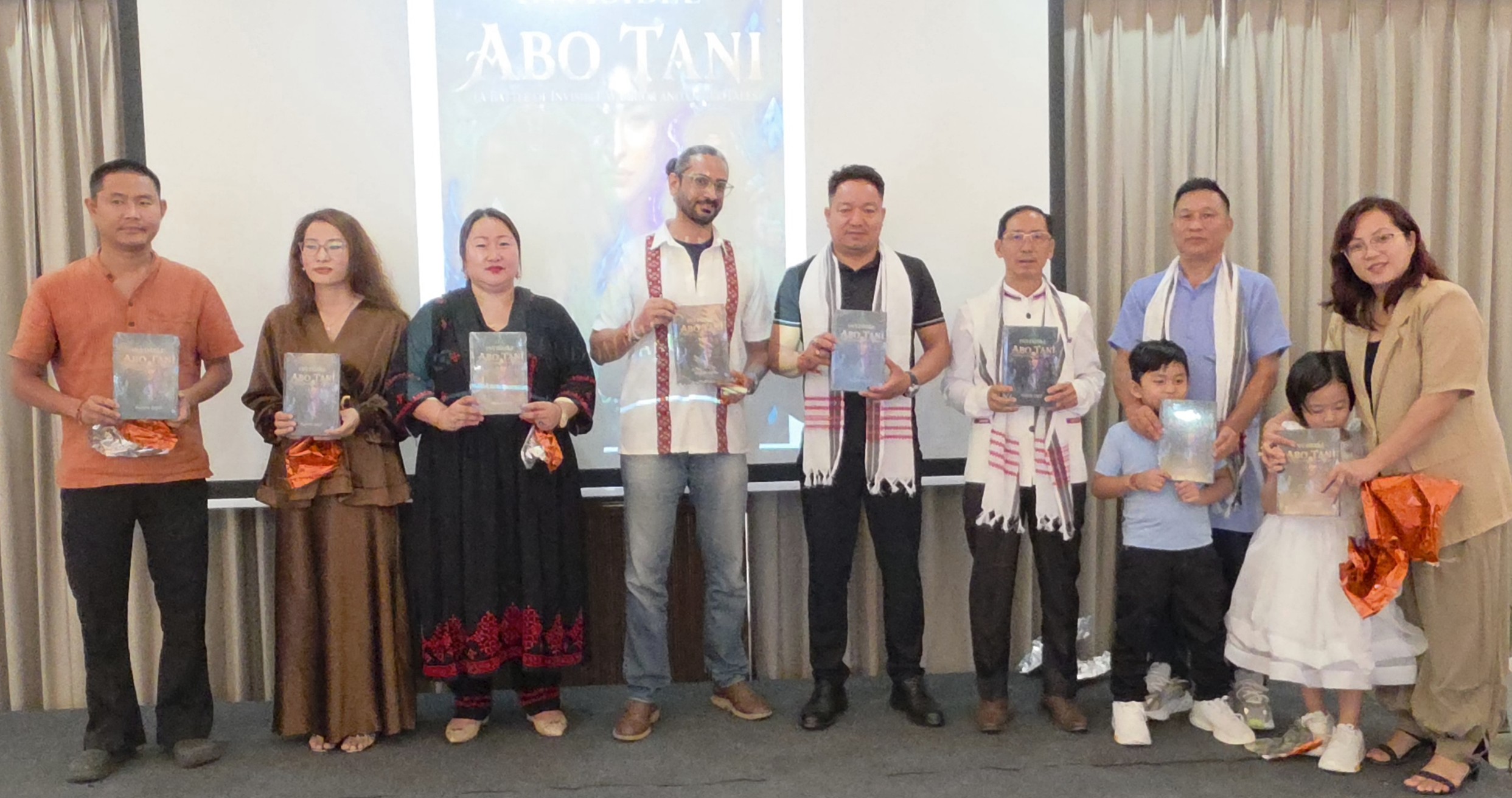
ITANAGAR, Sept 20: The 3rd book on ‘Invisible Abo Tani], authored by Pudom Taku, was released in presence of distinguished personalities including Nyishi Nyum Acham (NNA) vice president Apong Gyadi Taniang; Medical Board of Arunachal Pradesh chairman Goruk Pordung, Greater Kameng Badminton Association (GKBA) president Aju Khunjuju, Tribal Patt MD Yachi Natung Taniang and, Story Teller Shiva Tell.
Pudom Taku, a B.Tech graduate in Mechanical Engineering and serving as DLR&SO now, has over the years pursued literature, folk songs and folk drama alongside his professional responsibilities. His creative works are deeply influenced by the oral traditions, myths and cultural memories of the Nyishi community.
Among his earlier creative compositions are the folk song ‘HoloHolo Hoicha’ and the folk drama “Patta Nitting – A Flight of Hope,” which carries a message for the preservation and protection of birds and discourages indiscriminate hunting.
His literary journey began with his first book ‘Dojang Napong’, a dramatic tale centred on the emotional bond between a brother and sister. The story takes a dark turn when the sister becomes a victim of a conspiracy involving a mysterious witch-shapeshifter driven by hatred and sinister motives.
Blending human emotions with supernatural elements, the narrative explores love, betrayal, jealousy and sacrifice.
His second book, ‘Who Is Abo Tani?’, explores the legendary world of Abo Tani, the cultural hero and ancestral figure associated with the Tani communities of Arunachal Pradesh.
The book presents stories of Abo Tani’s love, struggles and fight for survival, including his relationship with Ane Dony and his encounters with supernatural forces. It also narrates his efforts to revive and protect his younger sister and his magical confrontation with his own brother, Saki, who possesses extraordinary supernatural abilities.
Another dimension of the story revolves around love, deception and hidden intentions, where affection and personal missions collide. Through its various chapters, the book seeks to communicate ethical and moral lessons, customary understandings and philosophical ideas that guided relationships among human beings, communities and nature.
The newly released ‘Invisible Abo Tani’ takes the legendary character into an even more imaginative and mystical world.
Taku, while interacting with media persons said that, the book primarily revolves around three interconnected themes—the journey of Abo Tani into the magical world, his rise through supernatural powers, and the eventual loss of those extraordinary abilities.
In the narrative, Abo Tani enters mysterious realms and acquires magical tools and instruments that enable him to become invisible at will. Armed with these extraordinary powers, he travels through hidden spiritual territories, mysterious worlds and darker supernatural domains, encountering spirits, demons and powerful guardians of nature.
As his influence and supernatural strength increase, however, rivalry begins to grow around him. Even those close to him gradually become challengers.
The book depicts how Abo Tani confronts his rivals, uses supernatural abilities to overcome obstacles and punishes those who challenge him. Yet power does not remain permanent. Through a dramatic magical deception, Abo Tani is eventually trapped and deprived of his magical instrument and extraordinary powers.
The story also portrays his ability to transform his physical appearance according to circumstances. Through these transformations, encounters and adventures, the character learns important lessons concerning wisdom, restraint, courage, pride, greed, relationships and coexistence.
‘Beyond magical adventure’ & ‘Invisible Abo Tani’ also bring traditional Nyishi folk songs and oral narratives into written literature.
One of the chapters draws inspiration from the folk expression:
“Rikam Ngo Padda – Ngo Nyenggoh Jaa…
Renium Ngo Yame – Ngo Nyengoh Jaa…”
It tells the moving story of two lovers who leave their homes and begin life together in an unknown place. Their journey, which begins with hope and companionship, gradually turns into tragedy. The sorrowful voice of the woman continues to echo through the traditional song, carrying the memory and longing for her beloved.
Another important narrative presents two sharply contrasting personalities—Balo Rajja and Rangka.
Balo Rajja is portrayed as an enormously wealthy ruler whose obsession with possession makes him unwilling to part even with a grain of rice. His philosophy is centred on accumulating more wealth and protecting everything he owns.
Rangka, in contrast, is presented as a free-spirited man who possesses little material wealth but believes in living life fully and without fear. To him, happiness, dignity and freedom are greater treasures than material possessions.
Their opposing philosophies gradually spread throughout the village, dividing public opinion and creating a psychological rivalry between them. Eventually, they compete to demonstrate whose philosophy offers a better way of life.
The conflict is not primarily a physical battle but a clash of ideas—wealth versus freedom, possession versus contentment and accumulation versus celebration of life.
The episode culminates through the traditional folk expression:
“Hu Rangka – Balo Rajja Ho… Deming Derram…
Taku said one of his major purposes in documenting such stories is to provide creative material to the younger generation, particularly those skilled in digital storytelling, filmmaking, animation, documentary production and theatre.
He believes that the adventures of Abo Tani contain enough imagination, drama, humour, conflict and philosophy to be adapted into films, documentaries and stage productions.
“Our young people today are highly creative and technologically capable. If our traditional stories are properly documented, they can transform them into meaningful films, documentaries, dramas and digital content while retaining the values embedded in the original narratives,” he said.
He said the stories incorporated in his books have been collected largely from Nyibu, traditional oral narrators, elderly fathers and mothers, and villagers who have preserved folklore through generations.
He stressed that these elders are the real custodians of indigenous memory, having transmitted stories, chants, beliefs and life philosophies orally for centuries.
For Taku, Abo Tani is therefore more than a legendary personality. His stories represent a repository of moral and ethical ideas concerning human behaviour and the relationship between people and the natural world.
Through the adventures of Abo Tani, the narratives remind readers that human beings are not isolated from their surroundings. Mountains, forests, rivers, birds, animals, aquatic life and the spiritual world are part of an interconnected existence.
‘Invisible Abo Tani’ is thus an effort not merely to tell an entertaining supernatural story, but to preserve oral heritage in written form and make it accessible to younger generations.
At a time when traditional knowledge is increasingly challenged by changing lifestyles and declining oral transmission, the book seeks to build a bridge between the wisdom of village elders and the imagination of a digitally empowered generation.
Through literature, music, drama and storytelling, Taku hopes that the rich folklore of the Nyishi community and the larger Tani cultural world will continue to inspire future generations—while reminding them that development and modernity need not come at the cost of losing one’s roots.


 20
