
By Pradeep Kumar
NAHARLAGUN | Dec 28 | A plan is afoot to give Arunachal Pradesh capital, the mirror of the state, a desired shape to make every Arunachalee proud with the state Govt intending to encash its high potential tourism sector by adopting ‘Better late than never’ (Der ayae drush aye) policy.
The present state Govt has engaged Remote Sensing Investment (RSI) of Hyderabad company to conduct survey of Capital Complex from all angles to turn its plan into a reality. This would also supplement in its race to win the Smart City mission, proposed by the central Govt.
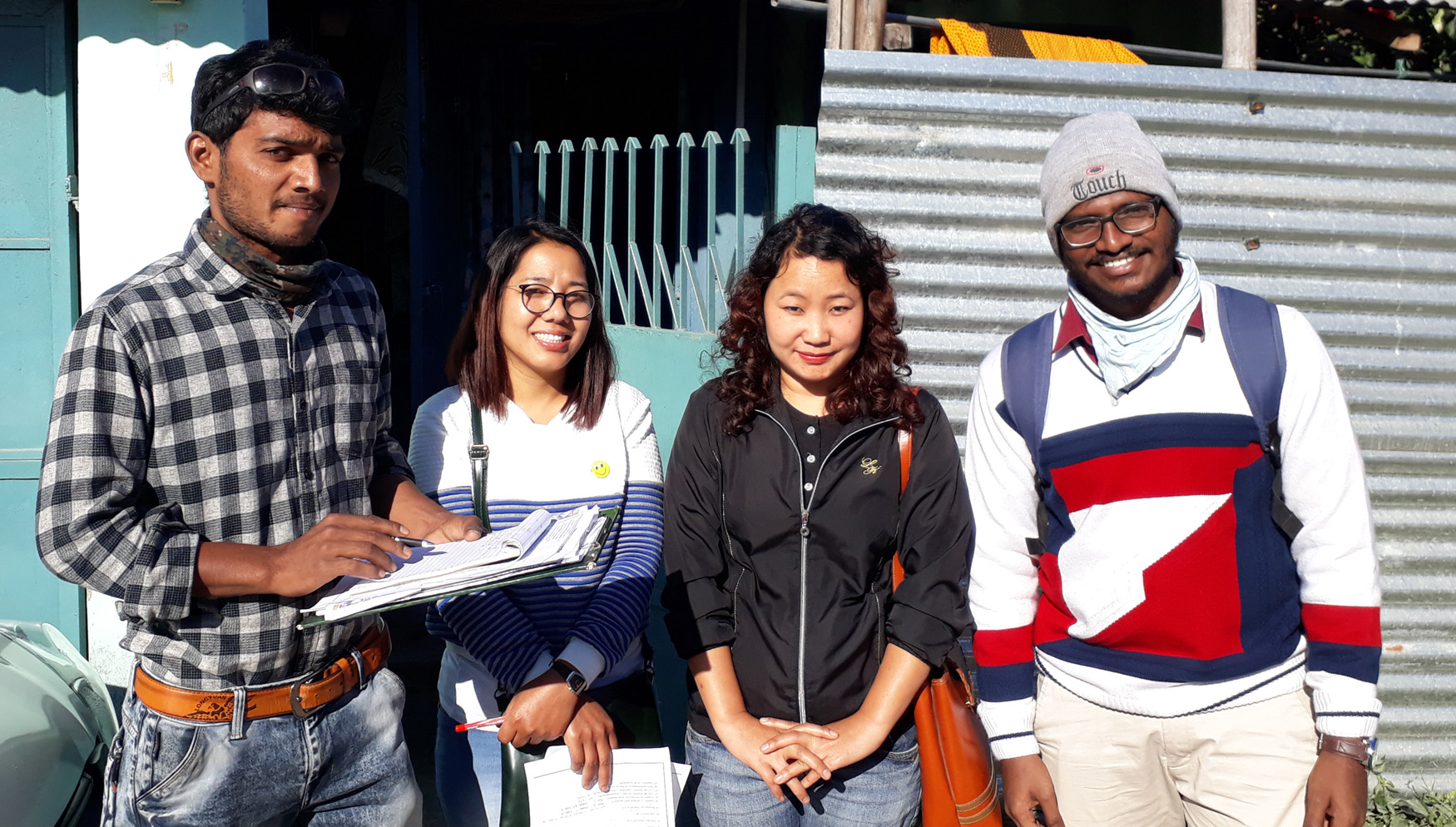
Realising that Arunachal Pradesh, particularly Capital Complex, has been facing the worst crisis for lack of planning resulting in unplanned growth and mushrooming of kaccha houses, multi structures buildings and trade establishments even without any space in inhabited areas for fire tenders to move during emergency, the GoAP has embarked upon the survey. The survey surfaced as a group of four youth, namely Yami Gadi and Duyum Amo, both pursuing BA in DNGC and RSI technical employees Badshaah and Anandh approached with 45 questioners to seek replies. The survey aim at said collecting primary and secondary data of Itanagar Capital region to form city master plan, they said.
“Empty vessels sound much”, goes the adage as the Capital Complex is yet to see any pragmatic plan for reasons best known to the lawmakers, planners and executives. The people need reasonably-priced housing; stores that sell things people actually need; decent public transit, safety, security and atmosphere to live in communal harmony. When will it happen is a million dollar question?
GoAP silent spectator to disaster in making
Multi-storied structures are springing up in the Capital Complex, particularly within space of the government quarters overlooking the Arunachal Pradesh Building Bye Laws, 2010 Act despite the state is located in zone-V seismic prone area. Notably Prof K S Valdiya, globally known environmentalist visited Itanagar twice, at the request of former CM’s secretary K D Singh when he had conducted mass awareness on building codes, once specifically for lawmakers in Nokme Namati Hall to caution that building should be earthquake proof or else there would be multi-pronged disastrous effects. But none bothers justifying the common saying: Civilizations sprang up and vanished for jaru aur zamin (women and land) which had prompted Russian philosopher, writer and novelist Leo Tolstoy to pen: How much land does a man require? The protagonist, a peasant named Pahom, of his short story, who in his last for land forfeits everything, including his life to be buried in a six feet grave. “If land was the reason for most of the wars fought in history, Mahabharat between the Kauravas and Pandavas neither an exception, the mission to search land is on in Arunachal Pradesh.
“Can there be development without land? The economic powers could develop themselves globally by making the best use of their land resources. But there is hardly any land in the Capital Complex without any owner. Either a board or some bamboo clamps identifying ownership would draw attention if one looks in any direction in the state capital.
“I remember HD Deve Gowda, the first Prime Minister to tour the NE at a stretch for six days in October 1996 and to introduce mandatory earmarking of 10% of every central department for the development of NE region renamed now as Non-Lapsable Central Pool of Resources (NLCPR), reprimanding me for repeatedly asking about the fate of the proposed airport. Glaring at me with annoyance, he had quipped: “Tum bahut badmash ho… Why don’t you ask your state Govt to provide land? I can provide fund but cannot send land from Delhi, samjha?” Alas … the airport is still a mirage!
The land policy is for name sake and officials taking right steps face the brunt while rampant encroachment of government land continues unabated. Chief estate officer (CEO)-cum-ADM Talo Potom is the best examples who faces political ire. However, former CS Ramesh Negi in a meeting on 23.05.14 had directed the CEO and the land management director to prepare a category-wise list of encroachers, along with a list of encroachment cases pending before courts, the UD & housing director to write to banks and other HoDs to stop issuing building loans to anyone without an NOC.
Many ambitious projects are getting inordinately delayed for acquisition of land. With a new disposition in New Delhi, the monitoring and accountability would be too strict for the GoAP, which always grumble for inadequate central funding.
Urban & Country Planning Act 2007 still a mirage?
Pekimodi, a nondescript village on a hilltop in Upper Siang district is proposed to be relocated to save the villagers from being wiped out in a likely major earthquake as the village is located on a major seismic fault. Efforts are on to persuade the 17 tribal families to shift 30-km away to Millang village in Mariyang circle of the district, but the people are resisting the move of the Upper Siang district administration, its deputy commissioner Mimong Tayeng had informed this author as reported on 18.04.08 – Roadmap mooted for disaster Resilient Arunachal by 2020.
NEC member P P Srivastava, who had advocated to respect tribal wisdom of choosing a suitable place for constructing traditional houses in the disaster management action plan but exhorted the people to adopt new technology to chemically treat and make bamboo fireproof before using it as housing building material along with senior engineer Athop Lego, who in his paper – ‘Earthquake resistant design of RCC building & retrofitting’- , had cautioned that a major fault-line passes through Karsingsa, around 27-km from Itanagar which has the capacity to create a massive earthquake that is overdue as the state experienced the last major earthquake in 1950.
Srivastava along with NDMA members Prof. N B C Menon and K M Singh had called on the state Chief Minister Dorjee Khandu, who had directed the town planning department to immediately adopt the Town Planning by-law as soon as the Arunachal Pradesh Urban & Country Planning Act 2007 is notified to ensure that the new building constructions will comply with the techno-legal regime. The workshop called for the formulation of a perspective disaster management plan by pooling all scientific talents for a futuristic roadmap – ‘Disaster Resilient Arunachal – 2020’. The plan and its actions are a mirage till now, why?
Moreover, watching the mad rush in constructing buildings where ever little space was available in Capital Complex, former CM Gegong Apang once had feared that in case of a major earthquake the Capital Complex would turn into a graveyard.
The above examples are enough. This reminds me of Rahul Dev Burman’s meaningful number Kal kya hoga kal kibaat; aaj kyon na jiya? (Kasme Vaade, 1978).


 20
