
Villagers unwilling to shift: Libang
NAHARLAGUN | Jan 22 | The threat of possible major earthquake could wipe out Pekimodi, a nondescript village on a hilltop in Mariyang circle of Upper Siang district located on a major seismic fault, still continues as relocating the villagers proposed in April 2008 is yet to be materialised.
Tuting-Yingkiong lawmaker and present Panchayati Raj and Rural Development Minister, in an exclusive interview to the editor of this daily, admitted that thaere was warning from foreign experts to shift the village but the villagers are unwilling.
The village was developed with the inhabitants of original Millang hamlet, 30-km away, shifting there, he informed, adding that the Upper Sing deputy commissioners and he himself along with Lok Sabha member Ninong Ering had also visited the village, stayed one night to pursue the villagers to shift. However, only 12 houses are there with male members and the rest have shifted to different villages, he disclosed.
It would be worth mentioning here that ‘Siang Window’ is a new rock formation over rocks formed millions of years ago and could throw light on the tectonic movement of the earth ‘Siang Window’ has been drawing earth scientists from across the globe to Arunachal Pradesh as tectonic movement is one of the most important subjects for in-depth studies.
It is an opening which could help the researchers peep through and learn the developments taking place in the crust for millions of years, according to Prof. Jonathan Aitchngton, head of the department of geology and earth science, University of Hong Kong.
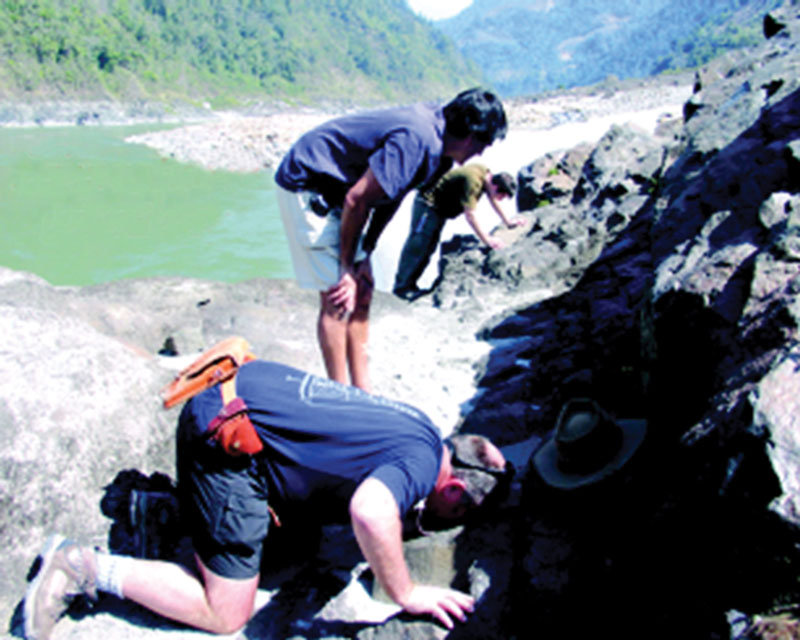
Prof. Jonathan, heading a three-member team as part of a research group, toured the right and left bank of Siang river from Pasighat to Yingkiong for 10 days in April 2012 to collect evidence, particularly fossils to support their study. The team, including Jason Ali and researcher Alan T Baxter, clad in shorts, had trudged through the river bed at various places to look for evidence with piercing eyes, tour operator Oken Tayeng, who escorted them, had disclosed.
The India Plate is currently moving northeast at 5 cm/yr (2 in/yr), while the Eurasian Plate is moving north at only 2 cm/yr (0.8 in/yr). This is causing the Eurasian Plate to deform, and the India Plate to compress at a rate of 4 mm/yr (0.15 in/yr).


 20
