
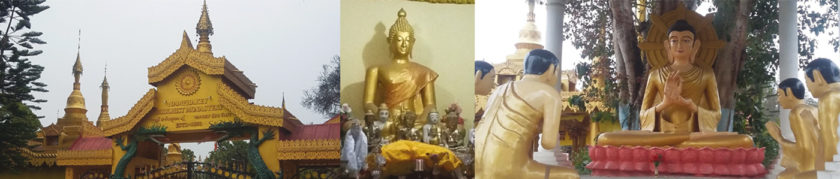
The Buddhist Monastery at Nampkahe of Tai-Phakey, in Naharkatia district of Assam, 37-km from Dibrugarh, built in 1850 and one of the largest and most respected, stands tall today as a testimony to their migration history.
Interactions for few minutes would convince anyone that present head priest Gyanpal Blikklu, a monk full of with wisdom and a palmist, is adding spiritual value to the monastery.
In early 13th century, Tai prince Sukaphaa, a Shan (Mong Mao), began his journey with about 9000 (Edward Gait) followers, mostly men.
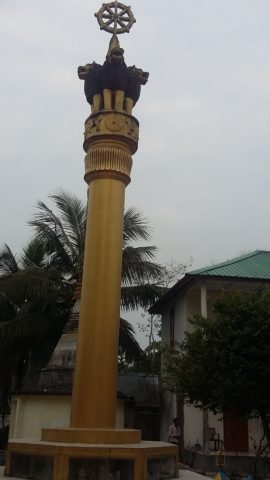
Patkai: On the foothills, they had sacrificed a chicken (kai) with a sharp weapon at one stroke (pat) which gave the name Patkai, senior Khampti leader and lawmaker Chowna Mein had once said. They crossed the Patkai hills and reached Brahmaputra Valley in 1228 to set up Ahom Kingdom and ruled for nearly 600 years (1228-1826) in parts of present-day Assam.
The Ahoms, who had brought dispersed tribal groups and regions under one roof, are considered the architect of modern Assam. They live in the NE India, particularly in Brahmaputra Valley of Assam and Arunachal Pradesh. The Burmese were defeated by the British in the 1st Anglo-Burmese War resulting in the Treaty of Yandaboo in 1826, which paved the way for the British to convert the Ahom kingdom into a principality that marked the end of Ahom rule.
The Tais of Mongoloid origin, categorized as Tai Ahom, Tai Khamyang, Tai Khamti, Tai Phake, Tai Aiton and Tai Turang, had migrated from Southeast Asia. Tai-Khamti or Khamti or Hkamti Shan in Burmese or Chao Tai Kam Dtee in Thai are a sub-group of Tais found in Sagaing division, Hkamti district of Burma now Myanmar. The Khamtis, among the most civilized tribes, are found in Lohit, Namsai, Changlang & East Siang districts of Arunachal Pradesh besides in some parts of Assam. The Tai Khampti descendants live in Tengapani basin. While about 2,00,000 Khamptis live in Myanmar, their population stood at 12,925 in Arunachal Pradesh as per 2011 census.
Nampkahe monastery artistic architecture with spiritual relevance proves Tais’ craftsmanship.
Occupation: Khampti are settled agriculturists, who use plough (Thaie) drawn by a single animal, either an ox or a buffalo and elephant in olden days. They cultivate paddy (khow), mustard/sesame seeds (nga) and potato (man-kala) but their staple food is rice. They drink rice (low) made a beer made from as a beverage which is not
Festivals: Sangken celebrated on 14 April is the main festival of Khampti reflecting true colors of secular India as people irrespective of their tribe, caste, culture, race, take part in the ritualistic celebrations. They splash clean water, symbol of peace and purity. The images of Buddha after a ceremonial bath are taken out in procession, accompanied by drums, dances and enjoyment. This holy bath of lord Buddha is an auspicious event which continues for three consecutive days. The locals usually make homemade sweet, distribute them and exchange gifts. Their other festivals are: Poi-Pee-Mau (Tai Khampti new year), Mai-Kasung-Phai, Khao-Wa, Poat-Wa etc.
Demon Dance (Kaa Phi Phai), reflecting their rich cultural heritage, is prominent and performed on important social and religious occasions. Its theme revolves around attainment of enlightenment by Lord Buddha despite attempts of king of evil spirits (Mara), to disturb his deep meditation. It symbolizes the victory of holy over the evil and marks Buddha’s attainment of ‘Nirvana’.
Society: The Khamti society is divided into classes, each signifying distinct status in the social hierarchy. The chiefs occupy the highest positions, followed by the priests, who wield considerable influence over all ranks. Peace-loving Tai-Khampti are very strong believers of Theravada Buddhims with every house having a prayer room for all to pray every morning and evening by offerings flowers (nam taw yongli) and food (khao tang som).
Language: Tai Khamptis are one of the two tribes in Arunachal Pradesh which boast of its own language and script while Monpas use Bhoti language. Tai Khampti mother tongue, closely related to language of the Shans of Myanmar, China and Thailand. They use script of Shan (Tai) origin, known as Lik-Tai.
The richness of the Tai-Ahom language is evident from the Ahom dictionary project. Dr Stephen Morey, a postdoctoral fellow at Research Centre for Linguistic Typology since 2003, has held fellowships from La Trobe University, the Endangered Languages Documentation Programme and from the Volkswagen Foundation through the DoBeS Programme.
Morey during his visit to Tengapani near Namsai to attend the Golden Pagoda consecration and dedication ceremony (February 22-25, 2010), built by DyCM Mein had given the details in an exclusive interview with this editor. His research covered Tai, Singpho and Tangsa language groups, all inhibiting the Patkai range of Arunachal Pradesh.


 20
