
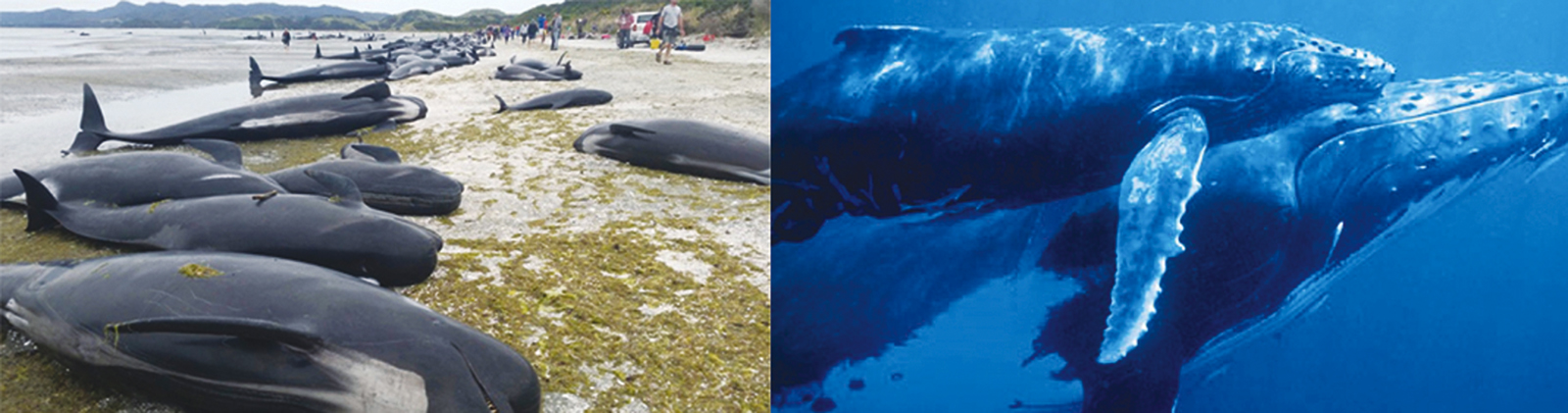
Whale deaths in 2017: Odisha beach- 1, New Zealand beach – 280
The sighting of carcass of a 32-feet long whale washed ashore Autarang sea beach, near Puri in Odisha on 03.04.17 took such findings 11 times since 2009. Environmentalists have called for conducting a scientific study behind such “unusual deaths” of deep sea mammals on Odisha coastline.
Whales, closest living relatives of dolphin & hippopotamuses, having diverged about 40 million years ago and diverged about 40 million years ago. Once relentlessly hunted for their products, whales are now protected by international law. The North Atlantic right whales nearly became extinct in 12th with a population low of 450 and North Pacific grey whale population is ranked critically endangered by the IUCN. However, whale watching has become a form of tourism around the world.
Interestingly, nature is unique as bowerbirds paint bowers, peacocks spread magnificent tails, gorillas beat their chests to reflect love. But humpback male whale only sings the longest, most ornately patterned song to lure giant females, known in the animal world.
Climate change, which affects the sea, might be the cause of the death of whales, Berhampur University marine science department Prof K C Sahu had said in the past, adding it was not only the state coast but several dead whales were washed ashore in Tamil Nadu, Mumbai and Goa recently. He had termed phenomenon very unusual.
Over 400 whales were stranded on a New Zealand beach, one of the largest beachings recorded, with about 70% dying before wildlife officers reached the remote location on 10.02.17 (Friday) as was reported by Neil Sands. Most of them dyed quickly as frustrated volunteers desperately raced to save the survivors. It was one of the largest mass beachings recorded in New Zealand, where strandings are relatively common, Conservation Department had said.
Department’s regional manager Andrew Lamason had said 416 pilot whales swam ashore at Farewell Spit in Golden Bay region on the northern tip of South Island. About 70% had perished by the time wildlife officers reached the remote location and about 500 volunteers pitched in to get the remaining whales offshore. The department said it was New Zealand’s third largest mass stranding. The biggest occurred when 1,000 whales beached at the remote Chatham Islands in 1918, followed by 450 that washed ashore in Auckland in 1985.
 However, earth scientist K D Singh, former Arunachal Pradesh state election commissioner in an exclusive interview to this daily today offered mixed opinions. Climate change has been the most debated topic across the world today with clear two schools of thoughts, he said, adding one terms it as a happening phenomenon while the other reasons it as a hoax.
Citing the example of ice age instance and highly advanced scientific predications tools, the second school offer logics with fossils found now are nothing but what took place on earth hundreds of years ago. With the fast development, particularly industrialization, the modern human beings are leaving a climate footprints by releasing huge quantity of carbon dioxide to the atmosphere resulting in climate change by the green gas affects.
March has been too hot this year, Singh said citing New Delhi as example. When pointed out about recurrent rains in Itanagar with people requiring blankets in night, he quipped: Itanagar is a janhat (swarg).
The climate change records mostly 200 years old since 1988 which are hardly nothing considering the age of earth. Nothing is known what had happened thousands years ago, thus what has been happening is a natural cycle, argues the second group. Many emotionally surcharged have been arguing about modern men leaving a climate footprint indicating climate change is rubbish.
Thus, is difficult to pinpoint the cause behind the deaths of whales as climate change topic is intriguing.
However, Lamason conceded the outlook was gloomy and by late afternoon the majority of the 100-plus whales that were refloated at high tide had swam back ashore. “With that number dead, you have to assume that the rest are in reasonably poor nick as well,” he told Radio New Zealand. So we’re sort of preparing ourselves for a pretty traumatic period ahead.”
Department spokesman Herb Christophers said there were so many whale carcasses that it was difficult for the volunteers to get living animals into the water. The dead ones that are floating around out there are obstructing their course out to sea,” he told AFP.
“I understand they’re concerned about people’s welfare… there’s quite a safety issue there.”
The volunteers at the beach were also advised to be wary of the thrashing tails and fins of the distressed whales, which can weigh up to two tonnes. Pilot whales grow up to six metres (20 feet) long and are the most common species of whale in New Zealand waters.
They are renowned for tragically swimming back ashore after being refloated in an apparent attempt to rejoin their pod. Volunteers will again attempt to refloat any survivors on Saturday.
In the past, whales that repeatedly re-strand have been euthanised after becoming steadily weaker with every attempt to return them to the sea.
Christophers said whale carcasses were sometimes tethered in the shallows so sea creatures could feed on them but such a solution might not work for Golden Bay, a popular tourist area.
He said they would probably “dig a bloody big hole” and bury the carcasses.
Farewell Spit, about 150-km west of the tourist town of Nelson, has witnessed at least nine mass strandings of the species in the past decade, although the latest is by far the largest.
Lamason said the reason the whales beached themselves was unknown but he believed it was partly due to the local geography.
“If you designed something to catch whales then Golden Bay is probably the perfect design,” he said.
“Out at Farewell Spit it’s a big massive sweeping hook of sand coming about, the bay is very shallow and once the whales get in there… it’s very difficult to work out which way is out.”(with agency inputs)


 20
