
He left an inedible mark in my mind. My father late Kshetra Mohan Behera had personal relations with him. As CM, he inspected our area in 1963 but at the insistence of my father had changed the route to touch my village Bhimda. I was to garland him but short heighted at five years, I failed despite his bending. He picked me up and made me stand on his jeep to garland him.
When I visited him in his Delhi’s 5 Race Course bungalow in 1982 and told him that I am from Bhimda, he quipped: Are you Kshetra Mohan’s son? That was the exceptional quality of the flying man.
By Pradeep Kumar
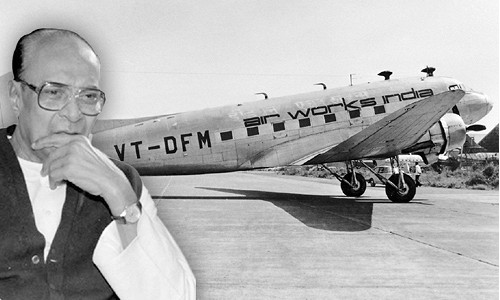 Patriots Biju Patnaik was born on 05.03.1916 to Lakshmi Narayan and Ashalata Patnaik, who belonged to G.Nuagan, Bellaguntha, Ganjam district, of Odisha, around 80-km from Bramhapur or Berhampur.
He was educated at Ravenhaw College but due to his interest in aviation he dropped out to be trained as a pilot. Patnaik flew with private airlines but at the start of the WW II, he joined the Royal Indian Air Force eventually becoming head of air transport command.
He showed keen interest in nationalist politics while in service and used air force transports to deliver what was seen as subversive literature to Indian troops. But Patnaik remained committed to fighting the Axis Powers and when he was jailed for two years for his illegal activities.
He had played a vital role in Indonesian freedom struggle by saving Sultan Sjahrir: Patnaik met Jawaharlal Nehru during his participation in Indian freedom struggle and became one of his trusted friends. Nehru viewed Indonesia as a potential ally and freedom struggle of Indonesians parallel to that of India. When the Dutch attempted to quell Indonesian independence on 21.07.1947, President Sukarno ordered former Indonesia prime minister Sjahrir to leave the country to attend first Inter-Asia Conference, organised by Nehru in July 1947, and to foment international public opinion against the Dutch.
Sjahrir was unable to leave as the Dutch controlled the Indonesian sea and air routes. Nehru asked Biju Patnaik, who was adventurous and an expert pilot, to rescue Sjahrir. Patnaik and his wife Gyan Patnaik flew to Java and brought Sultan Sjahrir out on a Dakota reaching India via Singapore on 24.07.1947. For this act of bravery, Patnaik was given honorary citizenship in Indonesia and conferred ‘Bhoomi Putra’, one of the highest Indonesian award, rarely granted to a foreigner. In 1996, when Indonesia was celebrating its 50th Independence Day, Patnaik was awarded the highest national award, the ‘Bintang Jasa Utama’.
 Role in saving Kashmir: Patnaik piloted the first plane that left Palam Airport at Delhi on 27.10.1947 at dawn and landed at Srinagar Airport in early morning. He brought 17 soldiers of 1-Sikh Regiment commanded by Lt. Col. Dewan Ranjit Rai. “…….. The pilot flew low on the airstrip twice to ensure that no raiders were around… Instructions from PM Nehru’s office were clear: If the airport was taken over by the enemy, you are not to land. Taking a full circle the DC-3 flew ground level. Anxious eye-balls peered from inside the aircraft – only to find the airstrip empty. Not a soul was in sight. The raiders were busy distributing the war booty amongst them in Baramulla.”
Politics in independent India: Patnaik’s political ideals were centred in socialism and federalism. His strong advocacy for equal resources to all needy Indian states made him a champion of his Oriya constituents.
In 1946 Patnaik was elected uncontested to Odisha Legislative Assembly from North Cuttack constituency. In 1952 and 1957 he won from Jagannath Prasad and Surada seat respectively. In 1961, he became president of state Congress. Under his leadership, Congress Party won 82 of 140 seats and Patnaik (representing Chowdwar constituency) became Odisha chief minister of on 23.06.1961 at the age of 45 and remained in the position until 02.10.1963 when he resigned from the post under Kamraj Plan to revitalise Congress party.
Patnaik was close to Indira Gandhi who took over as Congress Party as president in 1967. However, they clashed in 1969 over the presidential election and he left the Congress and formed a regional party – the Utkal Congress. In the 1971 assembly poll, his party did reasonably well. Patnaik then re-established contact with his old friend Jayaprakash Narayan and plunged into JP movement as it picked up momentum in 1974. When the Emergency was declared in 1975, Patnaik was one of the first to be arrested along with other opposition leaders.
He was released in 1977. The same year later, he was elected to Lok Sabha first time from Kendrapara and became Union minister for steel and mines in both Morarji Desai and Charan Singh Govts until 1979. He was re-elected to Lok Sabha again in 1980 and 1984 from Kendrapara as Janata Party candidate despite the Congress wave in 1984 following Indira Gandhi’s’s assasination. With the Congress defeat in 1989, he bounced back into political limelight. However, after playing a key behind-the-scene role in manoeuvring V P Singh to the Prime Minister’s post, he again chose to return to Odisha, and prepared for the 1990 state assembly election. The JD received a thumping 2/3rd majority which saw Biju Patnaik being the CM for the 2nd time until 1995.
He was re-elected to Lok Sabha in 1996 from Cuttack and Aska constituencies as a JD candidate. He retained the latter until his death on 17.04.1997 due to cardio-respiratory failure.
In 1992, Patnaik left this quote for the people of Odisha: “In my dream of the 21st century for the State, I would have young men and women who put the interest of the State before them. They will have pride in themselves, confidence in themselves. They will not be at anybody’s mercy, except their own selves. By their brains, intelligence and capacity, they will recapture the history of Kalinga.”
Of his numerous contributions, few greatest contributions include:
Paradeep Port: Patnaik was keen to build the port at Paradeep. When PM Neheru refused to grant funds to build the Paradeep port, he said: To hell with the Government of India. I will build the port with state government and my own money. And he spent Rs 1.60 billion on it. Later, of course, Nehru sanctioned funds for the project and a building n a month where Neheru had stayed while inaugurating the port stand tall today as a proof. Today that is Odisha’s most prominent port.
Nehru and Patnaik: Nehru Patnaik “India’s buccaneer”. When Nehru was criticised in the Parliament for his decision to provide more aid to Odisha. Nehru replied, ‘”Biju Patnaik has the courage, dynamism and zeal to work. So there is no blunder in giving more aid to Odisha.” During the Sino-India War in 1962, Nehru consulted the Oriya leader repeatedly for advice. For sometimes he was Nehru’s defence advisor, unofficially of course. ‘The PM was dazzled by Patnaik’s familiarity with military subjects,’ wrote a political commentator of the time.
Anti-corruption stand: To fight against corruption, he once proclaimed ‘beat up all corrupt officials’. Although his Govt failed to control and defeat corruption.
On death: When a journalist asked in him on his 79th birthday how he would like to die, he had quipped, ‘I would like to die in an air crash rather than from prolonged illness. I would like to die instantly, just fall down and die’. This was later narrated by one of Patnaik’s close associates advocate Manas Ranjan,.
On Odisha and for Oriyas: To be born poor is not a crime but to remain so is indeed a crime’. ‘Be loyal not to me but to the destiny of the State’. ‘Odisha is a rich state where poor people live’. ‘Be a pride to your State and not a shame’.
Memorials: The Govt of Odisha has named several institutions after the Biju Patanaik. They include the Biju Patnaik Airport at Bhubaneswar, the Biju Patnaik University of Technology, Biju Patnaik Stadium at Nalco Nagar, Angul etc. Also his son Naveen Patnaik made his birthday 5 March as the Panchayat Raj Divas, a holiday in Odisha in his memory.
Family: Patnaik’s younger son Naveen Patnaik is the current Chief Minister of Odisha. His daughter Gita Mehta, is an English writer, his elder son Prem Patnaik is a Delhi-based based industrialist.
Popular incidents and quotes: The Vijoynagar advanced landing ground (ALG), along India-China-Myanmar tri-junction in Changlang district, was reopened by then Governor Gen (Retd) J J SIngh on 18.11.11 after renovation by the IAF. Coincidentally, I had accompanied the governor.
The IAF commenced its operations with Dakota and Otter there in 1962 and subsequently AN-32 was pushed into service since 1984. But after renovation, this ALG facilitates routine and regular air maintenance reflecting IAF’s commitment to national security besides turning a boon for the needy and poor people of the valley.
Its operation revived NEFA days when famous federal pilot Biju Pattanaik’s Kalinga Airlines, which had maintained the lifeline of NEFA from 1956-57 by flying AN-32 from Supply & Transport directorate at Rowriah, JorhatIN Assam to drop rations throughout the remote hinterland and landing at Anini and Ziro. Then Food & Civil Supplies (FCS) Minister Kamlung Mossang had told this editor that the ALG, one of the eight, renovated under the PM’s 2008 package, resumed supply of essential commodities regularly since its renovation. Its operation was suspended since 26.08.09 and K Oil since 2005-06.
“The difference is that it was Biju Babu’s AN-32 then and AIF’s now,” he had said, adding with Governor JJ Singh and chief minister Nabam Tuki attaching top priority to ensure food supply to the poor and needy, I, with the support of the duo, would revitalize PDS to meet the people’s aspirations, which was initiated by former chief minister Dorjee Khandu,” he had said.
Achievements as a public representative: Patnaik set up Kalinga tubes, Kalinga Airlines, Kalinga Iron work, Kalinga Refractories and the Kalinga, a daily Oriya newspaper. In 1951 he launched the International Kalinga Prize for popularisation of Science and Technology among the people and entrusted the responsibility to the UNESCO. The projects which he was known to have spearheaded includes the Port of Paradip, Orissa Aviation Centre, Bhubaneswar Airport, Cuttack-Jagatpur Mahanadi highway bridge, Regional Engineering College, Rourkela, Bhubanesaw Sainik School, Orissa University of Agriculture & Technology, Bhubaneswar, National Aluminum Company (NALCO), Talcher Thermal Power Station, Balimela Hydel Project, HAL, Sunabeda and Chowdwar & Barbil industrial belts besides launching Kalinga Cup in football.


 20
