
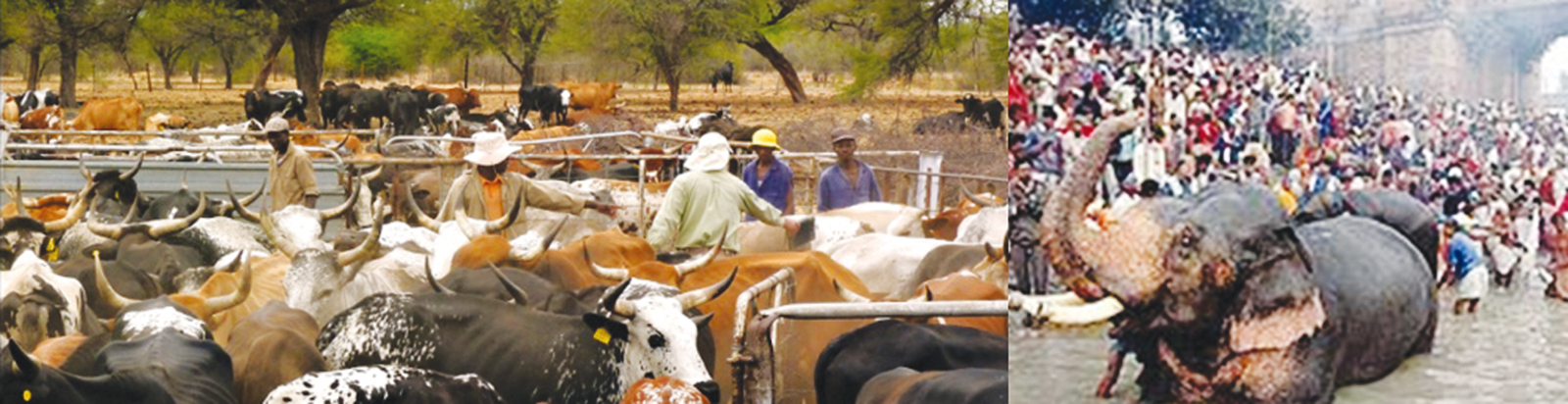
Cow born as a calf to nourish children of mothers incapable of breast feeding is revered by the mankind, particularly Hindus who worship them as gomata. Cow, however, is symbol of love-hate relations in the society since ages.
Cow after giving birth to many male and female off springs, which either become bullocks or cow again, grows old incapable of bearing child and giving milk. The love for her gradually disappears as feeding her becomes too costly. Grazing land becoming scarce in rural areas buying grasses without any return becomes a costly proposition for the owners.
The owners look for alternative, like either to exchange her for younger ones or sell her. Traders with cattle herd tour villages offering such opportunities. Owners while exchanging or selling her feed and worship for last time before bidding good bye. Same is the case with old oxen.
Moreover, experts in treating animals, mostly quarks, are engaged by the rearers to treat them. Such scenes are very common in rural villages of India.
The other platform for exchange or sell is animal fair or rural markets. Sonepur Cattle Fair or Harihar Kshetra Mela in Bihar is the largest in Asia and attracts visitors from all over Asia. The 15-day mela is held on the full moon day in November on the confluence of Gangages and Gandak river .
Many farm animals are sold at the mela including all breeds of dogs, buffalos, donkeys, ponies, Persian horses, rabbits, goats, camels, varieties of birds, poultry while elephants are lined up for sale.
Originated during King Chandragupta Maurya (340-297 BCE) who used to buy elephants and horses across river Ganges. The Sonepur Fair once used to attract traders from places as far as Central Asia.
Originally, the fair venue was Hajipur near Harihar Nath temple of Sonepur. Mughal Emperor Aurangzeb shifted the venue to Sonepur. The temple is believed to have been originally built by Lord Ram while on his way to Janakpur to marry Mata Sita, daughter of King Janak.
Sonepur, 25-km from Patna, is easily accessible by road, railway and air while Bihar state tourism department plies ferries during the fair.
Interestingly, India is the top global exporter of cow meat while xxxx people are involved in leather industry. India’s mean meat production in July to October of 2016-17 fiscal rose by 8.48%, nearly 33% of total targeted mean production 7.37 million tonnes, as per GoI record as on Thursday (16.02.17).
Total meat production during July to October, 2016-17, called “rainy” season output, rose to 2.43 million tonnes as against 2.24 million tonnes during same period in 2015-16, according to official integrated sample survey 2016-17. India’s total meat production in 2016-17 was 4.67 million tonnes, including summer season output, 63.36% of annual target.
The 2016-17 Economic Survey tabled in Parliament on 31.01.17 by Finance Minister Arun Jaitley forecasted a GDP growth of 8% to 10% as GST implementation, demonetisation follow-up and structural reforms enactment would push up FY18 projected growth rate of 6.75 to 7.5%.
But the notification to ban cow butchering, which has evoked strong opposition by Tamil Nadu and West Bengal chief ministers, raises many questions.
PM Narendra Modi’s Make in India mission, food processing is an important aspect and buffalo meat processing forms an important part of it,” a senior officer of Agricultural and Food Products Export Development Authority (APEDA) said.
Amidst political debates over beef ban, apex food export agency APEDA feels that it is impossible to ban beef exports as it would hit the economy very hard.
A senior APEDA officer on condition of anonymity said, “When we are talking of beef, mostly buffalo meat. The second largest product exported from India after rice yielding revenue of over Rs 29,000 crore. Thus, banning it would be a big setback for the economy which no Govt irrespective political affiliation could afford. Besides, it has no religious significance.” “The political statements coming on the issue are misguiding people. The political leaders are themselves not aware what India is exporting,” he added.
“Food processing is an important aspect and buffalo meat processing forms an important part of Modi’s Make in India mission,” he said, adding there are proposals to expand the industry whose details he refused to divulge.
Indian buffalo meat demand in international market increased in 2012-13 registering 27% growth, while processed meat demand declined by 28%. The main markets for Indian buffalo meat are Vietnam, Malaysia, Thailand, Saudi Arabia, Egypt and UAE.
Indian buffalo meat is in high demand for low rate. Australian Bureau of Agricultural and Resource Economics and Sciences report-2014 on meat and livestock said that while Indian buffalo meat per kg costs around US $2.88 against US $4.52 and US $4.73 of Brazil and Australia respectively. India in 2014 exported 1.56 million tonnes of buffalo meat or popularly known as carabeef bypassing leading exporters, like Brazil and Australia which exported 1.18 MT and 1.07 MT only.
In 2014-15, Indian exported animal products worth Rs 33,128.30 crore – buffalo meat (Rs 29,282.60 crore), sheep/goat meat (Rs 828.11 crore), poultry products (Rs 651.21 crore), dairy products (Rs 1,205.38 crore), animal casing (Rs 19.32 crore), processed meat (Rs 14.21 crore), other meat (Rs 2.67 crore) and natural honey (Rs 535.07 crore) .
As per Food Processing Ministry till 31.03.14, India had 1623 registered slaughterhouses. Top five states are Maharashtra (316) followed by Uttar Pradesh (285), Andhra Pradesh (183), Tamil Nadu (130) and Karnataka ( 96).
An official, on condition of anonymity, said, “Slaughterhouses are monitored by state Govt through municipal authorities and it was not possible for Centre to monitor these and check if the animal being butchered is buffalo or cow. However, we haven’t received any reports of cow slaughtering by any registered slaughterhouses.”
UP meat processing industry accounts for 50% of India’s exports and employs 25 lakh people, directly or indirectly, HT reported on 30.04.17. As per estimates, meat exports account for Rs 26,685 crore annually, according to UP’s animal husbandry department. According to the All India Meat and Livestock Exporters’ Association, a ban on meat exports would mean a loss of at least Rs 11,350 crores of revenue for the state. And if it persists the for next five years, then the revenue loss can mount up to Rs 56,000 crore. In the year 2015-16, UP exported 5,65,958.20 metric tonnes of buffalo meat.
Only 31% Indians are vegetarians: In 2006, a survey conducted by Centre for Study of Developing Societies (CSDS) for Hindu-CNN-IBN, revealed that only 31% Indians were vegetarians. It was only 21% for families whose all members are vegetarians. The poll based on interviews with 14,680 respondents spread across 883 villages and urban areas in 19 states. After the survey was out, CSDS director Sanjay Kumar, on publication of survey, told the media that the figures did not come as a big surprise as India as vegetarian is a widespread perception.
Moreover, global leather and its products trade has been increasing over the years from a mere USD 4 billion in 1972 to USD 221.3 billion in 2012. Although, exports of Indian leather and their products have grown many folds during the past decades, India’s share in global trade is only around 2.2%, occupying 9th position of total exports, according to Council for Leather Exports. India has emerged as a credible and reliable supplier of leather and their products. Other exporting nations are China, Italy, Germany, Brazil, Spain, Belgium, USA, France, India and Korea. However, prospect of Indian leather industry seems to be bright in near future with India emerging as a credible and reliable supplier. As of today several international brands import leather and leather products from India.


 20
