
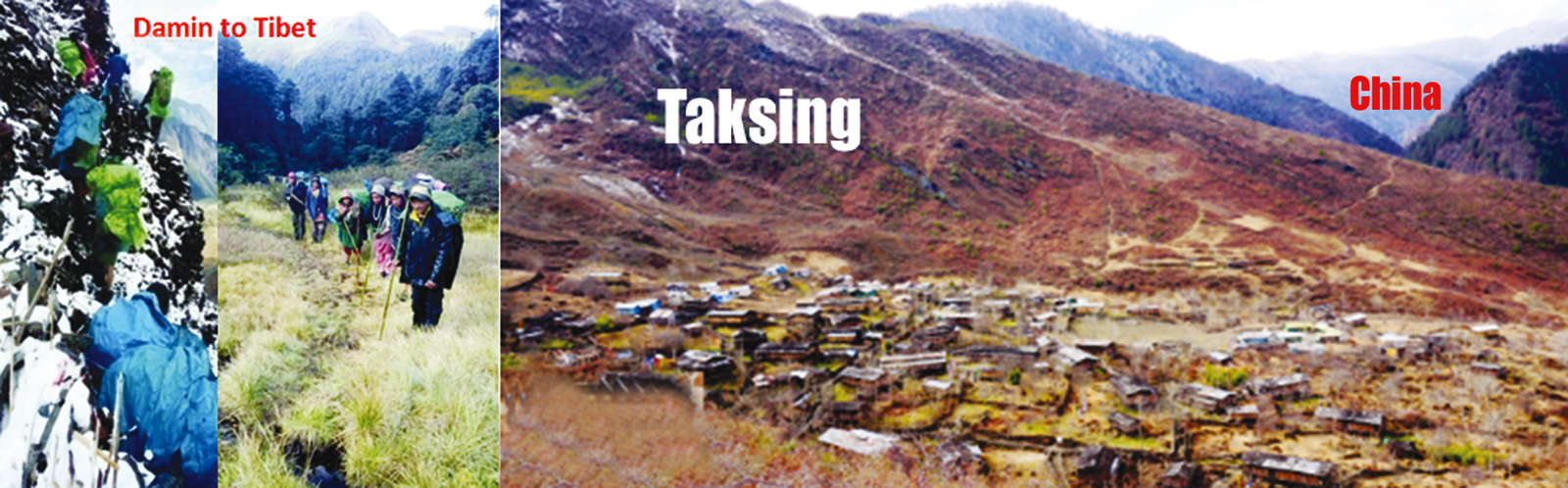
National media der aye par drust aye
Can national media journalists even dream that barter trade still continues in Arunachal Pradesh even 70 years after independence?
The picture given by Kurung Kumay ZPC Sangha Tagik depicting a group of people from Damin carrying bags with commodities recently crossing through snow-clad mountains to Tibet to collect essential through barter trade for their survival. They are forced to adopt such age-old practice as public distribution system is yet to penetrate into their villages in Upper Subansiri district.
On visiting Taksing, 22-km China border, one would reliase with how much difficulties the people live along Indio-China border without any food supply health and education services.
“We are left to fend for ourselves trapped in a valley without road, air, telecommunication connectivity where darkness rules after evening with cultivation and animal husbandry unsustainable and hardly any help from outside,” were the honest opinion of GPM Norbu Chadar and GB Logu Tarba”, I quoted them in – Jite yahan Ram bharose: Residents – after visiting the area with then minister Tanga Byaling on 08.01.15.
Manogya Loiwal filed a story from Vijaynagar, published in India Today and posted on 06.08.17 by Isha Gupta, is nothing new. National media persons would bring many unknown gospel truths before the world if they visit Indo-China border areas.
Spread across 8,000
This desolated and isolated region is Vijaynagar, nestled in the Himalayas on the India-Myanmar Border in Arunachal Pradesh, which takes around seven to 10 days to reach on foot through dense forests.
Spread across 8,000 sqkm, Vijaynagar is unique for many reasons. It was discovered by the Assam Rifles paramilitary force during an expedition named Srijit II in 1961 under Major General AS Guraya, IG of Assam Rifles. The virgin valley was named by him after his son.
Discovery: Since it was an unexplored valley without India-Myanmar border demarcation at the time, around 200 families of ex-servicemen of Assam Rifles were induced and inducted in this area on the line of duty through a settlement scheme, which was both special and exceptional in nature. The border demarcation was carried out in 1972 after the completion of settlement of Assam Rifles families in various batches.
The strategy was to settle the ex-servicemen who would retire by 1971 and remain in the valley for years to come. So, the ultimate aim of colonising the area was to ensure security and stability in the remotest border part in national interest.
They were taken in good health and assurance to a place that had no roads, communication channels, electricity or school and instead had dense forests. Years later, the situation has not changed.
Octogenarian Assam Rifles ex-serviceman Z Ralte in Vijaynagar since 1970s, said, “I was serving in the AR when the Indian Govt located us here in 1964, promising to give us 50 acres, but instead gave 11 acres. Since then, we have been working in farming activities here. Salt is a big problem in this area, we have to pay Rs 150 per kg. Therefore we request the Govt to supply salt, oil and other food products. It is difficult for old people to travel on foot any more. My family’s expenses are met by the pension I get. Conditions have deteriorated since 1986.”
Agony of 300 families: But this is the agony of just one of 300 families settled over the years in the valley. They were promised of good health and wealth, but have lost both and are living in pain. The women in the family have no option left but to live with the limited resources and double expenses.
It is not just about the prices of essentials like salt and sugar but even when they have to make calls from local PCOs, it charges them Rs 5 per minute. Their per day income is Rs 200 and they buy goods at Rs 150 per kg. The medical facilities are even worse. The nearest hospital is 200-km away and the patients can reach there only via airways.
Utsav said, “I would like to thank India Today and the team of Aaj Tak for reaching out to us, since past 70 years, this is the first channel that has reached out to us and we are grateful to you. Poor transport, medical and food facilities are our major problems. Salt and other goods are very expensive. We are thankful to AR for their constant help. Pregnant or ill patients have to either wait or meet death. Education is a huge problem, my wife and I have started a school as an effort to overcome this problem by educating children.”
There is just one primary school which charges Rs 500 per student and sometimes even teaches for free only to serve for a social cause to the society.
Interestingly, I had brought to limelight on 26.03.08 – Rs 150/kg in Pip-Sorang, PDS still has miles to go: Arunachal needs a salt movement.
“Though Mahatma Gandhi launched Dandi March in 1930 to free salt from British control, salt needs a tedious days-long foot march to reach inaccessible parts of Arunachal Pradesh even 63 years after independence.
Gandhi’s soul may not be in peace at Rajghat even 62 years after his death. Because, Pip-Sorang is ahead of Singla (Upper Siang) where a kg of salt is sold for Rs 150 there; blame non-availability of road links to numerous such remote villages of the state.
Apatanis, who have developed indigenous salt to meet their needs, used to barter 20 eggs worth Rs 2 for half a kg of salt worth 5 paisa in 60’s in the then NEFA.
Despite the Govt’s desire to provide connectivity to remote areas, the task is Herculean for Pip-Sorang and Tali administrative centres in Kurung Kumey district because of steep hilly terrain, said Nangram Pingkap, first circle officer to reach Dana Raha village under P/Sorang circle after trekking for three days.
Carrying essentials on head for three days, while spending nights in unsafe caves on the way is challenging and risky, which skyrockets cost of essential commodities in those inaccessible areas, he justifies, adding salt is Rs 10/per kg at Itanagar but Rs 150/per kg at Pip-Sorang.
Though the PDS items were reduced to five (rice, atta, sugar, salt and K. oil) from 24 in the 1980’s as decided by the central purchase organization (CPO), the items are not being supplied now, demanding effective PDS functioning. The existing cooperatives should be given the responsibility to ensure supply of salt to interior areas, least Gandhi wakes up from his grave to launch a movement. Should the civil society wake up to this call?
The PDS rice supply has considerably improved in K/Kumey, said Pingkap, now holding the charge of district food & civil supplies officer. The air-fed CPO centres at Sarli, Chambang, Damin, Parsi-Parlo, Tali and Pipsorang are also getting rice, subject to weather conditions, he disclosed.
After this daily highlighted food crisis in this remote district on 8th and 14th February editions, steps were initiated to speed up supply. With the PDS being monitored constantly by Chief Minister Dorjee Khandu, 14 fair price shops (FPS) licenses were cancelled and 57 FPS licensees were showcaused in K/Kumey recently for non-renewal that was causing revenue loss, Pingkap informed.
Staff shortage is another hurdle in monitoring the PDS, official sources said, adding that no post has been created in FCS department even after the creation of K/Kumey, Anjaw and Dibang Valley (after bifurcation of L/Dibang Valley) districts. Besides Pingkap, Tarak Kama is the only FCS sub-inspector for entire K/Kumey without any ministerial and contingency staff to manage the show. Kama tours the district in his personal car once every month to monitor the PDS delivery.
Air connectivity: The surface communication network in the region is sketchy and the road network rudimentary and restricted to the lower reaches of the mountain ranges. Air logistics, by fixed or rotary wing aircraft, is the only way to transport troops and material. The IAF has been ferrying tonnes of equipment for the BRO, engaged in border road construction in key valleys. The IAF operates 14 designated Drop Zones (DZs -some as small as 700×300 feet since there is not enough space in higher mountain reaches sloping), reduced from 100-odd. This elaborate network of DZs (like Tawang, Tato, Bhawani and Yapik close to the Chinese border), ALGs, and helipads are lifelines of both military personnel and civilian population.


 20
