
*Are you aware, Mr Governor & Mr Culture Minister?
By Pradeep Kumar
ITANAGAR | Jun 22 | Little known Koro, whose few seniors only knowing their language, is on the verge of extinction Arunachal Pradesh, an unique cultural mosaic rich with heritage and traditions.
This could close a chapter of human history as an impact of modernization and influence of western culture on numerous known and unknown tribes, who speak in about 200 languages, highest in the world.
While Neolithic evidences pinpoint that people lived in this land since 11,000 years ago, many Arunachalees also took part in freedom struggle of India reflecting their staunch patriotism.
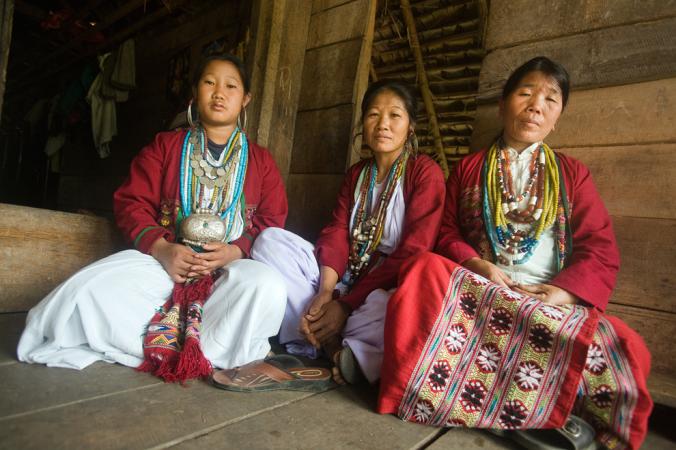
Most of young Arunachalees speak Hindi and English very fluently but shockingly do not know their own dialects. Jai Hind in Hindi is not only the common greeting but is the lingua franca of Arunachalees while Hindi Prasharan Samity survey on national language (Hindi) has found Arunachal Pradesh as the best Hindi speaking state, among eight NE states.
“Hidden” language found: Dan Morrison of National Geographic News had reported on 06.10.10 that a “hidden” language has been documented in an isolated hill tribe in a NE Indian region considered a “black hole” in the study of languages, linguists had announced.
Koro, the new language, is spoken by about a thousand people in Arunachal Pradesh, a state for which little linguistic data exist, due to restrictive entry policies, according to the linguists behind the findings.
Koro belongs to the Tibeto-Burman language family, which includes 400 languages such as Tibetan and Burmese. About 150 Tibeto-Burman languages are found in India, but a team with the National Geographic Society (NGS)’s Enduring Voices Project discovered that Koro was distinct from all other languages in its family. (The Society owns National Geographic News.)
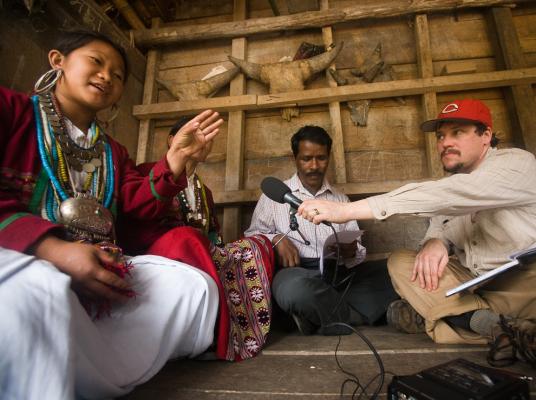
The linguists stumbled upon the language in 2008 while researching another two poorly known languages -Aka and Miji -which are spoken in one small district.
While listening to these tongues, the researchers detected a third language, Koro.
“This is a language that had been undocumented, completely unrecognized, and unrecorded,” said researcher Living Tongues Institute for Endangered Languages director Gregory Anderson.
What’s more, the newly identified Koro tongue may be endangered: Only about 800 people are speakers, most of them older than 20 and the language hasn’t been written down, Anderson noted.
Newfound language in a class by Itself: The team climbed steep hillsides and took to bamboo rafts to access the remote villages, where people make a living raising pigs and cultivating rice and barley.
Going door-to-door among the stilted bamboo houses, the team recorded villagers speaking the newfound language.
It’s unknown how the Koro, who number between 800 and 1,200 people, came to live as a sub-tribe of the 10,000-person Aka tribe.
But it’s clear that Koro differs greatly from Aka, the team found. For instance, Koro’s inventory of sounds is completely different, as is the way sounds combine to form words. Words and sentences are built differently in Koro too.
For example, the Aka word for “mountain” is “phù” while the Koro word is “nggõ.” Aka speakers call a pig a “vo,” while to Koro speakers, a pig is a “lele.” The groups share about 9% of their vocabulary.
“Koro could hardly sound more different from Aka,” linguist K. David Harrison of Swarthmore College writes in his new book The Last Speakers. The linguist is also a National Geographic Society fellow.
“They sound as different as, say, English and Japanese.”
Language differences downplayed: Though they lack a common language, Koro speakers and Aka speakers insist there is no difference between them, Harrison noted.
The coexistence of separate languages between two integrated groups that don’t acknowledge an ethnic difference is very unusual, the Living Tongues Institute’s Anderson noted.
Typically, the minority language in such an arrangement would lose ground to the majority language and in time die out – or the smaller group would maintain its own language by asserting a unique identity.
But in the villages of the Aka and the Koro, in the shadow of India’s contested border with China, everyone maintains the tribe and sub-tribe are the same but for a small variation in dialect.
“Local people downplay the difference in the languages,” said Harrison, who helped Anderson in his research, along with Ranchi University’s Ganesh Murmu. “But they are radically different.”
Pressing concern on Koro language origin: “Linguistically, their enigmatic origin is a pressing concern,” said Anderson, who will describe Koro’s documentation in an upcoming edition of the journal Indian Linguistics.
“When did the Koro end up submerged within the Aka, and how did that come to be? Our most pressing task is getting decent documentation out into the professional domain so that specialists in other Tibeto-Burman languages can weigh in.”
K.V. Subbarao, professor at the Centre for Applied Linguistics and Translation, University of Hyderabad, said Koro’s uniqueness is an “interesting case.”
“It is quite possible that two living communities can coexist and still maintain their separate languages,” said Subbarao, who was not involved in the research.
“Certainly, it is uncommon for them to deny a distinction—the smaller group usually insists they are different.”
Times of India senior assistant editor Subhro Niyogi, a of had reported in Times News Network that “The state is a linguistic hotspot with a different language or dialect every 10-km. Most tribes do not comprehend the language that others speak. In the absence of effective communication, conflicts were inevitable. Hindi was promoted in a big way after 1962 Chinese aggression and this allowed the tribes communicate with each other better,” says Mysore-based Central Institute of Indian Languages director in-charge Rajesh Sachdeva, who had spent 15 years to conduct research on NE languages.
“Koro belongs to Tibeto-Burman language family, a group of some 400 languages of which more than 100 are spoken in India. Only around 1,200 men and women speak the language now. The remaining 600-odd consisting of youth and children, converse only in Hindi, living in cluster of five disjointed hamlets located in Bana block of East Kameng district.
“Nestled among the remote virgin hills to the south-west of the state, three of the five hamlets – Yengsey, Sopung and Yeme – can be accessed after a 250-km road journey from capital Itanagar. Pichang and Chichang do not have motorable tracks. One has to trek for a day to reach them. Bhalukpong, the entry point for tourists doing the popular Bomdila-Tawang circuit along the China border, is closer at 130-km.
This is enough to draw attention of those who matter in the state, particularly Governor P B Acharya, who went out of way to protect & promote Puroik community, and Culture & Research Minister Dr Mohesh Chai. The proposed assessment to identify tribes, cultures and languages under threat need to be expedited by dedicated teams before it is too late to repent.
It may be recalled that terming language as part of indigenous identity, Dr Chai had informed state assembly during question hour on 09.03.17 that UNESCO has listed state’s 33 languages endangered, including four very critically on the verge of extinction, 17 definitely endangered and 12 vulnerable.
After documenting 42 languages, research department has been continuing documentation of other languages, Dr Chai had disclosed, adding the survey will help learn the exact number of languages and their status.
Rs 5 crore has been allocated to research department for the purpose, Dy Chief Minister Chowna Mein had informed, adding strategies will be evolved and national and international experts invited to achieve the goal.


 20
