
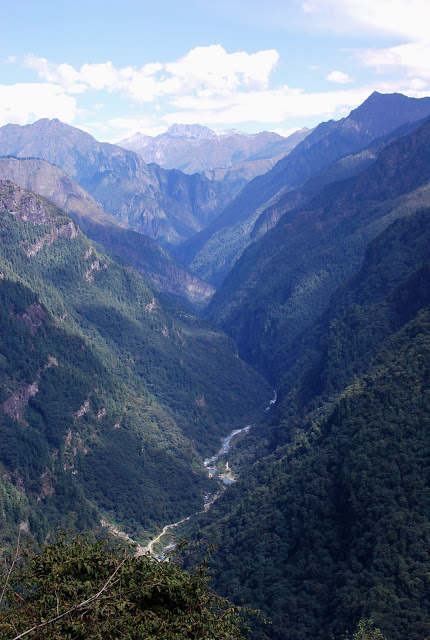
The 1962 war resonates through Bhupenda’s monumental song:
Koto jowanor mrityu hol, kata jibon joubon gol,
Xei mrityu aporajeyo tene mritok noholu moi kiyo…
Koto pitri putrohara hol, koto matrir buku xuda hol,
Ronga xendur kaar mosa gol, kar baxona apurno rol
Proti jowanor roktorey bindu hol xahoxor ononto xindhu
Xeye xahoxor durjeyo lohorey jaasiley prodigya joyorey
(“So many Jawans lie dead: lives, youths, so many have gone. If death is unconquerable why I did not die? So many fathers have lost their sons; so many mothers’ hearts lie empty, Red sindur wiped off from the heads of many, so many desires unfulfilled, Every drop of the jawans’ blood is an unending river, a Sindhu of courage And these unvanquished valorous waves bring the firm promise of victory).
Bhupenda’s scintillating voice dripping with emotions of waste of human lives, senselessly ravaging promise of an entire nation. This song embodies the reality of a war that was fought at their doorstep poignantly in Arunachal Pradesh.
The 1962 Sino-Indian War between China and India that occurred along the McMohan Line on 20.10.1962. Chinese troops advanced over Indian forces in both theatres, capturing Rezang La in Chushul in western and Tawang in eastern theatre. The war ended when China declared a ceasefire on 20.11.1962, and simultaneously announced its withdrawal from one of the two disputed areas. Indian posts and patrols were removed from Aksai Chin, which came under direct Chinese control after the end of the conflict.
The War is notable for the harsh mountain conditions under which much of the fighting took place, entailing large-scale combat at altitudes of over 14,000 feet while air force was deployed by either side.
Hatung La (14,500 feet) in Tawang sector under Indian possession overlooking Thag La (16,400 feet) under Chinese possession is where the forces of both the nations are juxtaposed face to face since the 1962 bloody war. All defence top rungs are tightlipped with an advisory from the national security advisor to keep mum on the sensitive matter with international ramifications.
Braving inclement weather, thigh-deep snow, thick fog and bone-breaking chilly wind during winter and heavy rain during summer, the jawans maintain 24X7 vigils round the year for the people of India to live in peace. One realizes the tremendous mental and physical strength needed with dedication to serve at the post, considered one of most vulnerable among all such border posts of India.
Keeping an eye on each other’s movement from observation and listening posts and intercepting telecommunication by using high-tech devices by forces of both sides is an open secret. “It is eyeball to eye at Lumpo,” I had learnt during my visit to this border outpost in December 2013, thanks to local legislator Jambey Tashi.
The Thag La post of the PLA boasts of massive infrastructures including wide black-topped road, multi-storied RCC buildings with provisions of modern amenities. On the Indian side, contrary to the claims of New Delhi mandarins, the situation is much below the expectation even after the humiliating defeat of the Indian Army by the PLA in 1962.
History will never forgive for the suicidal move in October 1962 that had claimed the lives of four divisions of Indian Army at Hatung La for want of communication, winter clothes, food and ammunition at the height of 14,500 feet. The wound is still fresh in the minds of the forces deployed there and they observe lot of rituals to honour the martyrs and officers whose souls, they believe, are not liberated so far as bodies of most of them were not recovered and their last rites are yet to be conducted.
The Hatung La and Thag La passes are still standing tall while Nyamjang Chu and Namka Chu (rivers) witnesses to the gory conflict but the gallant acts of Indian forces still flow as usual, whose green waters ask – Is India ready for trial of strength?
In Tama Chung Chung Ridge in Upper Subansisir district, 15 Sikh Light Infantry’s 22 Infantry Brigade was posted at Ketinala and 2 Jammu and Kashmir Rifles havildar Shere Thapa “was part of a protective patrol of one platoon located near Rio Bridge in the Upper Subansiri valley. On 18.11.62 at 3 pm, about 200 Chinese troops came in contact with Thapa’s party. He had fought bravely and killed approximately 160 Chinese soldiers before succumbing to his death but had delayed the Chinese advance to nearly 72 hour. The Chinese had recognized his bravery and buried his body with an inscription in Chinese script appreciating. Locals had brought him mortal remains to Limeking, performed the last rites and built a grave. The great soldier is highly revered in the area for his gallant act.
But he was court marshalled for defying the Army HQ order to retreat for choosing to fight with great courage along with another soldier for which he was declared a deserter and never given the recognition.
To pay the tribute to the legend, guard of honor was given in a wreath laying ceremony in presence of Col Satyasheel Baber, deputy commander, 22 Infantry Brigade and various other dignitaries besides 200 civilians of nearby villages including GBs of Limeking, TCC and Orak. The 15 Sikh Light Infantry paid tribute to Thapa to commemorate his 52nd death anniversary on Nov 16. If Thapa sacrificed his life while protecting Mother India, why Indian Army did not recognize his heroism?
Casualties suffered by Indian army included: 1,383 killed, 1,047 wounded, 1,696 missing, 3,968 jawans captured and Chinese People’s Liberation Army: 722 killed, 1,697 wounded. (source:historyguy.com)


 20
