
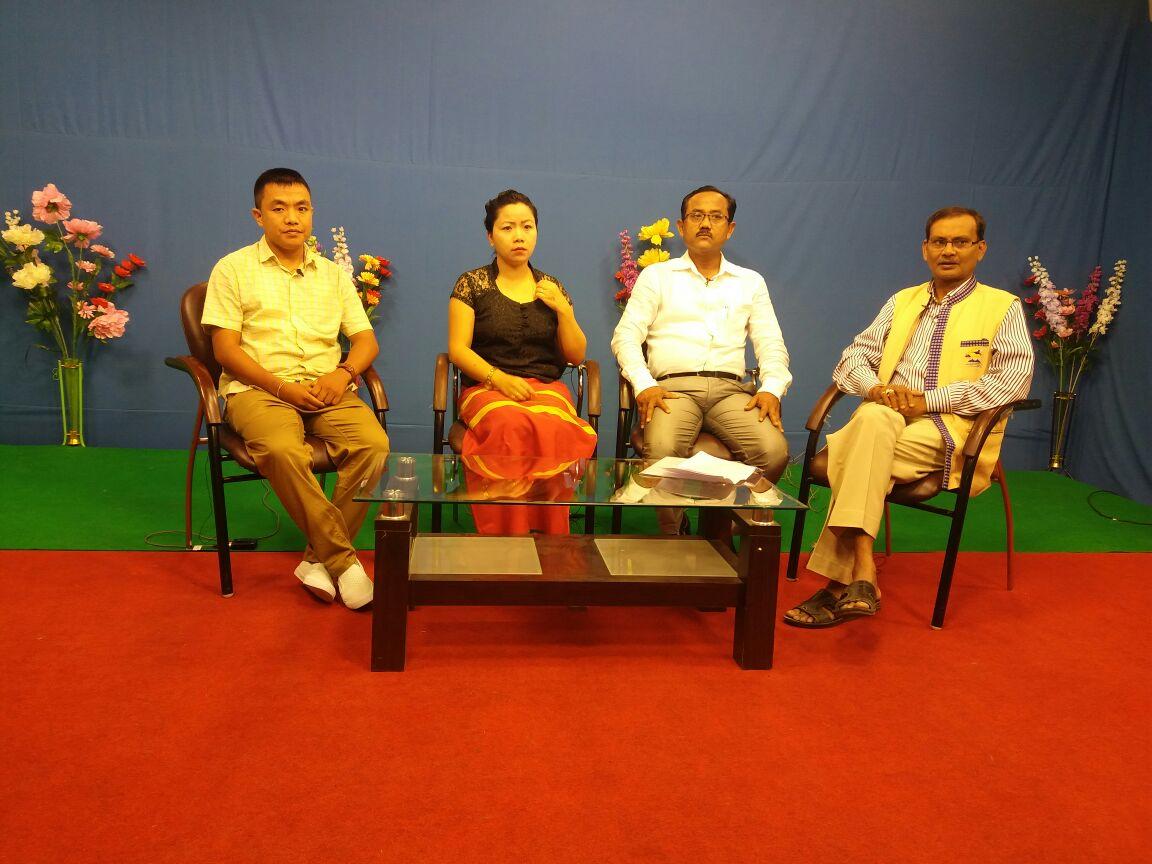
Relevance of Independence Day – a discussion in DDK
ITANAGAR | Aug 13 | The Doordarshan Kendra here recorded a discussion on ‘ Relevance of Independence Day’ by DNGC Economics HoD Dr Ibotombi Singh, RGU faculty member Dakter Esse and Arunachal Vivekananda Yuva Shakti founder Ramesh Jeke.
As anchor senior journalist Pradeep Kumar set the ball rolling by asking are we Indian socio-economically independent even 70 years after independence in 1947(?), Dr Singh said though the question is debatable but the country has achieved multi-faceted development in various fields.
India’s GDP stood at 2.26 trillion US dollar (2016), but India has still miles to go. Esse pitched in to say that the fruits of development are yet to percolate down to the targeted beneficiaries living in far-flung remote area like Arunachal Pradesh.
Kumar supplemented that former deputy prime minister L K Advani in his public address on 15.11.03 at Itanagar had said “It was deeded not to develop Arunachal to serve as a buffer zone against China after 1962 Chinese aggression. It was a historical blunder”.
However, PTI quoting World Bank on 03.10.16 had said that India has highest number of people living below poverty line (BPL).
India accounted for the largest number of people living below international poverty line in 2013, with 30% of its population under the $1.90-a-day poverty measure, the World Bank said.
India accounts for one in three of the poor population worldwide, it said in its inaugural edition of the report ‘Poverty and Shared Prosperity’, according to which extreme poverty worldwide continued to fall despite the global economy’s “under-performance”.
“India is by far the country with the largest number of people living under the international USD 1.90-a-day poverty line, more than 2.5 times as many as the 86 million in Nigeria, which has the second-largest population of the poor worldwide,” the report said.
India had 30% of its population living BPL at 224 million, it said.
Nearly 800 million people lived on less than USD 1.90 a day in 2013, around 100 million fewer poor people than in 2012, it added.
Its statistics – 13,40,000 children below 5 die in a year, that is 3,671 under 5 child deaths per day, nearly half of all children deaths under 5 in India are attributed to under nutrition and 1 in every 11 children in India is working, when they should be in school – were shocking and startling, Kumar pointed out.
India is a nation of sub-continent size and tackling all issues by the Govt would be possible when the masses become willing partners of the process, Dr Singh said and Esse joined in support.
Jeke responding to a question said that the entire humanity is related through blood and all out efforts should be made to ensure that none dies for want of blood.
Development has undoubtedly taken place but no to the desired extent.
“Let us chale saath saath for India to progress and Indians to enjoy its fruits,” was the concluding message for the viewers.
Everyone in India knows that India got freedom from the 300 years of British Rule at the stroke of midnight as India moved towards 15.08.47. Millions of lives that sacrificed for this freedom and many of them are not even known or remembered during the I-Day celebrated every year with great splendor, joy and respect for Mother India. It is a national festival and has equal importance for every Indian regardless of religion, class, creed or race.
The discussion will be telecast at 6 am tomorrow followed by next day. (Sources:DDK)


 20
