
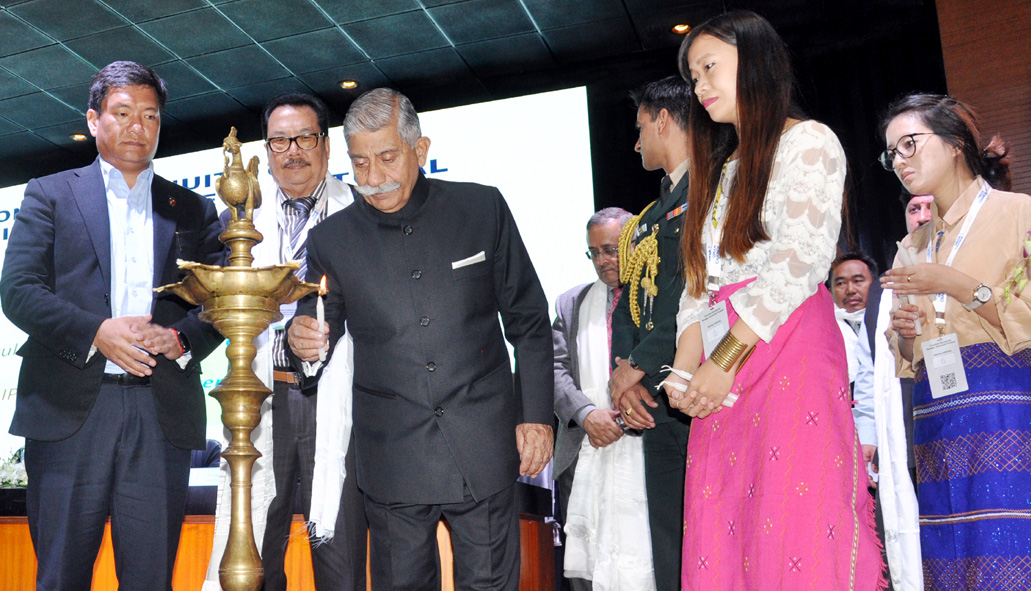
*Explore ways for inclusive growth: Guv
ITANAGAR |Dec 08 | Arunachal Pradesh Chief Minister Pema Khandu, in his address today to inaugural session of a maiden conclave, themed ‘Dream Change-Arunachal 2027: Reshaping development discourse of Arunachal Pradesh’, termed it historic as all state’s stakeholders, policy-makers and experts besides from outside have gathered under one roof for putting their brains and expertise in framing a roadmap for the state to grow in the next one decade.
“We have been lagging behind on all fronts for long. But with the keen interest and determination of the GoI under Prime Minister Narendra Modi, North East is on the path of accelerated development. As GoI is offering all assistance for our development, it’s upon us to plan a time-bound roadmap for ourselves for the future. Hence this conclave,” he said.
While citing important projects under implementation like road, rail and air connectivity, Khandu found no reason that the state should remain backward anymore.
“We have all resources at our disposal. With the coming up of road, rail, air and digital connectivity, the road ahead is open and inviting for us. We just need a comprehensive and time-bound roadmap to guide us and the determination to achieve it,” he pointed.
Khandu expressed hope that with the presence of eminent personalities, like renowned economist and Axis Bank CEO S Bhattacharya, social worker & researcher- Ashish Bhave, National Skill Development Council (NSDC) ED and COO Jayant Krishna, RBI ED S Marandi, Akshay Rout of Union Drinking Water & Sanitation Ministry, among others, the conclave will be path-breaking for the state.
Urging all stakeholders to sincerely rake up their brains for state’s future, Khandu assured that the results when translated into a roadmap will be strictly followed.
“I believe when so many of the best of best brains come out with a comprehensive roadmap, it will not fail. On my part, I assure that the suggestions and path ahead shown by you all will be strictly followed. I know the stepping stone to a brighter and surer future has been laid down today,” he said.
State Governor Brig (Rtd) Dr B D Mishra, in his address, termed the initiative as a trail blazer, which will immensely benefit the state and its people. He complimented the CM-led team for the conclave and lauded participating eminent scholars, academicians and other prominent personalities.
He called upon the participants to explore various means and ways for state’ inclusive growth by addressing welfare challenges of the last man at the last rung of the society. He urged them to focus on 11 amenities – food, clothing, shelter, road, electricity, water supply, education, security, healthcare, justice and employment -, which should reach the people. The poorest of the poor must benefit from the development schemes, he said, adding that uplifting weakest section of the society indicates development.
Reminding the participants to ensure that tax payers’ money is utilized for development with well defined benefiting objectives with transparency, accountability besides review & audit of utilized fund. Project implementation should be continued in safe and secure social environment.
Dr Mishra advised that the recommendations of the conclave be compiled, sifted, studied, integrated into plans and implemented in a time-bound manner for Antyodaya to benefit the poorest.
Besides DyCM Chowna Mein, Ministers Kumar Waii (Home), Alo Libang (RD), Honchun Ngandam (Education), DoNER secretary Navin Verma, chief secretary Satya Gopal, the inaugural session of two-day conclave, was attended by several legislators, bureaucrats, technocrats, social activists, NGO leaders and academicians from RGU and other institutes and institutions.
The conclave, a imitative of the GoAP, particularly by planning, finance & investment department led by its commissioner Ashish Kundra, in collaboration with Rajiv Gandhi University and Center for Cultural Research and Documentation (CCRD) would witness deliberation on subjects like economy and development, expanding agriculture and allied sectors, health service delivery, challenges of education, skilling for the future and protection and continuity of heritage and cultural expressions by over 130 speakers including policy makers, researchers, economists, scholars, academicians etc. (PROs)


 20
