
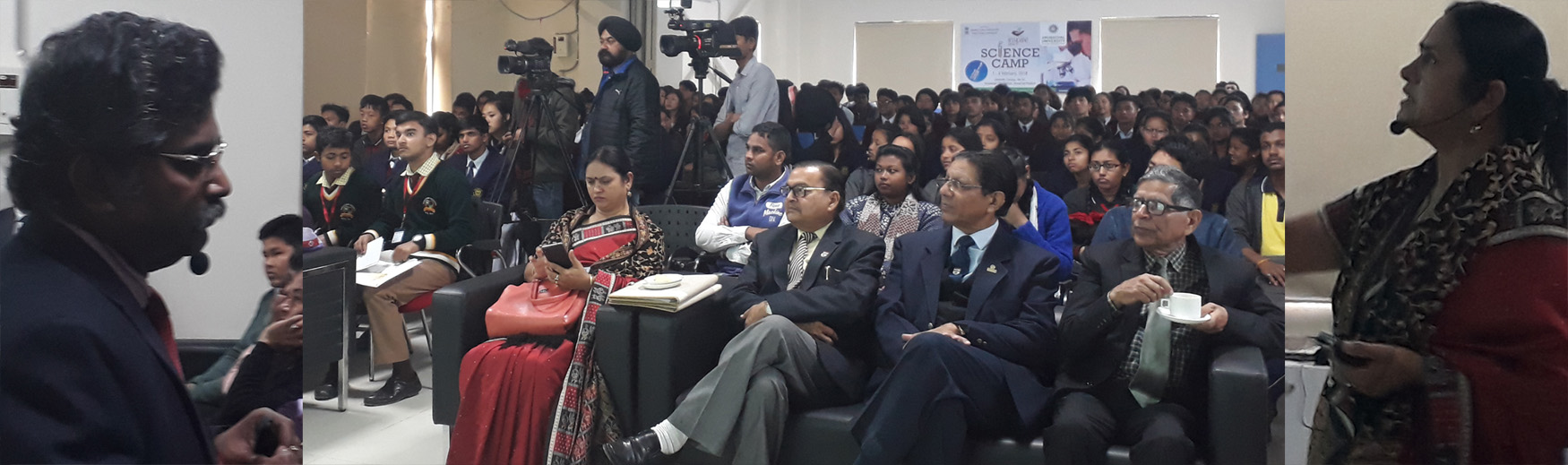
INSPIRE stirs 270 students
By A O News Service
NAMSAI | Feb 01 | India needs another Green Revolution the was such revolution in 1970 had turned the country from food crisis to a exporter, ICAR principal scientist Prof A Arunachalam said to stress the rising global importance of agriculture.
Conducting the five-day science camp in knowledge city of Arunachal University of Studies here today to help them imbibe their scientific temperament, he said “If agriculture fails what could succeed, if agriculture succeed, what could fail?”
What are the ways for sustainability are most important as the present generation lacks traditional knowledge, he said to stir their inquisitiveness. “To understand is science, he said adding, samjhoge, sikhogey, tabhi agey badhogey (You will grow if you understand and learn).
It is high time to attract the youth to agri-horti sector, he said toeing the appeal of Deputy Chief Minister Chowna Mein on Thursday to ICAR to focus to tap the huge potentials of this state, known as of the 10 bio-diversity hotspots of the world.
Addressing 270 students of Namsai, Lohit and Lower Dibang Valley districts joined the residential camp, themed Innovation in Science Pursuit for Inspired Research (INSPIRE), sponsored by S&T department of Union S&T Ministry, he said that India would be youngest nation of the world with highest 18-31 population by 2050. The energy of these human resources has to be channelised to raise agri-horti productivity.
Indian Basmati rice sold for Rs 1100 per kg and its turmeric are globally known though the issue of genetically modified food (GMF) is the agriculture buzz across the world, he said.
Responding to a question – how to create interest in agri science among students? – from Tezu KV Ria Doloi of Cl-XI, he said that the GoI has been spreading awareness programmes besides conducting talent hunt to attract talents in the field.
When asked by this editor – Why research is not conducted to popularise high productive and testy rice species of Pasighat, Ziro, Anjaw and Namsai districts? -, Dr Arunachalam said that agriculture is a state subject. The Agriculture & Horticulture College of Pasighat and Basar ICAR should take the lead, he suggested.
Moreover, ‘I as a scientist have enlisted 111 high productive rice species of this state and if one is successfully cultivated would serve as a boon to raise productivity. Present time demands expansion of cultivation area which Arunachal lacks for which the solution is to add value to traditional varieties and cultivation methods,” he said with conviction.
“Everything is achievable with desire. If you desire you should work to deserve for success,” said Doon University dean of school of environment & natural resources Prof Kusum Arunchalam before giving a talk on relevance of environment for survival of humanity.
Responding to a question from this editor as to why water of the Ganges or Ganga is holy and never gets polluted for long time, she said that parasites are formed when the water falls from higher reaches at Gomukh, foot of Gangotri Glacier at an elevation of 12,769 ft forming bacteria phage which kills all destructive bacterias to allow Ganga water to remain pure, she clarified, adding parasites affect every form of life, including all animals, plants, and even bacteria.
AUS vice chancellor Prof V K Kawtra, energised the students by announcing that AUS has signed MoU with Maijeo University of Thailand for students and faculty exchange programme. Moreover, another MoU would be signed with a Japanese varsity soon, he added.
The AUS, a brainchild of World Education Mission president Dr Ashwini Kumar Agarwal and chancellor Kamal Lochan Agarwal, has not only become a global varsity but facilitating its students to fly anywhere they wish, to the thunderous applause of the students.
The chancellor exhorted the students to match their steps with present fast changing world, lest they leg behind. “Distinguish between good & bad and change your attitude to achieve success in life,” he added.
University Inter-linkage Cente director-cum-organising secretary of the event department head Prof Trilochan Singh said that resource persons, mostly scientists, would to conduct the camp, an annual event being and take the students to physics, chemistry, zoology, botany, agri & computer sciences. Moreover, it would seek feedback from the students on judge the mentor, about the event, arrangements, any improvement and suggestions.
Academics director Prof Setuma Rawal, earlier informed that the students divided into groups, would be given practical demonstration in various laboratories to gain practical knowledge.
A Pali dictionary was released by chancellor to mark the occasion.
India once known for its Krushi baniya was exporting rice then, but now onion is being imported, said Bhante Panna Sera, coordinator of Buddhist Studies here, adding present S&T advancement could help tap vast potentials of this Himalayan state.


 20
