
Tama Chung Chung has unique distinction
By Pradeep Kumar
Brave Shere Thapa of Indian Army’s 2 Jammu & Kashmir Rifles hiding in a very advantageous position went on firing nonstop as his lone soldier-mate continued changing the carbines. His light machine gun boomed relentlessly. One after another unsuspecting Chinese solider got killed and fell into Ngo River without anyone to count. The day was October 18, 1962.
People Liberation Army of China had sneaked through the Tama Chung Chung ridge. Thapa had positioned himself at a vertical slope – invincible high mountain ridge on one side, steep slope down to Ngo stream, source of Subansiri River, on the other side. He had located the most strategic place, either to stop or kill the advancing Chinese soldiers.
Thapa did not notice anymore Chinese after emptying all magazines with the fired brash khokas lying scattered. He confidently came out of his bunker for a recce. Death was waiting for him. He peeped towards the heap of corpses with great satisfaction. A wounded but alive Chinese solider lying on the heap along with his colleagues fired, killing him instantly. China withdrew its forces after cessation of firing, following 29 days (Oct 18 to Nov 16, 1962) of fierce battle, leading to the humiliating defeat of the Indian Army.
Political interpreter Chader Mangha along with many villagers, who carried supplies, arms and ammunition for Thapa’s Army section, were witness to his bravery. Mangha, who died in 1994, was given a commendation certificate by the GoI in recognition of his service to the nation and promoted to the rank of political assistant. He had also narrated the entire episode to his daughter Yating Byaling a resident of Gosing Taying village under Taksing circle, wife of senior lawmaker Tanga Byaling. Byaling also vouch of the bravery of Thapa and the village folk.
Even the Chinese had respectfully buried him and left a small note praising his bravery. Why none ever bothered to honour his brave act, even posthumously is intriguing?
Villagers inhabiting the Indo-China border claim that the PLA had sent its troops through passes, including Taksing, Mechuka, Anini, etc where the forces camped waiting for orders. Supply line was cut off following retreat order which never reached the duo. Left with no food and insufficient ammunition, they feared any eventuality and decided to fight till death. Thapa sacrificed his life in Middle sector (Upper Subansiri district) while protecting Mother India. His mortal remains were brought to Lemiking, last rites performed and a grave built there. The neglected grave and a bridge named after him are evidences of his heroism.
“The first bridge, named after soldier Shere Thapa, with a 600m steep climb….” is the reference about him with picture of his grave found in ‘Secrets of Subansiri, Himalayan Club, recoding the 2005 expedition report by a group of trekkers to famous Buddhist pilgrimage Takpa Shiri; Arunachal Expedition – Takpa Shiri; In Search of Old Pilgrimage Route to Takpa Siri 2005 and India 2005 – Alpine Journal.
Septuagenarians in border villages still recall their unforgettable memory when Chinese forces appeared on the horizon of the high hills. They could not understand anything as Indian soldiers used to be occasional visitors, friendly with them and take their help for reconnaissance of the border areas. The same practice continues even today as was told by the war veterans of Kibithoo area. Septuagenarians Menjum Meyor and Thega Meyor of Anjaw district’s Kaho, the last Indian village located on Tibet-Burma-India tri-junction, had assisted the Indian Army in digging trenches, carrying arms and ammunition, escorting them for maintaining surveillance when the Battle of Walong was fought at Namti. During an interview, they had admitted continuing do so even today, but their services during the war were neither recognized nor remunerated. Their plain speaking begging with ‘Jai Hind’ reflected patriotism: “We do not recognize anyone as our forefathers were living in India and we have followed suit. We are son of the soil.”
Shockingly, 75-year-old Mayaso Pul had lost his left hand after ammunition carrying on shoulder got accidentally ignited. He regretted while talking to me: “Neither was I paid any remuneration nor any certificate given to me as a freedom fighter, though I have become handicapped for my life and living in penury.”
I presumed that martyr Shere Thapa, Pul and Mayors might not have a god father or a senior Army officer to recommend their brave act. But with facts surfacing, it is still not late to honour them as I wrote on 18.10.12: Oh ungrateful India, salute 50-yr old Sino-India war hero Shere Thapa!
The BRO’s accomplishment proves the importance of Gelemo to transport men and materials for national defence, whose absence was one of the greatest drawback during 1962 posing challenges for Indian Army.
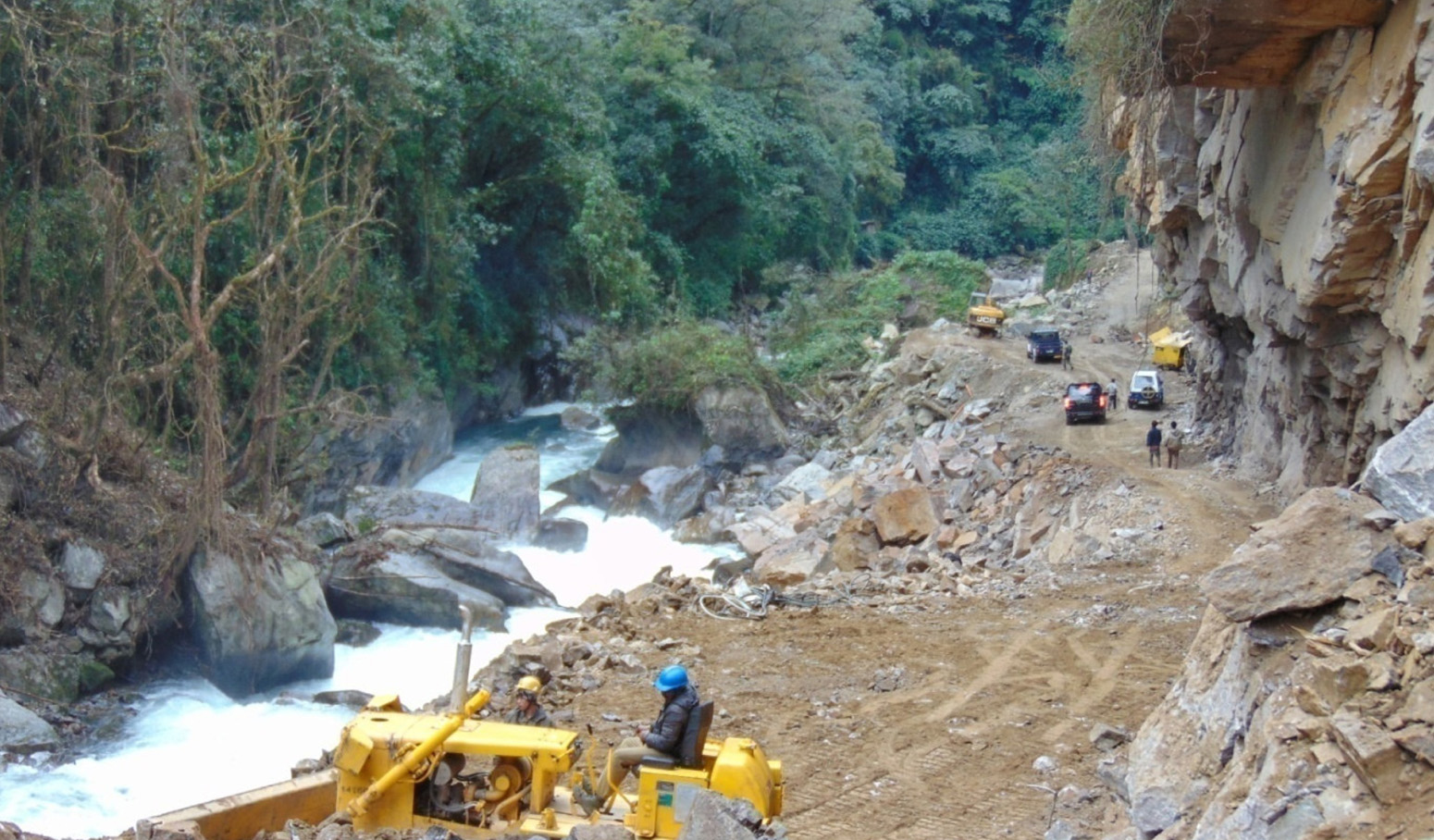
ITANAGAR | Feb 13 | The Border Roads Organisation (BRO) has connected operationally critical road ahead of Limeking on Tama Chung Chung (TCC)-Maza axis along Indo-China border recently.
The BRO with its motto “Creates, Connects and Cares (Shramena Sarvam Sadhyam) inked history with this landmark achievement of connecting TCC with Bidak, about 25-km away. A BRO team led by Project Arunank CE, 23 BRTF commander, 128 RCC OC, among other officers, drove in a 4X2 vehicle from Limeking to Bidak in two hours that day to assess the road status, according to BRO sources.
Work on critical TCC-Bidak road, commenced in 2009, has been executed against formidable challenges, including difficult and inhospitable terrain, inclement weather conditions with unpredictable rains for almost eight to nine months in a year, dense vegetation, thick undergrowth, jagged & steep mountains with near vertical mountain slopes & turbulent River Tsari Chu flowing along the alignment.
Though the BRO is adept in working under similar challenging conditions since inception, the challenges on this particular stretch of road were unique and difficult to handle by the tough job was accomplished. This could be possible due to persistent painstaking efforts by engineers and personnel 128 RCC/HQ 23 BRTF and with strong support of Project HQs for last two years.
The task entailed establishment of on air maintained detachment at Gelemo and air lifting all the construction equipment and vehicles after dismantling them. These included heavy excavating machinery, drilling machinery, heavy earth moving equipments like dozers and vehicles.
Indian Air Force played a major role by providing air lift. Smaller equipment, like compressors, fuel, explosives & rations were transported with manual labour on many occasions when air lifting was not possible due to inclement weather. All equipment had to be reassembled at the other end. BRO personnel along with casual labourer camped in tented accommodation for months together and even survived off the jungle.
A major boost was given to the effort in 2017 by launching first single span 200-feet Bailey bridge over formidable Subansiri River on 24.10.17 which opened a new attack point. Despite the huge challenges, the indomitable spirit of BRO personnel, commitment and high morale ensured completion of the task but at the cost of lives of four personnel during the construction. Thus, the BRO pays homage to them for their great sacrifice for the cause of the nation. Moreover, two dozers, large number of vehicles/construction equipment were also lost.
This has evoked appreciation from civil administration and the public, particularly for 128 RCC/23 BRTF, and the road of course added yet another feather in the cap of “TWENTY THREE…ON WINNING SPREE”, while it continues to strive for nation’s security with commitment to Arunachal Pradesh development, the sources added.


 20
