Beyond the Horizon
By Pradeep Kumar
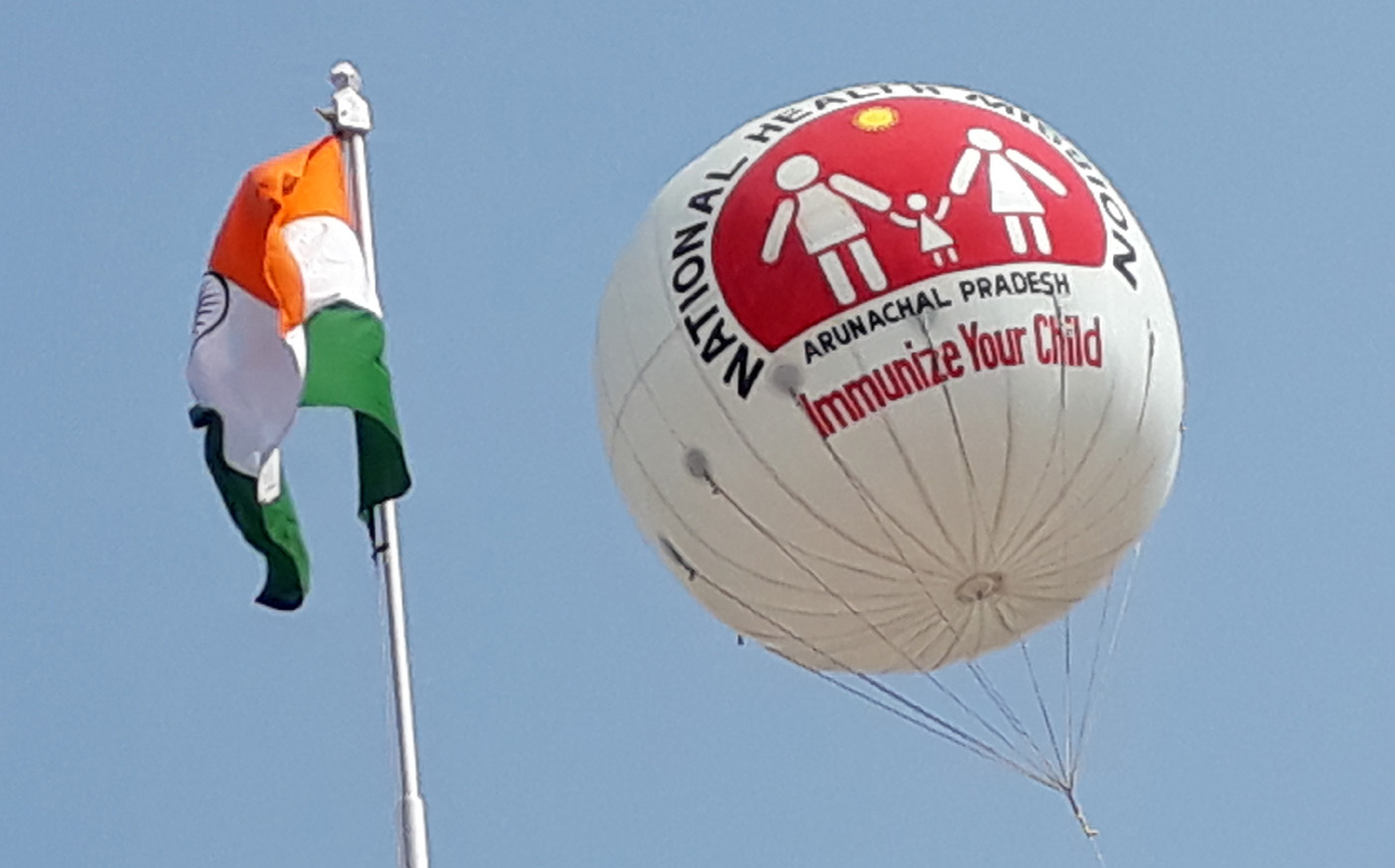
The tri-colour flip-flopped since its hoisting on February 20 at IG Park here but National Health Mission air balloon inscribed with ‘get your child fully immunised’ sending a louder message ‘health is wealth’.
Though the state Govt has attached ‘no tolerance policy’ to health and education sectors, but the health care delivery system is still in dismal condition in this land-locked state. Lacks of facilities, shortage of doctors and medical staff, inadequate number of hospitals and non-avialibity of medicines are common, leaving the people to fend for themselves. Governor Brig (Retd) B D Mishra is justified in his suggestion to the state Govt to move the Centre to get doctors including specialists on deputation to meet the acute shortage in the state.
India had only 938,861 registered allopathic doctors or just seven doctors per 1,000 people, according to a report released by health minister J.P. Nadda on 23.11.15, as reported by livemint.
The report, prepared by the Central Bureau for Health Intelligence (CBHI), states Maharashtra and Bihar have the worst doctor to patient ratios, with each doctor serving 27,790 and 28,391 patients, respectively. Chhattisgarh is a close third with a doctor to patient ratio of 1 is to 25,032.
The number of qualified allopathic doctors registered with state medical councils or Medical Council of India (MCI) nearly halved to less than 16,000 in 2014. The data for 2014 is provisional. The number of registered dental surgeons, on the other hand, has been on a steady rise since 1994. In the capital, each allopathic doctor serves 2,203 patients while a dental surgeon caters to 64,398 patients.
India also has 154,000 dental surgeons and 737,000 Ayush doctors, meaning those that practise alternative medicine systems such as Ayurveda and Homeopathy, according to the report. India’s 400 medical colleges produce approximately 47,000 doctors each year. Maharashtra had the highest number of registered doctors at 148,575 closely followed by Tamil Nadu at 102,328 while Arunachal Pradesh had the least at 510.
One government hospital bed serves 1,833 people on an average. The worst ratios are in Bihar (8,789) and Jharkhand (6,052). According to the report, there are 20,306 hospitals which have 675,779 beds in the country. There are 183,602 beds in rural areas and the urban areas have 492,177 beds.
The Centre’s share of public expenditure on health, which has been extremely low as a share of its GDP, has fallen over the last two years. Among all states, undivided Andhra Pradesh had the highest public expenditure on health in 2012-13.
The state also has the highest number of auxiliary nurse midwives (ANMs) – 134,694- working while the number is a dismal 641 in Arunachal Pradesh. The seven states in the northeast and Goa spent the most on health per capita while Bihar and Jharkhand spent the least.
Out-of-pocket private expenditure on health has risen steadily over the years, with the cost of medicines, followed by that of hospitalisation accounting for the largest share of the household expenditure. Amongst states, Kerala spends the most privately on health.
There were only 4.8 practising doctors per 10,000 people in India in 2014 and to achieve a modest doctor-to-population ratio of 1:1,000, India will need 2.07 million more doctors by 2030, according to a study published in the Indian Journal of Public Health, in September, 2017, livemint had reported on 28.11.17.
The study titled Aggregate Availability of Doctors in India: 2014-2030, conducted by the economics and business policy faculty at the FORE School of Management, used Medical Council of India’s (MCI) historical data from 1960-2015 on registration stock of doctors obtained from Indian medical registers. Also, it accessed other data on emigration of doctors from the Organization for Economic Cooperation and Development and destination country sources.
According to the WHO and Union Health Ministry, India has seven doctors per 10,000 people. The research paper found that there were only 4.8 practising doctors per 10,000 people available in India in 2014.
“As per the availability of practising doctors in India for 2014, the latest year for which data are available, there were 600,031 doctors available for practice in India in 2014 to serve its 1,239 million (1.239 billion) population with a doctor-population ratio of just 4.84 per 10,000 people in contrast to the government data,” the study said.
The research has also highlighted that given these findings, and the prospects of the numbers increasing over the next 15-year period, it looks like an impossible task to achieve even a modest doctor-population ratio of 1:1000 by 2030, by when the population is estimated to reach 1.476 billion.
“The current availability of doctors data in India is based on the registration stock of doctors accumulated since the early 20th century. This has not been adjusted to attrition of the strength occurring due to retirement, emigration, etc. Rest of the registered doctors have either retired or emigrated from the country to practice abroad. It is estimated that the country would be able to achieve a ratio of about 6.9 practising doctors per 10,000 people only by 2030,” said Basant Potnuru, associate professor, economics and business policy, FORE School of Management.
Due to non-availability of data, the leakage of doctors for reasons such as those who discontinued medical practice due to change in profession, death or for any other reason during 1979-2014 (35-year period) is assumed to be zero.
“Thus, taking into account only two important causes of attrition of doctors such as retirement and emigration, the strength of practising doctors reduced by 36.5% of the stock and the doctor-population ratio slipped from 7 to 4.8 per 10,000 people,” said Potnuru.
“Similarly, the availability of practising doctors in 2030 will be based on the estimation of the stock and attrition due to retirement and emigration. If the registration stock of doctors continues to increase at the rate it has increased in the last two decades, the availability of practising doctors in 2030 will be 1,018,008, after deductions made for retirement and emigration of doctors,” he said.
Why is the health sector so miserable and where the fault lies? — Is the Govt not paying adequate attention and not allocating required funds? Are those health managers acting irresponsibly leading to the dichotomy?
Someone has to call ‘a spade a spade’ to bell the cat to take the health sector to its much desired level. But who is a vital question? Wake up Arunachalees … wake up!


 20