
Help revive Stillwell Road
for Arunchalees to dream
ACCI spokesman Toko Tatung, flanked by chief adviser Pradeep Kumar and GS Tarh Nachung, sought revival of historic Stillwell Road (Ledo to Kunming) via Pangsau Pass to make the state window to South East Asia where 50% of world’s rich live. The road in tune with Act East Policy would facilitate fast growth of trade and commerce encouraging the Arunachalees to dream for a better future.
Moreover, the Arunchalees are not land owners but only protectors as the state is under 5th Schedule of the Constitution for which the GoI is owner of all mineral resources unlike Meghalaya, Nagaland and Mizoram, which are under 5th Schedule of the Constitution to earn royalty themselves. He pleaded for constitutional amendment to bring Arunachal Pradesh under 6th Schedule to make Arunachalees land owners.
By A O News Service
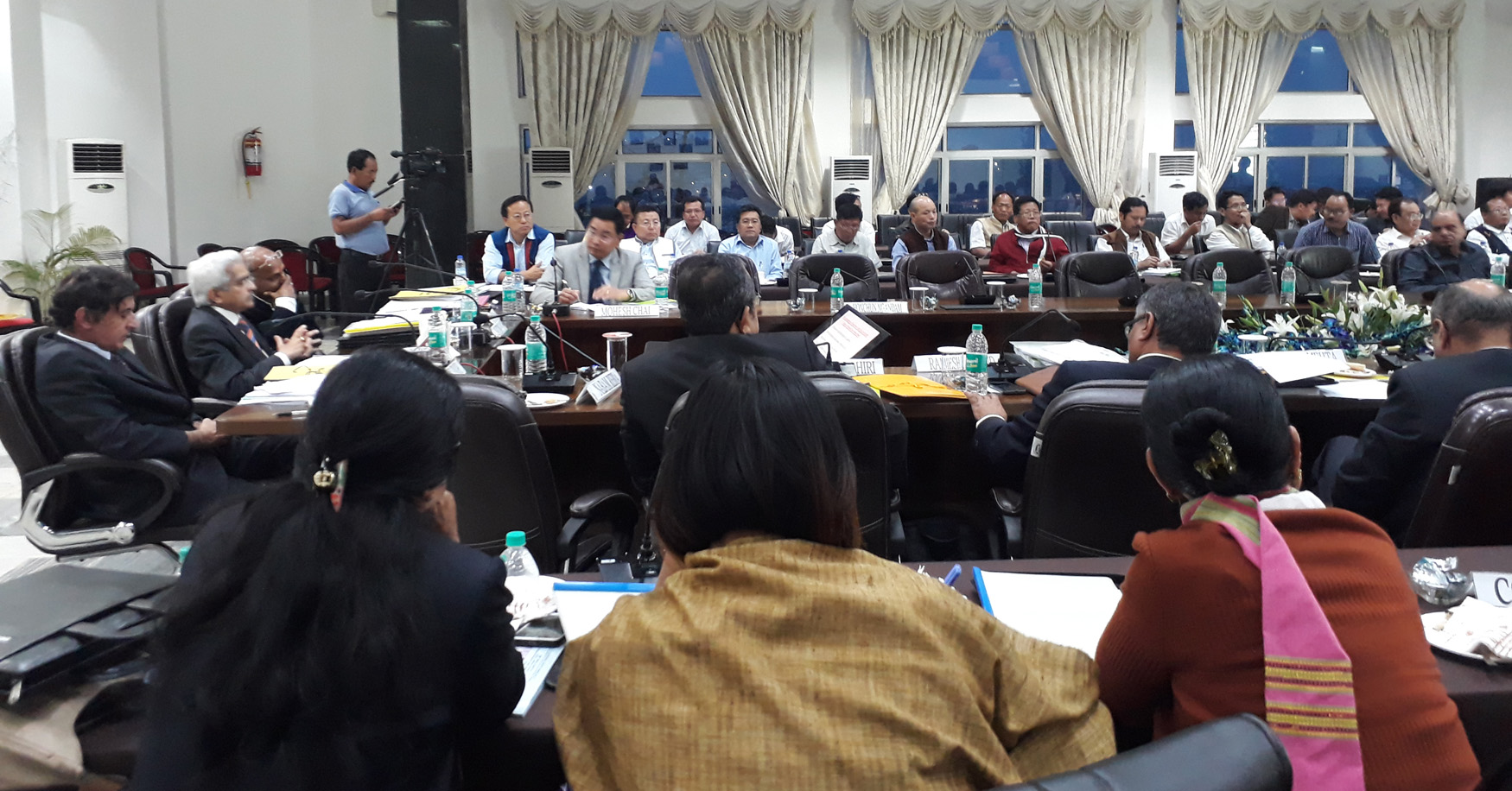
ITANAGAR | Apr 06| Arunachal Chamber of Commerce & Industries (ACCI), in its memorandum to 15th Finance Commission (FFC) chairman, highlighting infrastructure deficiencies, said that suitable funding criteria is panacea to turn treasure trove Arunachal Pradesh as food bowl and help meet India’s fuel needs for next 100 years.
The ACCI, state’s supreme traders’ body, affiliated to Confederation of Indian Industries (CII), has been working to supplement efforts of state and central Govts to expand trade and commerce sector as every living being from a beggar to President of India is basically a consumer of goods and services.
Rainbow state Arunachal Pradesh, 14th largest state of India, is spread in 83,743 sqkm area and inhabited by about 14 lakh people with 17 per sqkm density, 82% forest coverage inhabited by over 200 mammals species (highest diversity in India). But Neolithic tools date back to approximately 11,000 years have been found in the state, known as the ‘Land of the Rising Sun’ or ‘Orchid State of India’ or ‘Paradise of the Botanists’ or ‘Future Power House of India’, with highest number of regional languages in Indian subcontinent and unique indigenous cultures, for which development poses a great challenge.
This eastern most frontier state 18th (0.617) in Human Development Index (HDI assessed in 2005) paints a most peculiar scenario in national map as its people are still ‘prisoners of nature’ being a hidden land still as it remained unadministered till creation of North-East Frontier Agency in 1954 to come under Union Home Ministry. The wound of 1962 Sino-Indian war is still afresh. Though, China withdrew back to McMohan Line that demarcates border between two nations but the border-trade with Tibet was terminated.
Border trade: Those living in far-flung border areas struggle to earn their livelihood and have been migrating to urban areas for which the GoI has decided to develop 18 border villages as model ones with all basic facilities at the initiative of present Governor Brig (Retd) B D Mishra. Trade & commerce department, in a memorandum on 15.05.06, had urged the CII to influence the Centre to reopen border trade with Myanmar, China and Bhutan as such trade has been going on for ages with those neighbouring counties. Arunachal has vast potential for export and import which could be possible if CII motivates the Centre to realize the reality, the memo added.
Belated development: Infrastructures are prerequisite for any development but belated process justifies shocking disclosure of former deputy Prime Minister Shri L K Advani in his public address at Itanagar on 14.11.03 and in 2005: “Delhi had decided not to develop Arunachal Pradesh after the 1962 Chinese war, fearing it could benefit the neighbour (China). It was a historical blunder”.
PDS still a nightmare: The central policy to air drop food items is still a mirage as people are left to fend for themselves. Thus, barter trade, born with the civilization, still continues in the state as seen in above 2016 picture. A group of people from Damin carrying bags with commodities had crossed through tough snow-clad mountains to Tibet for barter trade to collect essential for their survival. They are forced to adopt such age-old practice as public distribution system is yet to penetrate to their villages in Upper Subansiri district. There are still many air-fed areas where essential PDS commodities fail to reach even 70 years after independence.
In many air-fed areas of the state, ration items are carried back load (officials called head load) for days together. The porter carry about 50-kg rice and consume about 20-kg in three days on way to the destination. Arunachalees relish salt but it costs Rs 150 per kg after physical transportation, which had prompted local media to write: Arunachal needs a salt movement on 26.03.08 to highlight the crisis.
Border villages like Taksing & Damin, (Upper Subansiri district) Mechukha & Manigong (West Siang) and Vijaynagar (Changlang) are bereft of basic facilities including road, electricity, medical and education facilities even though the present central Govt has announced to develop infrastructures on this side of the border matching with the other side of the border. Regrettably, a bag of cement costs Rs 8,000 at Vijaynagar.
Travelling up to Indo-China border is tough for lack of road. Gypsy and Scorpio, fail to travel 45-km road from Tawang to Bumla along Indo-China border while Land Rover travels on the other side of the border at 60-km speed. It is clearly visible in above picture from Bumla, located at 15,200-feet whose average temperature during winter goes below -150. Army personnel guarding the border in Zemithang in Tawang district live in tents like a war zone, while face to face on the other side Chinese Army personnel live in multi-storied RC building.
Funding criteria: Despite being “the sentinel of the country because of its strategic location,” the GoI’s universal fund allocation criteria failed to break the isolation syndrome of this hilly state for lack of special attention. Huge hidden and visible natural resources of this nature’s trove are still untapped for lack of infrastructures – road, railway, air and telephone connectivity and market linkages.
Treasure trove: Arunachal enjoys the distinction of largest kiwi producing state in India and annually produces an average of 30,945.2 MT of apples, 4,720.5 MT of kiwi, 1,76,707 MT citrus and 67,580 MT of pineapples.
Arunachal Pradesh Horticultural Produce Marketing & Processing Board (APHPM&PB) had inked a MoU with Pune-based Hill Crest Foods and Beverages Pvt Ltd in December 2013 to ink record to produce Arun Kiwi Wine. The state Govt had funded 18, 84, 000 for the project to offer over 2.5 tonnes of kiwi for brewing the wine.
Wakro, state’s citrus bowl in Lohit district, produces huge quantities of citrus fruits, bananas, pineapples, spices and oranges boosting the economy of local inhabitants. But lack of market linkages and communication difficulties had prevented such products to reach the national market to benefit local farmers. Some orange orchards in Wakro are auctioned for Rs 8 to Rs 10 lakh to foreign traders, including from Bangladesh. Rail link could encourage commercial production and facilitate the products to reach the regional and national market. Moreover, an effective mechanism once developed could turn agriculture-horticulture sector a money spinner for this agrarian society.
Krishi Karman Award: This national award was won four consecutive times with higher cash reward reflecting the tremendous growth in food grain production in the state. Launching of CM’s Agricultural Mechanization Programme by former CM Tuki gave a new thrust to the sector.
End middlemen: But, progressive farmers are not getting remunerative prices because of middlemen. Sourish Bhattacharya report in India Today’s 10.03.16 edition is the proof: “Over the last three years, Puneet and Ishira have seen Arunachal’s kiwis struggle to gain a toehold in national market. Ironically, there are no takers as long as they’re identified as locally sourced and cheaper to boot. Fruit wholesalers therefore have hit upon a novel idea, as Puneet and Ishita have discovered, to clear domestic kiwi stock and make more money. They sell them under a foreign label at prices commanded by the imported fruit. Does that benefit Arunachal’s kiwi farmers? Well, the market subterfuge does ensure their stocks don’t remain unsold, but do they benefit from the higher prices their produce now commands? No way!”.
Industrial policy: The CII deputy director general S Sen and member Chris Cajee during a meeting with the ACCI at Itanagar on 15.05.06 had advocated a pragmatic industrial policy with lucrative incentives to woo outside investors to harness state’s huge potentials to boost its economy. The duo had stressed on speedy improvement of road, railway, air and tele communication and infrastructure as transportation, accommodation, marketing and packaging could help Arunachal take over Himachal Pradesh in tourism sector.
Religious tourism: Kolkata-Parsuram Kund package could attract huge pilgrims from far and wide to Arunachal as a dip in the Kund of Mahabharat age was considered holy by the Hindus. Rail link would be a milestone to boosting tourism industry.
About one lakh pilgrims from Nepal and Bihar come to Parsuram Kund during Makar Sankranti annually. In 2007, Railway Minister Lalu Prasad Yadav, responding to an ACCI memorandum that broad gauge railway link from Tinsukia to Parsuram Kund in Lohit district, Malinithan in West Siang district could boost tourism sector, had announced fund for survey for railway line. ACCI memorandum read: “Your personal attention, particularly as a descendant of Lord Krishna, would materialize the railway project and boost high potential tourism sector of this Himalayan state, known as the last Sangri-La on the earth”. In fact, Parsuram Express between Kolkata to Tinsukia during Makar Sankranti was introduced but discontinued later.
Foreigners: The much talked about ‘Look East Policy’ (LEP) had not paid economic dividends to the region and it was been realized that development of infrastructure, connectivity were needed to link the booming economies of South East Asian (SEA) with the region. The Centre held a high-level meeting in October in New Delhi with chief ministers of the NE states to focus on finding practical ways to translate the LEP into a reality to boost development.
China is India’s top trading partner in the world, while New Delhi mandarins have not learnt any lesson from trade imbalance. Interestingly, foreign countries placing orders with Tripura for bamboo and cane products worth crores and a Chinese collaborative venture had set up Rs 100 crore factory at Chayagaon Industrial Growth Centre near Guwahati to produce tractors, power tillers and motor cycles to meet the requirements of NE, investment in the region.
Had India joined the development process of SEA, the prediction of Goldman Sachs that the BRIC (Brazil, Russia, India and China) economies can together be larger than G-6 (USA, Japan, Germany, France, Italy and UK) in less than 40 years (Dreaming with BRICs: The path to 2050, October 2003) would have advanced by at least two decades – as predicted in local daily on 19.01.09.
Work culture: Arunachal Pradesh led by dynamic young Chief Minister Pema Khandu is trying hard to get rid of obnoxious adage ‘Arunachal is a land of ‘khusi khusi’ with adoption of work culture with a stern warning “perform or perish”. No government can provide employment to all the job seekers though the number of white-colour job seekers is on the rise. There are innumerable entrepreneurship development programmes for which huge sums are being pumped in under various heads by the central government and its agencies. Regrettably, there is no system to monitor the outcome aimed at creating employment avenues.
Itanagar had found a place among nine cities in the ‘invest-in index’ of India in an all-India survey which published in on December 2007, followed by Guwahati by beating Mumbai in mopping up corporate taxes; and real estate developers’ attempt to develop a hotel at Itanagar, had indicated investment flow into the NE, Arunachal in particular.
GDP: The NE alone possesses all the ingredients to push the country’s GDP growth upward, if we realize and act now in tune with New Delhi’s vision. The fast changing scenario of NE region, poised to open up to SEA, home to 50% of the world’s rich, is in tune with the Centre’s ‘Look East Policy’ (LEP), rechristened as Act East Policy.
Stillwell Road: Eyeing to boost India’s strategic and economic ties with SEA nations, Prime Minister Manmohan Singh, during his visit to Myanmar on 01.06.12, had told in Yangon: “Better communication is the best way of promoting economic integration and there is much we can do to revive and build arteries of communication.”
The SAARC Marketing for Electricity, a strategic Indian initiative, joined by Nepal, Bangladesh and Sri Lanka, is envisaged on the lines of the Nord Pool in Scandinavian countries and West African Power Pool which bodes well with Arunachal Pradesh’s ambition to turn ‘power hub’ of India with its 57,000 MW potentials.
The historic 1726-km Stillwell Road from Ledo in Assam to Kunming in China built against all odds by Gen Joseph Warren Stillwell, Chief of Staff to Allied Forces in China-Burma-India (CBI) theatre, to liberate Burma from the claws of Japanese during the World War II.
But border trade with Myanmar was thriving breaking boundary as seen at Pangsau Pass. SEA’s gateway, Arunachal Pradesh, decided to develop the 32-km Jairampur-Pangsau Pass road and open border trade centre (BTC) at Nampong. India’s China fear was responsible in turning the road passing through the dense hills safe passage for numerous NE insurgents for to and fro journey to their camps deep inside Myanmar, which under Junta rule and China’s covert support to UG groups was a serious threat. The 20-km road up to Nampong was renovated at the imitative of then governor Gen (Retd) JJ Singh.
But this state is yet to encash its potentials. The prime requirements are: 1) Fare weather road connectivity, reliable railway, air and telecommunication services; 2) Foolproof security to investors; 3) A pragmatic industrial policy; 4) A mechanism to end middleman ship to protect progressive farmers and 5) Airfreight to Kolkata, Delhi and Mumbai for all horticulture produces be subsidized by 75%, like passenger fare for the farmers to get higher prices. Moreover, Arunachal is only state which has recorded 12 helicopter accidents during 1995 to 2017, the highest in the country. Thus, considering the tough terrain and necessity to fly choppers, a helicopter training institute should be set up in the state.
Thus, the ACCI makes a fervent plea to the FFC to consider the above requirements and allocate adequate funds for fulfilling the needs, essential for socio-economic development, the memo added.
Suitable funding criteria panacea to turn Arunachal Pradesh food bowl of 100
By A O News Service
ITANAGAR | Apr 06| Arunachal Chamber of Commerce & Industries (ACCI), in its memorandum to 15th Finance Commission (FFC) chairman, highlighting …https://t.co/gBss2TxQ9C pic.twitter.com/En5W8S3Pkl— Arunachal Observer (@ArunObserver) April 6, 2018


 20

