
Have relations any caste, creed, religion or region barrier?
By Pradeep Kumar
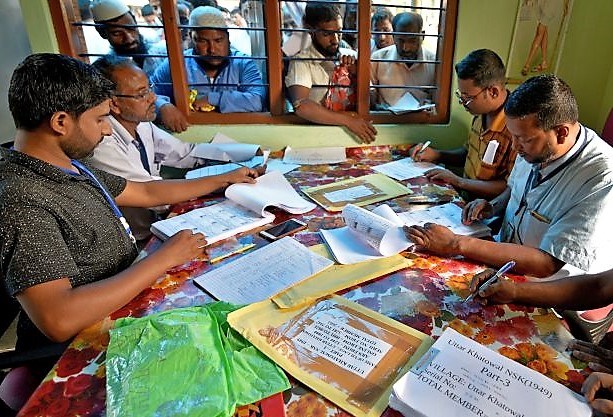
ITANAGAR, Aug 26: The National Registrar of Citizens (NRC), initiated in 1951 to end growing problem of illegal migrants in Assam, though laudable but made many natives refugees in their own land as their names were among 40 lakh found missing from the 2nd NRC draft, published on July 30 last.
Indiscriminate application to deny citizenship to over four million state inhabitants is cause for grave national concern. At one end, there have been warnings of a civil war and at the other there has been loose talk about deportations and concentration camps. There is, however, no final solution to a problem that cannot be examined without its historical, geographical, economic & political contexts.
As it resulted into misgivings creating murmuring all over the state, the Supreme Court of India on August 1 had directed authorities to not initiate any ‘action’ against 40 lakh persons left out of the draft NRC. “Well, we do not give assurances to anyone, we only pass orders. But we want fair opportunity for all,” Justice Ranjan Gogoi had observed. The SC judgment, in this case may in some quarters be treated as a judicial prelude to ethnic cleansing. The time has come for the SC, to unequivocally stand up for the last, the lost, the least, the left out and the looked over.
Marriage jeopardy: As Arunachal Pradesh was carved out of Assam, there were numerous inter-state marriages among Assamese and Arunachalees. Hundreds of Arunachalee women married to Assamese have been treated as refugees in Assam with their names missing from NRC draft under the pretext of lack of legacy of their mothers or fathers. An Assamese, who retired as EAC of Arunachal Govt in December 2017, was married to a Nyishi woman. However, both were shocked to find that her name was not entered in NRC. Does it mean Arunachal Pradesh not part of India? Will it not intensify the isolation syndrome of Arunachalees when such women covey their sentiment to their near and dear ones?
Arunachal after attaining statehood in 1987 instituted its administration. The uneducated people could not reach Govt offices for their rights due to ignorance, lack of awareness and communication bottleneck in far-flung remote areas of the state those days. Moreover, there was no land tenure and revenue system in the state till 1994 and land revenue system does not exist in interior villages even today. Electoral roll was never prepared and begun only in 1975.
However, Assam NRC authorities are not entertaining certificates, like marriage registration issued by MRO, permanent residential certificate issued by HGBs/GBs, appointed under Assam Frontier (Administration of Justice) Regulation, 1945. But they are insisting on the electoral registration of 1971 of fathers of Arunachalee women to prove their legacy which can never be produced.
This process would deprive innocent Arunachalee women married to Assamese serving in Arunachal long ago from their rights leading to discrimination in the society in the same democratic country which is untenable.
Arunachal was part of Assam: Interestingly, in 1914, some tribal-majority areas were separated from the former Darrang & Lakhimpur districts of Assam province of British India to form the North-East Frontier Tract (NEFT). In 1919, the Central and Eastern Section was renamed the Sadiya Frontier Tract, and the Western Section was renamed the Balipara Frontier Tract. In 1937, Sadiya and Balipara Frontier Tracts along with Lakhimpur Frontier Tract (also created in 1919) of Assam Province came to be known collectively as the ‘Excluded Areas of province of Assam’ under the provisions of Government of India Act, 1935. By Regulation 1 of The North Eastern Frontier Tracts (Internal Administration) Regulations 1943, Tirap Frontier Tract was created by amalgamating certain areas of Sadiya and Lakhimpur Frontier Tracts.
The Assam Frontier (Administration of Justice) Regulation, 1945 was made by Assam Governor with powers vested on him u/s 92(2) of Govt of India Act, 1935, a landmark step in NEFA history. After the independence of India in 1947, NEFT became a part of Assam state. In 1951, Balipara Frontier Tract, Tirap Frontier Tract, Abor Hills & Mishmi Hills districts Naga tribal areas were renamed as North-East Frontier Agency (NEFA). NEFA became a UT on 20.01.72 and state on 20.02.1987.
Genesis of illegal migrants: The Assam areas went from being administered by a chief commissioner to being added in 1905 to newly created province of East Bengal and Assam with its capital at Dacca. It emerged as a separate province with its capital in Shillong in the 1912 reorganisation of Bengal. At the time of independence and partition, the Sylhet district of Assam province opted by a referendum to go with East Pakistan, while its Hindu majority, Barak valley opted to stay with India. Some Muslim majority districts like Dhubri, which controls access to the chicken-necked NE were persuaded to remain in India by the sagacity of Assamese statesmen like Gopinath Bordoloi.
When Pakistan began to crumble into two halves after its elections of 1970, the West Pakistan Army began a crackdown on East Pakistani dissidents. Millions fled as refugees to neighbouring India, primarily to the states of West Bengal and Assam. On 25.03.1971, Pakistani Army crackdown on Dacca University, and the massacre therein led to events that culminated in the emergence of the new nation of Bangladesh. Shiekh Mujibur Rehman and Indira Gnadhi signed an accord, enabling the return of Bangladeshi refugees who had migrated to India post March 25, 1971.
The compendious NE areas of India were also reorganised in December 1971 with the passing of the North-Eastern Areas (Reorganisation) Act, 1971, Act No. 81 of 1971, which provided for the establishment of Manipur and Tripura states, and for the formation of Meghalaya state and Union Territories of Mizoram and Arunachal Pradesh. Thus, the present Assam emerged only in 1971 and having boundary dispute with Arunachal Pradesh and Nagalang.
While commonality of language ensured an assimilation of Bengali refugees in West Bengal, in Assam they were seen as ensuring Bengali dominance. The ruling Congress was seen as being backed by a voting troika of Ali (Muslim) coolie (tea plantation labour) and Bengali. Assamese and Ahom identity issues began to simmer particularly after 1971. This led to a state-wide student movement called the Assam Agitation, which lasted six years (1979 to 1985). A special law for the State of Assam, i.e. the Immigrants (Expulsion from Assam) Act, 1950, was enacted soon after the Constitution came into force, even before a citizenship law had been drafted for the rest of India.
The danger ahead: Eligibility to be included in the updated NRC would be ascertained based on the 1951 NRC, Electoral Rolls up to 1971 and, in their absence, certain admissible documents issued up to the midnight of March 24, 1971. More than 50,000 people have been employed for the updation process. Over Rs 12 billion of public money has been spent on the exercise. At first blush, the process for updation looks meticulously designed. The devil, as ever, lies in the detail.


 20

