
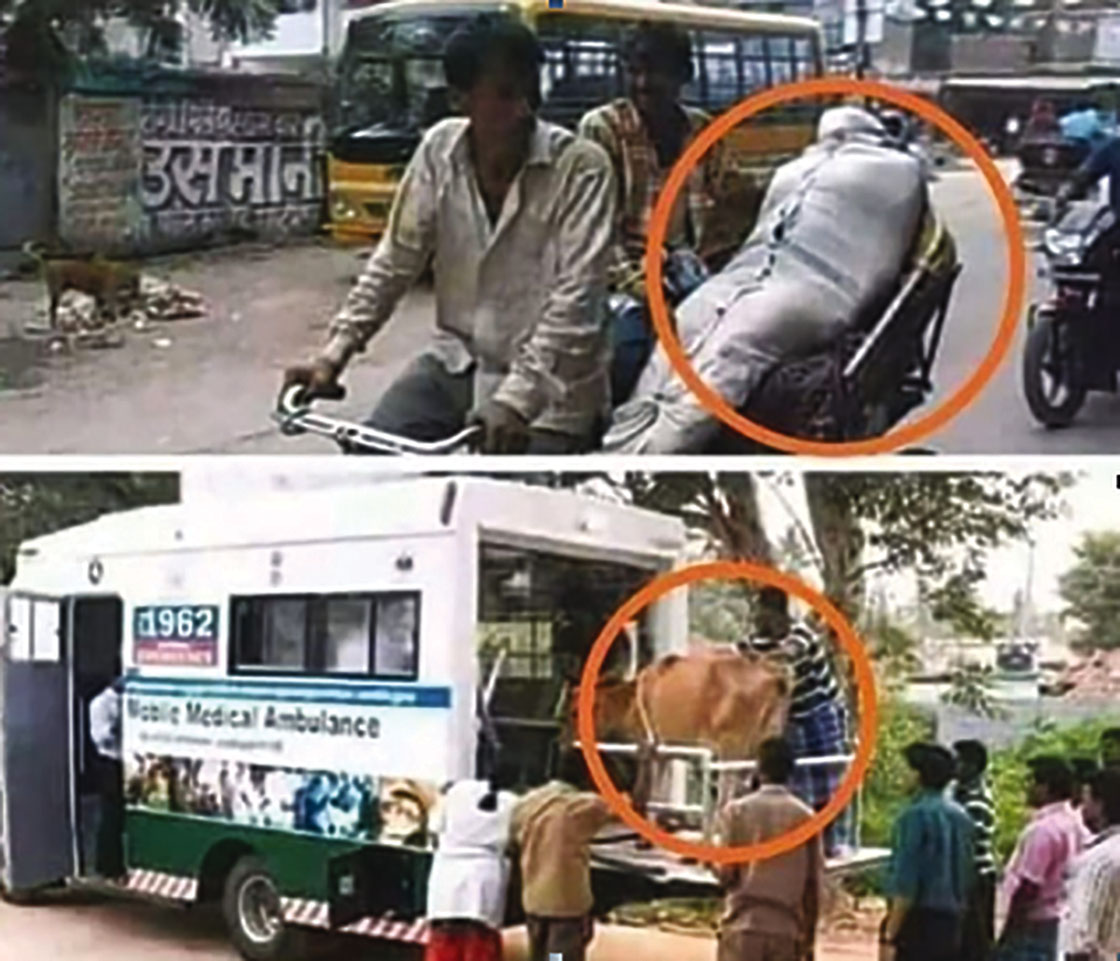
Poor Vs cow: India’s 1/3rd live in poverty
Beyond the Horizon
By Pradeep Kumar
The world had 872.3 million people below the new poverty line, of which 179.6 million people lived in India, according to a revised methodology. In other words, India with 17.5% of total world’s population, had 20.6% share of world’s poorest in 2011.
But, interestingly innocent people are lynched in the name of protection of cows which has been evoking protests from various quarters. Breaking his silence on the recent spate of lynchings carried out by cow vigilante groups, Prime Minister Narendra Modi on 20.07.17 said that killing in the name of the cow is unacceptable. ““Killing people in the name of cow is unacceptable. No one has the right to take law into his/her hands. We belong to a land of non-violence. Violence is not the solution to any problem,” said Modi while speaking at the centenary celebrations of the Sabarmati Ashram in Ahmedabad in Gujarat. He added that the father of the nation, Mahatma Gandhi, would never approve of such incidents.
Modi’s remark has come days after 15-year-old Junaid Khan was murdered on a Mathura bound train from Ballabhgarh by a group of people who taunted him about his community’s so-called beef eating habits. Junaid’s murder is one among a large number of such incidents that have taken place in the past since the Modi government came to power, including the lynching of Pehlu Khan, a 55-year-old dairy farmer and the case of 52-year-old Mohammad Akhlaq who was killed by a mob in Dadri on suspicion of eating beef.
PM Modi has remained largely silent on the issue, expect on one instance in 2016 when he called cow vigilante groups to be ‘anti-social’. Interestingly, his comment has come a day after a nation-wide protest was held against the recent cases of lynching.
Modi’s take on cow protection, however, is in stark contrast to statements made by him in the past, particularly during election campaign of 2014 and when he was chief minister of Gujarat. Targeting the Congress Govt’s plan for a pink revolution, which would involve an increase in meat exports, the then aspiring prime minister had often resorted to the idea of cow protection embedded in Hindu belief structure to criticise his opponents.
Speaking at an all-party meeting on 13.07.17 ahead of the Parliament monsoon session, PM Modi had said, “I have asked states to take strict action against those violating law in name of cow protection. It (cow vigilantism) should not be given political or communal colour; the nation doesn’t benefit from it. There is a widespread belief that cow is like mother but this should not let people take law in their own hands.” After the meeting PM Modi tweeted, “Cow is treated as a mother and it is an emotive issue. But we have to understand that there are laws governing cow protection and breaking it is not an alternative. All political parties should collectively castigate hooliganism in the name of cow protection.
However, Joanna Slater quoting Brookings Institution report wrote: “It is a distinction that no country wants: the place with the most people living in extreme poverty. The Brookings report was based on estimates generated by the World Poverty Clock, a model created to track progress against poverty in real time. As on 10.07.18, its figures showed that India had 70.6 million people living in extreme poverty, while Nigeria had 87 million.
Since 1990, the number of people living in extreme poverty has fallen more than 60%, according to the World Bank. Much of the reduction has come in Asia, first in places such as China, Indonesia and Vietnam, and more recently in India, which appears to have made striking achievements in recent years. India, with its population of 1.3 billion people, now has 5% of its population living in extreme poverty, according to the World Poverty Clock (in Nigeria, where the overall population is about 191 million, the rate of extreme poverty is much higher: 44% are extremely poor).
World Poverty Clock researchers, after 10.07.18, raised the tantalizing prospect that by 2021, fewer than 3% of India’s population will live in extreme poverty, a benchmark viewed by some development economists as “a watershed moment.”
Tens of millions of people in India remain destitute and thousands of farmers commit suicide each year. Nearly 40% of Indian children under 5 are short for their age, a sign of chronic under nutrition.
“The claims that India is on the verge of winning the battle against extreme poverty sit uneasily with the current concerns about job creation or rural distress,” said an editorial last week in Mint, a financial newspaper in India.
Part of disconnect may be the result of how poverty is defined. The extreme poverty threshold is an absolute measure used for international comparison. The World Bank in 2017, however, added another benchmark that aims to capture a sense of relative poverty. For “lower middle income” countries like India, it set the line at people who live on $3.20 day. By that measure, a third of Indians are poor, economist Surjit Bhalla estimated in a recent article.
More clarity could be only months away. In June, the Indian government completed a national survey which is conducted once every five years and provides the best available data on poverty. In the past, the results have been released anywhere from several months to a year after finishing the survey. Bhalla, an economist who also serves as a part-time adviser to the Indian government, believes that the country’s own data could show it made even more progress reducing poverty than the estimates produced by Brookings and the World Poverty Clock.


 20
