
Beyond the Horizon
By Pradeep Kumar
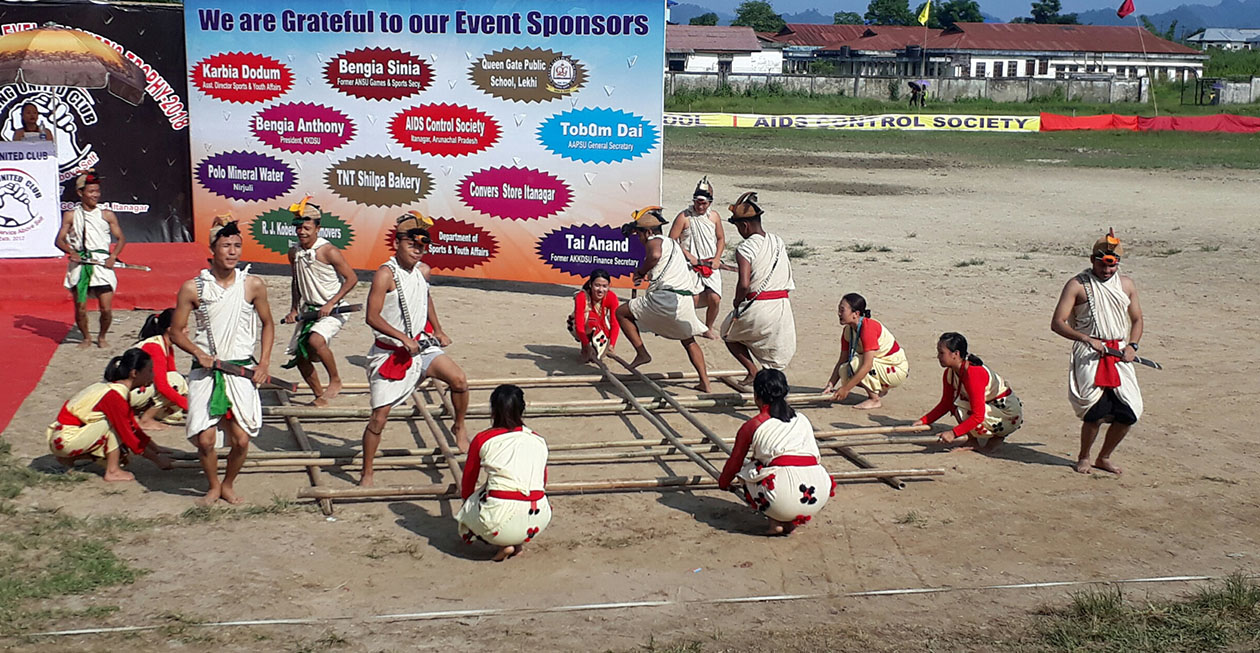
Arunachalee youths performing bamboo dance, the famous and oldest folk dance of Mizoram known as Cheraw dance, is unusual. By learning this dance form they have not only proved their adaptability but got qualified in Kolkata region for India Got Talent to take part soon in TV screening at Mumbai before competing in the final.
During the final math of 2nd edition of Teacher’s Trophy Football Tournament, organized by Ajing United Club in DNGC play ground at Itanagar on 17.09.18, they proved their skill to win the hearts of huge gathering including students. A dance called bamboo jumping dance was performed by boys and girls, choreographed by one Anand Chintey and Tadar Taji to leave the audience dumfounded.
Chintey, a class-XII student from North Lakhimpur had conceived the dance with his inborn instinct for a group of school and college going students, named Hunia NE Warrior, and started practicing. Thrilled by the news of India Got Talent, they headed for and performed on August 18 last to get selected. “We were selected for Mumbai Calling, where our performance will be screened live on TV,” he told this daily with a beaming face on Tuesday.
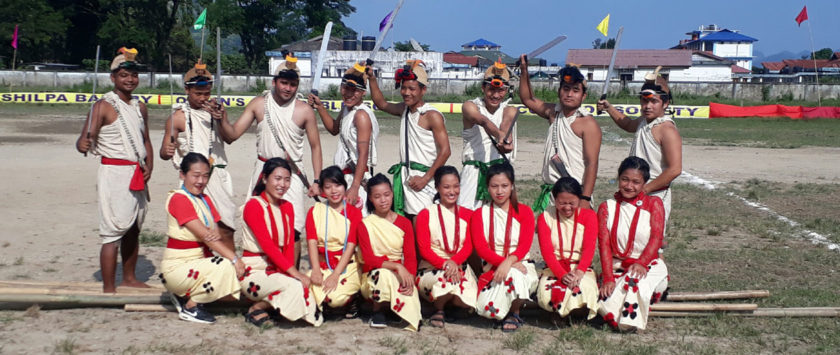
Chintey (leader), 26, dance teacher, class-XII; Shiva Dorjee, 16, class-X; Lham Chotten Miji, 17, class-XII; Tadar Magdaline, 32, designer; Anand Taid, 19, police havildar; Radhe Rang, 19, class-XII; Biswajit Burmon, 21, pursuing MA (sociology); Gollo Menia, 22, MA (1st year); Anand Kumar Jha, 21, class-XII; Tapi Sunku, 19, B.A (3rd semester); Techi Yogum, 21, BA (final year); Lishi Yaba, 17, BA (1st semester); Manisha Jomoh, 19, class-XII; Haorongbam Memikar, 18, B A (1st semester), Balo Deepa, 21, BA (5th semester);Taji Tadar, 26, LLB (final year); Sumit Gahatraj, 17, BA (2nd year); Nabam Nanmi, 21, pursuing MA; Hillang Yajik, 18, BA (1st semester); Sangey Tsering, 18, BA (2nd year); Bagjam Bhai, 18, class-XI and Hita Nabum Hina, 23, BA.
Bamboo staves are kept in cross and horizontal positions on the ground for the dance, when male dancers follow the rhythm while moving on these bamboos. The females dance by stepping in and out of the bamboo blocks. They clap the bamboos in rhythmic beats to produce a sound for the dance which indicates the dance timing too.
Cheraw dance being an integral part of almost every Mizo festival is the center of attraction during festive season in Mizoram. This dance is found in East and in Philippines (known as Tinikling). This dance, according to tales, originated as early as 1st century AD. Since then bamboo staves are used for this dance, known as ‘Bamboo Dance’. Supported by two bases, these bamboos are clapped together on a particular beat for male dancers. The females on other hand, dance gracefully by stepping in and out of the crossed and horizontally laid bamboo staves.
The female dancers usually clad in traditional dresses including Thihna, Vakiria, Kawrchei and Puanchei perform the dance. Mostly vibrant colour traditional costumes brighten up the surroundings. In ancient times, Cheraw dance was performed with the hope of providing solace to soul of a deceased mother who had left her newborn child on earth. However, the horizon of Cheraw dance has expanded significantly. In fact, this dance is performed on every big and small occasion of Mizoram.
The dance choreography is inspired by the nature. While some expressions mimic the swaying of trees, others resemble the flying of birds. Hence, Cheraw dance is notably the most enchanting form representing Mizoram culture.


 20

