
Beyond the Horizon
By Pradeep Kumar
Improving education scenario has been witnessing seesaw between traditional practices and impact of education in tribal dominated Arunachal Pradesh during last few decades. State’s average literacy rate as per 2011 census report was 66.96% up from 54.3% as per 2001 census report.
It is believed that education holds panacea to all ills confronting sate’s tribal society which undoubtedly has prompted present BJP ruling Govt led by Chief Minister Pema Khandu to attach zero tolerance policy to education and health sectors.

Arunachal Pradesh Women Welfare Society (APWWS) has been spearheading against traditional practices of forced marriage, child marriage and polygamy since its inception. Its president Bengia Dipti Tadar said that education has brought attitudinal changes, particularly among young girls and almost all those evils practices are passé now.
When pointed out, she admitted to early marriages of young boys and girls at very tender age while studying in schools and colleges, but said that the APWWS after threadbare discussion on the issue has worked out a strategy to restrain the dismal process.
“A campaign will be launched across the state to convince parents not to allow their children to marry before 18 years and anyone doing so should not be allowed to enter his/her educational institution for which head of the institutions would be taken into confidence”, she said, adding flying squads will be set up all over the state to keep watch on youth and take steps against any unsocial and immoral acts, she said.
However, the civil society organizations as well as the state Govt should extend support for this herculean task to ensure that the younger generations become worthy citizens and members of ‘Team Arunachal’, she added with conviction.
A female teacher earlier lauded the impact of APWWS efforts, but regretted that the younger ones are swayed away by modernity. “We should remember that present tribal society is caught between the whirlpool of customary traditions and present era of free-for-all. Time alone knows its outcome,” she said with her twinkling eyes raising many a questions.
The National Commission for Protection of Child Rights (NCPCR) report says that the girl child belonging to ST (15%) the SC (13%) are married off at a very tender age. The report has been prepared based on a comparative study of The report based on 3rd and 4th rounds of National Family Health Survey conducted in 2005-2006 and 2015-16, conducted by research agency Young Lives India, in collaboration with the NCPCR, record that this phenomenon is largely evident in West Bengal, Bihar, Gujarat, Telangana, Maharashtra, Haryana, Tamil Nadu, Manipur and Arunachal Pradesh.
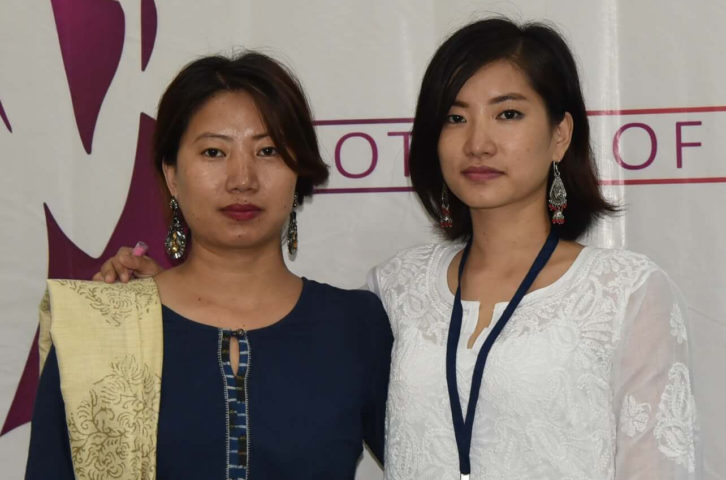
However, my both adopted daughters Ngurang Meena and Reena believe that polygamy and child marriage are still bitter reality of life in state’s tribal society and education alone could lift the society out of the abyss of these horrifying practices.
“I think the silence of women towards these atrocities is what pushed us to educate ourselves so that we could be their voice. The way they couldn’t voice their troubles and fight for themselves made us to do something about the way things were.”
Meena, however, advocated inclusion of moral education including disastrous effects of polygamy and early marriage in school syllabus. The youth are getting spoilt because a father, having many wives, has no time to nurture and guide his children on the right path. Thus, such parents are more responsible for creating a chaotic situation leading to free for all atmosphere in the society.
Appreciating APWWS, she exhorted the elderly members to intensify their fight against polygamy, the root cause of most of the problems of Arunachal. Most of such problems will disappear with discarding of polygamy, she reasoned.
There is no difference between man and woman, which the younger woman should realize to known their self-worth.
Reena, presently a faculty member of Delhi University, has turned a globetrotter and returned from Germany recently. But both have launched a movement to celebrate brave-heart women who have stood up for themselves against the ill conceived perception of the society about women as well as for others.
Meena is right as Arunachalee society is totally woman-centric whose survival would stand questioned without women.
Health has also equal role to play in life toeing the common adage: Health is Wealth. Good health is real wealth that helps to lead a peaceful life. However, young people are on an exciting part of their life journey with diverse physical, emotional and intellectual changes occurring on a daily basis, all of which influence their health and wellbeing. As a critical part of society, they are generally thought to be healthy, but actually not.
If education and health could make tall tale effects on state’s future generations, the GoAP should translate its zero tolerance policy, attached to education and health sectors, into a reality.
Development of basic infrastructure facilities in schools and health institutions in the state alone could help to achieve the goal which would require Rs 15,000 crore, as informed by chief secretary Satya Gopal on Wednesday, adding no past Govt gave a serious thought but dealt with the issue on adhocism. However, initiatives of present Govt deserve special mention, the CS said while enlisting numerous achievements.


 20
