
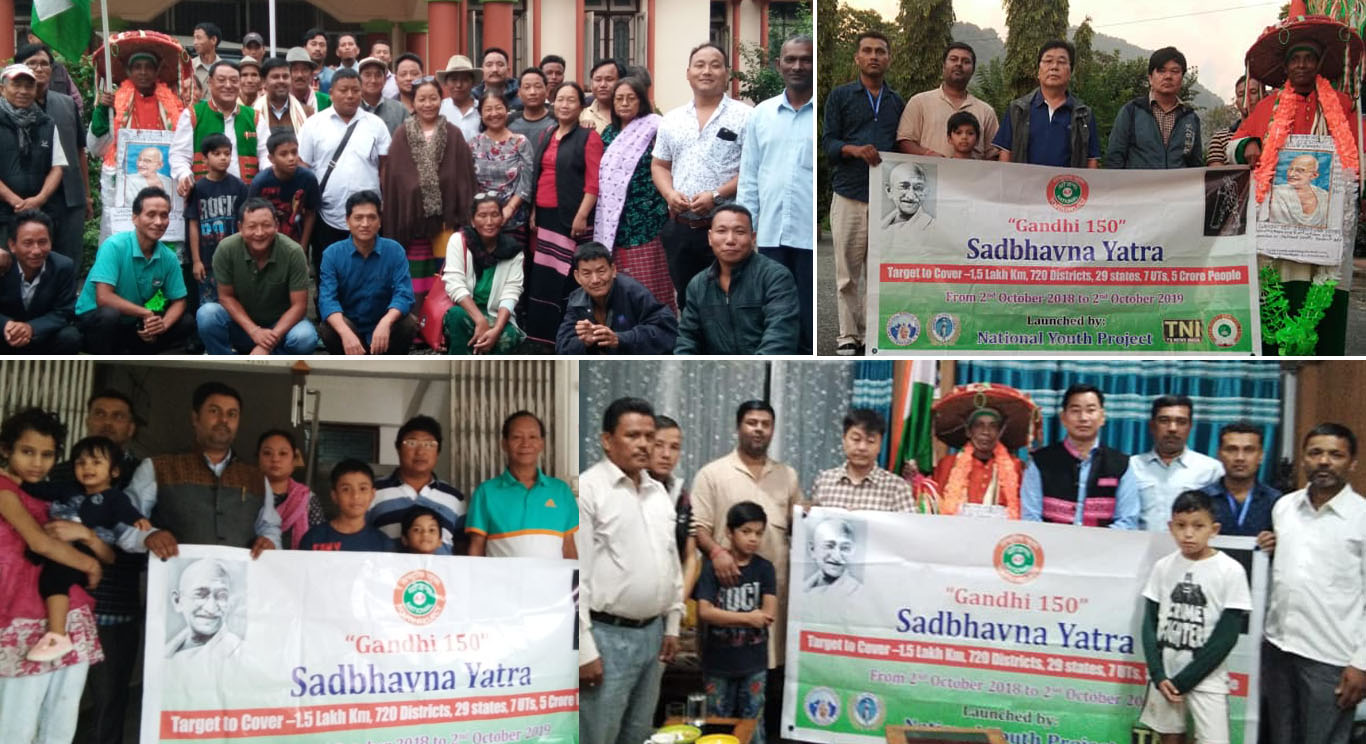
Gandhiji’s 150th birth anniversary celebration
By A O News Service
ITANAGAR, Oct 23: Joining the rest of India, Arunachal Pradesh National Youth Project (NYP) launched Sadbhawana Yatra from here on his birthday October 2 last to spread Gandhian philosophy.
An NYP team led by H P Biswas traversed through 19 of 26 districts of Arunachal Pradesh, four each of Meghalaya and Nagaland and 12 districts before returning here on late Monday night.
Born in Porbandar on October 2, 1869, as Mohandas Karamchand Gandhi, the father of the nation is known of his struggles for non-violence, equality and freedom, the need of the hour in present trouble-torn time.
The yatra, a collaborative effort of NYP, Arunachal unit Gandhi Global Family, New Delhi-based Gandhi Smarak Nidhi and Munshipara-based RB Memorial Trust has target to intermingle with about five crore people belonging to all sections of the society of 720 districts in 29 states and 7 UTs along the charted route of 1.5 lakh kilometer within a year by 02.10.19 at Gandhi Memorial at Rajghat. Senior state leaders pitched in support and addressed the gathering attracted by the team.
A large group led former education minister Bosiram Siram while welcoming the team at Pasighat, in his address, dwelt at Gandhian philosophy but exhorted the team to draw New Delhi attention towards the danger looming large over centurion town Pasighat because of repeated natural disaster in rivers in Tibet. This calls for prior information about flood data which wouold be possible if Indi sings water treaty with China, he added.
Culture Minister Dr Mahensh Chai at Tezu said that violence is no solution to any problem which the young generations should realize and adopt Gandhi’s principles for peace to rule Arunachalee society, the prerequisite for development.
Terming the present time a spring board of social turmoil, Rajya Sabha member & former chief minister Mukut Mithi at Roing said that Gandhiji’s principles are relevant today and will have relevance for ever to serve as panacea for all problems.
MLA Kento Rina at Koyu, MLA C T Mein at Chowkham also joined the NYP bandwagon and like others underscored the relevance of Gandhiji, the epitome of non-violence and social equality, at this present juncture when violence erupts in the society at the drop of a hat and people get divided on communal line to face uncounted social turmoil.
Biswas explained the objectives of such unique and why this maiden programme has been rolled out from India’s eastern most land-locked state of Arunachal Pradesh. He, however, remained in touch with NYP vice president Pradeep Kumar to update about the journey and its outcome.
It is time to adopt pan-Arunachal identity to speak in univocal language for nature trove Arunachal Pradesh to carve a niche for itself in Indian map while marching ahead for a better tomorrow, they advocated. The common voices of the leaders had uncanny similarity with Gandhi’s view, who born on the crossroads of Indian history and gave the country a purposeful direction as a reformer, thinker and a liberator. Familiar with the Bible, the Bhagavad Gita and the Upanishads, he gave the first place to communal harmony among the people of different faiths. This is reflected in his famous book – The Way To Communal Harmony, where he had pleaded for of better understanding among individuals and communities. He was well aware about certain problems that divide mankind. Everywhere in the world, individuals and groups are divided because of fear, suspicion, and hatred towards each other, which further depends on whether the division expressed itself along religious, economic, political, caste or colour lines. Whatever is the form, insecurity is perhaps the major cause of individual or social dissensions. Once these problems are overcome, the unity and integration of the society is a foregone conclusion was firm belief of Gandhiji.
Interestingly, Gandhi Vijay Kumar Singh Yadav, a national runner, known as dhawak (runner) and has been running across the country to propagate Gandhian philosophy, clad in Gandhian outfits, holding tri-colour and carrying Gandhi’s framed picture, drew everyone’s attention, particularly students. Moreover, a woman teacher and few children were part of the team toeing ‘all are equal’ principle.
The NYP team is scheduled to resume it journey on Wednesday..
At 5:17 pm on 30.01.48, Gandhi with his grandnieces in the garden of former Birla House (now Gandhi Smriti), was on his way to address a prayer meeting, when Nathuram Godse fired three bullets from a pistol at point-blank range killing him spreading a wave of shock across India. However, Prime Minister Jawaharlal Nehru, addressed over the AIR, that day had told countrymen: “Friends and comrades, the light has gone out of our lives, and there is darkness everywhere, and I do not quite know what to tell you or how to say it. Our beloved leader, Bapu as we called him, the father of the nation, is no more. Perhaps I am wrong to say that; nevertheless, we will not see him again, as we have seen him for these many years, we will not run to him for advice or seek solace from him, and that is a terrible blow, not only for me, but for millions and millions in this country.
Gandhi believed that swaraj not only can be attained with non-violence, it can be run with non-violence. A military is unnecessary, because any aggressor can be thrown out using the method of non-violent non-co-operation. While military is unnecessary in a nation organised under swaraj principle, Gandhi added that a police force is necessary given human nature. Swaraj to Gandhi did not mean transferring colonial era British power brokering system, favours-driven, bureaucratic, class exploitative structure and mindset into Indian hands. He warned such a transfer would still be English rule, just without the Englishman. “This is not the Swaraj I want”, said Gandhi. Gandhi saw democracy as more than a system of government; it meant promoting both individuality and the self-discipline of the community. Democracy meant settling disputes in a nonviolent manner; it required freedom of thought and expression. For Gandhi, democracy was a way of life.
Alas… with Gandhi his dream of Swaraj remained a mirage. Or else, l constitutional expert Dr Subash C Kashyap, who in his candid interview to this Editor on 20-12-13, had not opined:
“Though Congress party struggled for independence and their resolutions favoured to adopt British system, institutions and education, but what India inherited is the colonial system the Britishers had evolved to rule India.
“The British parliamentary system has 12 main characteristics and none is applied to Indian democracy. The first fallacy is that the vulnerable founding fathers of our system accepted it and it continues till date. This means we defied and defaced the western concept of democracy,” rued Dr Kashyap, who had served the Parliament for over 37 years including during the time of Jawaharlal Nehru and Malavankar, adding “This means we defied and defaced the western concept of democracy.”
“We don’t have a sovereign democratic republic in real sense. The rulers still are masters and ruled are subjects, where as in a sovereign democratic republic, the people are real masters.
“The people rule over them through their representatives who are not true in India as those elected are not their true representatives,” he said citing an example that 83.6% of all sitting members of Parliament then are those against whom the majority had voted.
“The promise of democracy is flawed as the White masters transferred power to the Brown masters and the slaves remained slaves in the slums and in remote rural India without feeling the glory of transfer power to become independent and true citizens,” he argued.
“The slaves like what their masters do, eat and wear, after independence the middle class Indians are taking pride in their British style living and education instead of in mother tongue,” he had said to drive home his point”.
Thus, Swaraj would be a reality only by adopting Gandhian principles by one and all at all levels.


 20

