
*Students’ satisfaction survey only in India: NAAC
* Quality is the buzz word today: Dr Tiotia
‘Schools given new infrastructures’
Responding to questions from this editor as to what steps the GoAP is taking to improve infrastructures toeing the much avowed quality education, Ngandam said that that renovation and construction of class rooms, toilets and other infrastructures on need-basis have been taken up under CM’s Samasta Shikshya Yojana, which offers Rs 4 crore.
On why not develop a common language, he clarified that Rs 3.5 crore has been sanctioned for conducting in-depth research for developing language and script for different tribes. The Wancho tribe has been conducting research for which “I shall be approaching the Govt for fund. He belongs to Wancho tribe.

By A O News Service
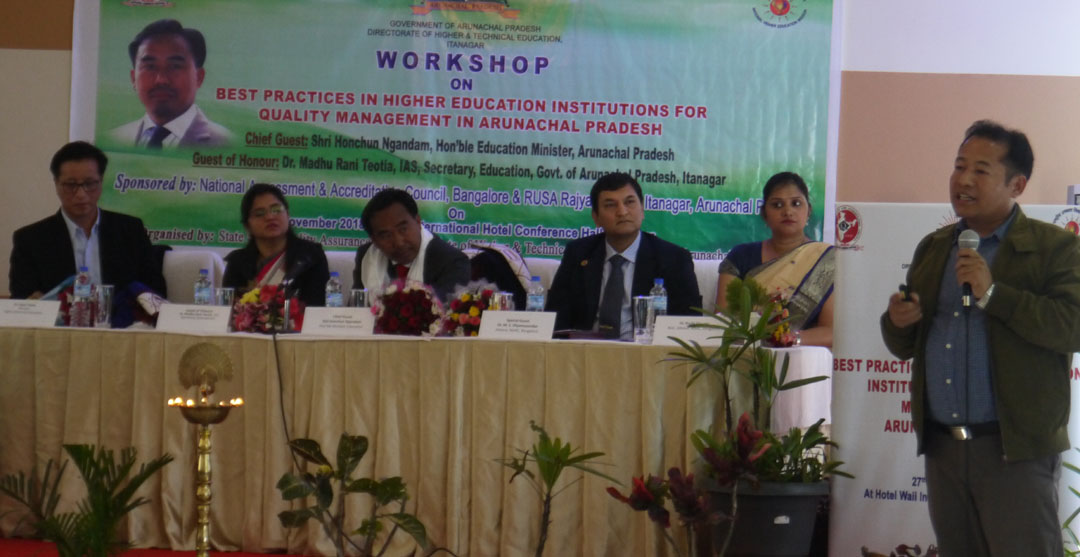
ITANAGAR, Nov 27: Quality of education is barometer to judge a nation, Education Minister Honchun Ngandam said, while addressing NAAC-sponsored workshop on ‘Best practices in higher educational institutions for quality management in Arunachal Pradesh’ here on Tuesday and termed it a golden opportunity in this ‘mini India’.
Higher education institutions should foster their link with their community at local, national and regional levels, to answer society’s needs as quality cannot be imparted at end and the quality should be by design. Quality product should be coming out of robust system and there is no summit in quality. There has to be continuous improvement in quality. Quality in technical education is indication of quality of society and country and its economic growth and the quality should be imparted in all aspects of a technical institute, he said.
Elaborating holistic approach to design the quality in an academic organisation, he said it may be inclusive of goal setting; external environment scanning and analysis; internal environment scanning and analysis; benchmarking; deciding achievable target; deciding quality (qualitative and quantitative); quality matrices; and methodology of measuring quality parameters. Accreditation itself fosters excellence in the teaching-learning of higher education while enabling an academic institution to maintain its organizational culture and its organizational identity, he added.
“In order to fetch fortunes from demographic dividend with globalization in India and stop demographic disaster, we certainly face quality challenges in higher education in general and technical and management education in particular which calls for reforms to ensure fundamental changes at all levels of operation. These changes further require greater accountability, transparency and morality (ATM) more important than ATM of any bank. The time has come to create a wave of institutional building and of excellence in the fields of higher education, research and capability with enhanced capacities. India needs educated people who are skilled and who could drive our economy forward, he said with conviction, adding the new knowledge economy for achieving professional, managerial, operational, behavioral, inter personal and inter functional skills require flexible education and training system that will provide foundation for learning to develop required competencies with morality, credibility and accountability through spirituality- the science of soul which can make us superior to anyone in the world.
The ruling Govt has taken many initiatives, he said by citing the example of sponsoring 25 students by funding Rs 25 lakh in Advanced Learning System here for IAS/IPS coaching more Arunachalee will join the UPSC services.
Instead of only quality, the NAAC is now going for qualitative and quantitative assessment based on performance data, NAAC advisor Dr M S Shyamasundar said, adding that creativity would serve as a boon.
Besides numerous changes in assessment process including hand holding technique after getting feedbacks to improve quality of education, he said that students’ satisfaction survey has been introduced by NAAC only in India in the whole world, he said.
Terming the workshop very important, said that he was hesitant to come to Itanagar from Guwahati because of communication hazard.
Quality is the buzz word today, education secretary Dr Madhu Rani Tiotia said, adding that such workshop should be conducted twice in a year.
Hindi is lingua franca of this Himalayan state, she said, adding quantity is not a problem with 13.5 lakh population but quality is the need of the hour. Therefore, NAAC accreditation is essential for higher education. How to improve ranking of colleges and what are the criterion – is students’ placement? Infrastructure status? Etc. should be known by the education administrators, she said, adding that that is the reasons as to why university vice chancellors, registrars, college principals and professor from across the state numbering 60 have been invited for the day-long workshop, she said. In fact, she has been instrumental in facilitating the workshop.
Highlighting education status, RUSA deputy state project director Minto Ete said that against national enrolment of 24.5%, Arunachal Pradesh boats of 21.12% – male-22.11% and female-2012%. The state has eight universities including seven private ones and one (Rajiv Gandhi University) is only accredited by Bangaluru-based National Assessment & Accreditation Council.
Of the 17 Govt colleges, six are accredited while of the seven private colleges only Ziro-based St Clariet College accredited, he said adding only Rajiv Gandhi University (central) has been accredited of total eight varsities and rest are private ones. There are nine BEd colleges which offer integrated courses but none has been accredited so far, Ete added.
Higher & technical education director Dr Tayek Talom and RUSA OSD Dr A Imbotomi Singh also addressed the gathering before the technical session. NAAC assistant adviser Dr Ruchi Tripahti and chief information commissioner Dr Joram Begi were speakers.


 20

