
* Jo hamara khet main hey woh pet mein hey: Agarwal
By Pradeep Kumar
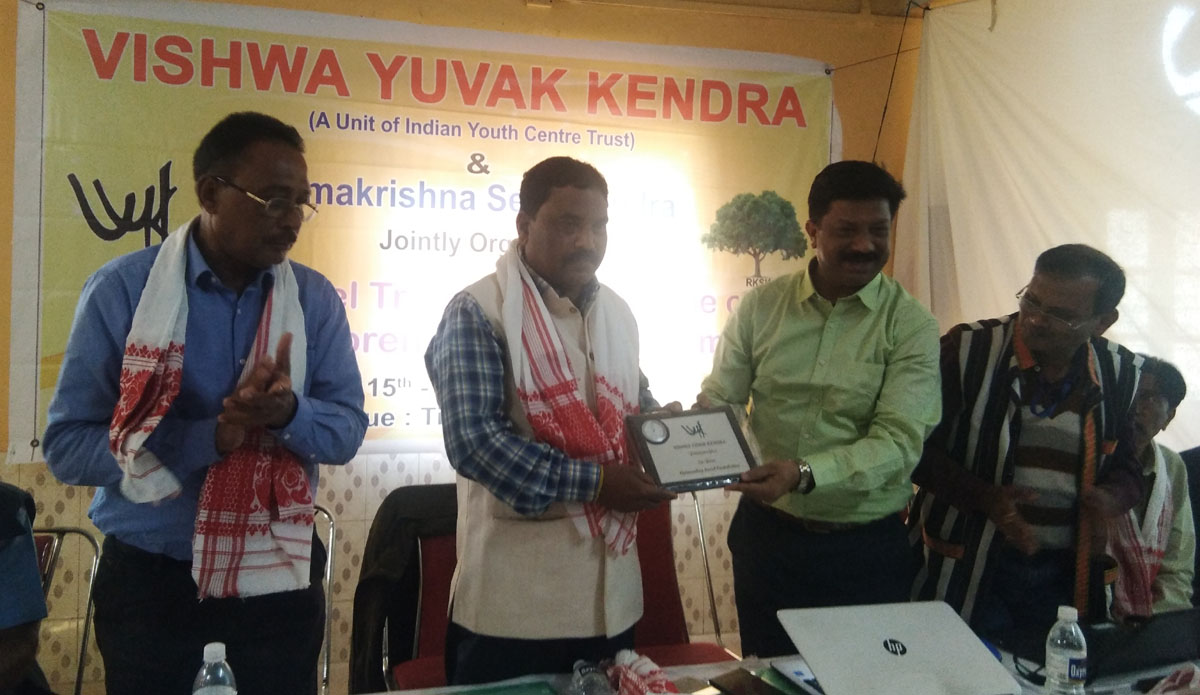
DUMDUMA, Jan 16: Agro entrepreneurship development (AED) training is the need of the hour, local MLA Durga Bhumij said as chief guest in his inaugural address to state level training programme on AED in Tinsukia district here on Tuesday.
Conducted for first time in Assam jointly by Vishwa Yuvak Kendra (VYK), a unit of Indian Youth Centre Trust, and Ramakrishna Seva Kendra (RSK), the three-day training aimed at promoting entrepreneurship in agro-horticulture sector.
Appreciating local organic tea cultivators, he said Tongna Tea Estate of the district and Mouth Tea Estate in Dibrugarh district produce certified organic tea. He lauded VKV and RSK for this training as it would go a long way in not promoting organic cultivation but also help in creating employment opportunities for state’s educated unemployed youth. He assured all support to intensify the process.
VYK proggramme officer Rajiv Nirmal, in his address earlier, said that its initiative aims at uniting the farmers under one platform for one-to-one meeting and creating a network for boosting agri-horticulture sector and facilitating remunerative prices for growers through forward market linkage. He demonstrated green tea produced by M/s DBM Tea in nearby Ruapi Siding area, about 2-km from here and assured the farmers all possible help to promote them.
Senior journalist & Arunachal Observer editor Pradeep Kumar as resource person, highlighted the vast scope of agriculture and horticulture sector in NE India, particularly Assam and Arunachal Pradesh.
Highlighting vast scope of agriculture and horticulture sector in NE India, particularly Assam and Arunachal Pradesh, senior journalist & editor of this daily Pradeep Kumar as resource person, through his PowerPoint presentation, said: “Agriculture is a way of life, a tradition, which, for centuries, has shaped the thought, the outlook, the culture and the economic life of the people of India. Agriculture, therefore, is and will continue to be central to all strategies for planned socioeconomic development of the country, quoting National Agricultural Policy 2000.
But its contribution of agriculture to India’s GDP has been steadily declining due to industrialization and various problems like lack of irrigation facilities, poor yield etc, he said and called for rapid growth of agriculture as agriculture accounts for 63% of Assam’s work force and rice is cultivated in 67% of gross cropped areas.
However, World Bank-assisted US$146 million Assam Rural Infrastructure and Agricultural Services Project had tripled rice yields per hectare, increased output of milk and fish, and introduced a variety of other crops, improving farmers’ well being substantially. Assam became self-sufficient in rice as reported in October 2016.
About 94% of Arunachal Pradesh population depends on agriculture to earn their livelihood. Besides paddy and maize; spices, aromatic and medical plants, flowers, and mushroom are highly cultivated in the horticultural sector of the state.
Arunachal Pradesh by default is an organic state. Manure is not used in any cultivation except in tea. However, Tadak Gab, had started tea cultivation in 30 hectare are in Dollongmukh area of Lower Subansiri district in 1993-94 and facilitated opening of Tea Board of India branch Itanagar, Arunachal’s first rubber man Ojing Aje by cultivating rubber in 1996 had won appreciation from Rubber Board of India and National Youth Project by turning 22 opium growers of Anjaw district as horticulturists by encouraging large size cardamom cultivation with its first harvest yielding Rs 1.76 crore, a national record, became role models. But, Tocklai Tea Research Centre of Tea Research Association in Jorhat is dedicated to scientific research and extension for improvement in productivity and quality of tea in North East.
It was trend setter politician Setong Sena, who had brought ensured speedy development of his insurgency-infested Changlang district and brought a turnaround in agriculture and allied sectors as agriculture, horticulture, animal husbandry & diary development minister during 2009 to 2014 to win National Krishi Karman Award for consecutive four times with higher cash reward. He was instrumental to set up state’s first a tea factory Eastern Tea Growers Multipurpose Cooperative Society Ltd. at Jairampur at an estimated cost of Rs 8.17 crore by 249 shareholders with Rs 6.39 crore loan from NCDC with a capacity to produce 25,000 kg tea daily.
The last but not the least, world’s largest botanical herbal garden is being developed by Patanjali Group in Sonitpur district along Assam-Arunachal border in nearly 21,000 hectares where around 7,000 identified medicinal plants would be planted,
Regrettably, despite being a nature trove, barter trade, born with the civilization, still continues in Arunachal Pradesh. Males and females of Damin in Upper Subansiri district with their products cross snow-fed mountain to reach Tibet to collect essential items for their survival, as shown in a 2016 picture.
This because failure of consecutive state Govts in developing agri-horticulture sector and road communication along border areas. Therefore, steps should be taken to overcome these deficits and set up organic certification branch in NE region for speedy growth of the most dependable sector, Kumar added.
Ninam Rekhung and Devi Dignium, in their paper, highlighted benefits of organic farming with pictorial demonstration.
Organic tea growers (their cultivated areas in hectares) Md Amin (8.5), Haidar Ali (2), Ranjan Medi (2), Dhujen Bora (1) and Dipu Moran (1) highlighted their success stories and advocated to go organic to prevent rising life threatening diseases among the masses for their healthy life. “This would create a special niche for Assam globally,” Ali said with conviction.
“Jo hamara khet main hey oh pet mein hey (which are available in our fields are for our stomach), said Ramakrishna Seva Kendra coordinator Vimal Agarwal to underscore the importance for agriculture sector.
The participants were dumbstruck by traditional Nocte dance presented by Arunachal’s Tirap district girls led by Tirap NYP coordinator Chalu Wangsa.


 20
