
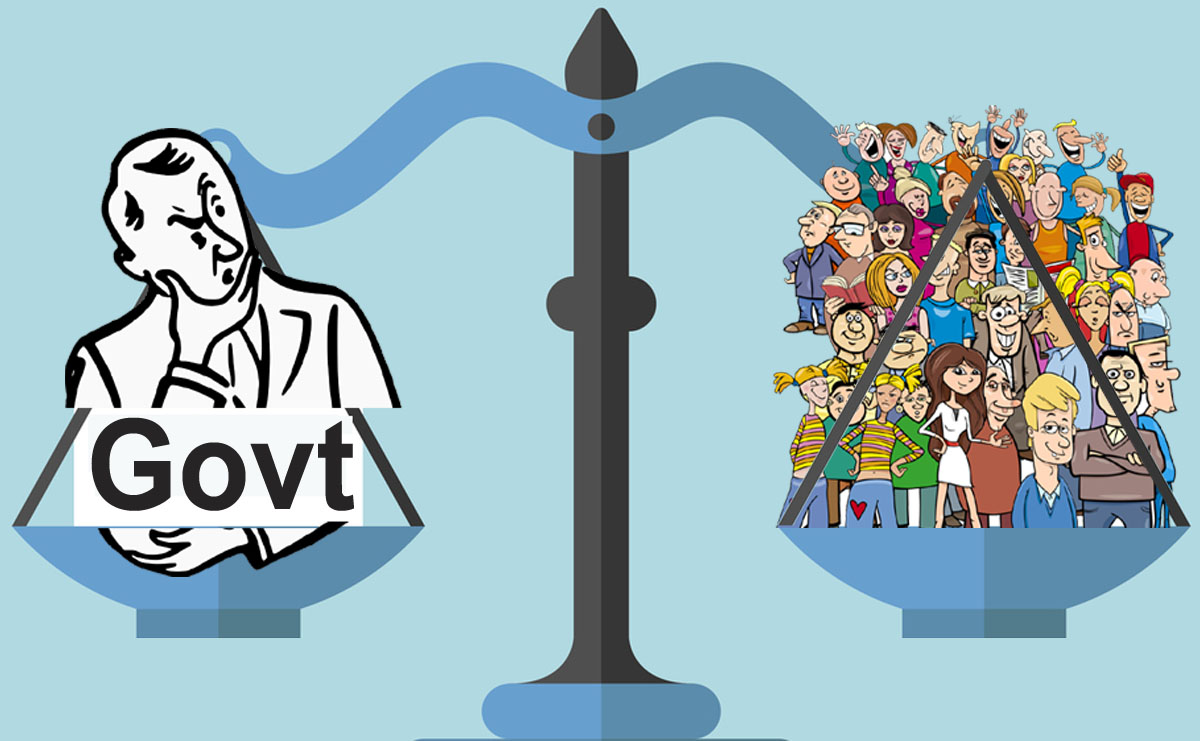
(The rulers in India still are masters and ruled are subjects, where as in a sovereign democratic republic, the people are real masters- Dr Kashyap)
Adult Franchise
The concept of Adult Franchise or Universal suffrage came into existence through the French First Republic, though limited in its nature; right to vote was extended to male members. Ergo, with the passage of time and establishment of modern states on the principle of Democracy consolidate the existence of Adult Franchise. In India, the concept is enshrined in Article 326 in Constitution of India 1949.
By Pradeep Kumar
Kings used to rule over India as a hereditary regime and the masses had no say in choosing their leader or leadership. The Chieftain system still prevails in some parts of Arunachal Pradesh. The British Raj is the best example which had ruled over the Indian subcontinent between 1858 and 1947. Job Charnok, an agent of the East India Company (EIC) in 1690, had chosen Bengal on the bank of Hooghly for a British trade settlement and Fort William was built. There were three large villages along the east bank of River Ganges – Sutanuti, Gobindapur and Kalikata, which were bought by the British from the local landlords by paying Rs 3,000 annually for freedom to trade. British traders widen their bases by influencing landlords and took over their rules to become rulers. By 1757, the EIC had become a powerful arm of British imperial might, with its own army, navy, shipping fleets and currency, and control over key trading posts in India. The system of governance was instituted in 1858 when the rule of the East India Company was transferred to the Crown in the person of Queen Victoria (who in 1876 was proclaimed Empress of India).
But, patriots including Mahatma Gandhi led independence movement to end rule of ECI (1757–1857) and British Raj (1857–1947). Most of the Indian subcontinent was under British rule then. India attained freedom on 15.08.1947.
The Constitution of India, the supreme law of India, was adopted by Indian Constituent Assembly on 26.11.1949 and came into effect on 26.01.1950 with a democratic government system, completing the country’s transition towards becoming an independent republic. It lays down the framework demarcating fundamental political code, structure, procedures, powers, and duties of government institutions and sets out fundamental rights, directive principles, and the duties of citizens. The Constitution of India repealed the Indian Independence Act, 1947 and Government of India Act, 1935 to become a sovereign democratic republic with its Constitution coming into force with Jawaharlal as first Prime Minister.
Article 326 envisions Adult Franchise fundamental pillar of any democracy is a right to vote irrespective of religion, race, caste, creed, sex. It was a nascent step to empower the democratic values and the result is Election or Right to choose our representatives. It is based on equality, a basic principle of democracy and demands that right to vote should be equally available among all – above the age of 18 (reduced from 21 years by 61st Amendment of Constitution) except lunatics, minors, criminals or anyone who has had this right revoked by the powers of any court for probable cause.
Indian democracy needs to reinvent itself: Dr Kashyap
I would like to quote former Secretary-General of Lok Sabha Dr. Subhash C. Kashyap, who in an exclusive interview to this editor at Naharlagun on 20.12.13 had said: Indian democracy has to reinvent itself to gain the confidence of the masses.
When asked though America is called the strongest democracy and India the largest in the world, why have Indian masses lost faith in the system, he had quipped: “The representative legitimacy of the representatives of this democracy is in doubt. Democracy is facing many challenges; the worst is nothing could be more tragic than the masses losing faith in their representatives. There is of course a way out for the democracy to reinvent itself to win the confidence of the masses”.
“The need of the hour is fundamental systemic changes, not from democratic form to presidential form, but to regain the faith make the masses the real masters,” he had said.
Dr Kashyap, who has authored 100 books in English and Hindi and associated with the Parliament for over 37 years right from Nehru to Mavalankar time, had said that though Congress party struggled for independence but their resolutions favoured to adopt British system, institutions and education, but what India inherited is the colonial system the Britishers had evolved to rule India.
“The British parliamentary system has 12 main characteristics and none is applied to Indian democracy. The first fallacy is that the vulnerable founding fathers of our system accepted it and it continues till date, he reasoned. This means we defied and defaced the western concept of democracy. We don’t have a sovereign democratic republic in real sense. The rulers still are masters and ruled are subjects, where as in a sovereign democratic republic, the people are real masters.
“The people rule over them through their representatives who are not true in India as those elected are not their true representatives,” he said citing an example that 83.6% of all sitting members of Parliament are those against whom the majority had voted. The promise of democracy is flawed as the White masters transferred power to the Brown masters and the slaves remained slaves in the slums and in remote rural India without feeling the glory of transfer power to become independent and true citizens, he argued.
“The slaves like what their masters do, eat and wear, after independence the middle class Indians are taking pride in their British style living and education instead of in mother tongue,” he had said to drive home his point.
“Those who struggled against slavery, they were not against slavery but wanted to take the place of the masters and have succeeded in doing so and that is democratic system in operation in India”, said Dr Kashyap, who was honourary constitutional adviser to Govt of India on PRI laws besides heading many national and international bodies.
When told about money and muscle free elections in Mizoram dictated by Young Mizo Association supported by the powerful missionary groups, Dr Kashyap, who was on his maiden visit as a main speaker of training-cum-workshop on ‘Legislative procedures’ for state assembly staff, had admitted that the state is a role model in the entire nation and could serve as panacea to present ills of our democratic system.
With wrong people positioned at wrong places reflects the worst side of democracy and its unavoidable costs the society pays. If horse trading by political parties to save their kurshi is any indication, it is as million dollar question for Arunachal Pradesh people to find its answer!


 20
