By Jisma S Nair
 Large population of agrarian state of Arunachal Pradesh still depends on jhum or shifting cultivation for failure of those who matter in channelizing the people’s energy in tapping vast untapped hidden resources of the state even over three decades after it attained statehood in 1987.
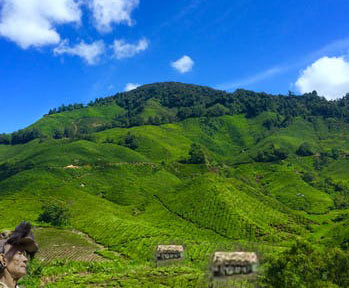
This Himalayan state with diverse topography known for unspoiled natural beauty, has earned numerous sobriquets — ‘Land of Rising Sun’, ‘Dawnlit Mountains’, ‘Orchid State of India’ and ‘Paradise of Botanists’ or ‘Nilalaya’ (named by editor of this daily) – offers scope for growth of hospitality and tourism industries. It also justifies former chief minister Gegong Apang, who once had said that agri-culture sector alone holds key to state’s better future. He was true as Arunachal is highest producer of kiwi in India, its oranges are exported abroad and its large size cardamom are demanded at higher rate in south Indian markets.
In all 500 species of birds, 85 species of mammals and 5,000 plants including numerous medicinal plants are naturally gifted to this state, making it not only one of the 12 biodiversity hotspots of the world but a nature’s wonder. The state offers huge scope for non-timber based industries with bamboo and cane growing aplenty in wild.
It boasts of vast hidden mineral resources as former Oil India Ltd CMD Chudamani Ratnam from 1990 onward went on record saying: India had a treasure trove of shale oil in Arunachal Pradesh and other parts of the NE which could produce 140 million tonnes per year for 100 years, making India a net oil exporter. However, the deposits looked uneconomic, so he was not taken seriously. Analysts laughed when he suggested that China might one day invade Arunachal Pradesh to grab the oil.
“Suddenly, that scenario no longer looks completely crazy. New technology in the US has hugely reduced the cost of extracting shale oil. The world over, oil companies are looking afresh at shale oil. China is surely doing the same,” The Economic Times consulting editor Swaminathan S Anklesaria Aiyar had written in his ‘Swaminomics column’ on 25.09.11.
Highlighting this aspect, senior journalist Pradeep Kumar had noted that Indian geologists had identified about 28 basins for shale gas exploration. They disputed US Energy Information Administration figures, which place the reserves at 96 trillion cubic feet (tcf). One estimate by Indian scientists placed potential reserves at as high as 527 tcf. Top officials had said Oil India believed Dishang Shales in 120-sqkm Deomali tract alone could prove to be a major find for the company.
Regrettably, Union Environment & Forest Ministry gave environment clearance, mandatory for oil extracting, after a gap of 12 years for Kumchai under Diyun circle of Changlang district after repeated pursuance. Moreover, geology and mining one of the revenue departments is ill staffed with meager fund allocation which does not justify its responsibility to tap state’s huge hidden treasure.
However, the state Govt pragmatic initiatives, like Apna Ban, Minor Forest Produce, Minimum Need Programme, Aided Natural Regeneration, Integrated Watershed Development Programme, Area Oriented Fuel Wood & Fodder Project to bring mass awareness and involve the local population in conserving rich flora and fauna of this geographically 14th largest state of India.
Handloom and handicrafts, the traditional cottage industry, including mat making and weaving of dresses have been offering rural employment, but lack of forward and backward market linkage and migration of rural population to urban areas in search of white-colour employment, has affected the cottage industry to great extent. Moreover, modern impact has direct bearing on traditional sources of livelihood earning.
Sharing border with Bhutan, Myanmar and China, the state far away from mainland India could develop trade ties with rich South East Asian nations, where, it is believed, world’s 50% live.
Present Chief Minister Pema Khandu inked a record with highest ever revenue generation of Rs 1598.49 crore during 2017-18 and fixed a target of Rs 2,000 crore during this fiscal. Moreover, the Sarkar Aapke Dwaar, a new initiative of present Govt has made vast difference in extending fruits of development to the masses at their door steps. Interestingly, such initiatives have made Sikkim most developing sate in NE India as was highlighted by Pradeep Kumar after visiting that state, particularly Paiyong gram panchayat unit (GPU) with then Agri, Horti, Animal Husbandry & Dairy Development Minister Setong Sena, secretary Hage Kojeen, adviser AK Purakayastha and NYP president H P Biswas in – Sikkim jangal mein mangal on 16.06.12.
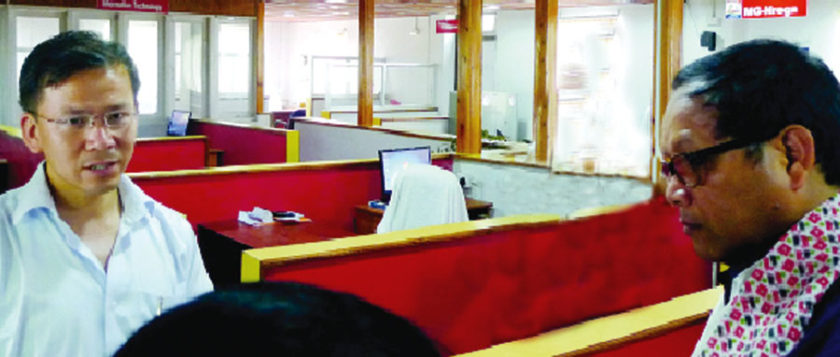
Melli Dara gram panchayat office (in picture) though looked like a corporate office but was a wi-fi enabled village administrative centre (VAC) office since 2008 and offering numerous services to 6,333 inhabitants (2006 census) of seven villages comprising 1,158 households and spread over a 13.5 sqkm area including 221 hectares reserve forests under its jurisdiction. The VAC under its single window system process any document of all applicants against nominal service charge. This helps the villagers to save their time and money and the VAC to earn but the poor and incapable are the greatest beneficiaries as the documents are obtained from nearby BDO office or delivered to the applicant. The BDOs with mobile offices visit every GPU once a month to issue documents and redress public grievances, GPU president Ganesh K Rai, husband of Melli assembly seat MLA Tulsi Devi, had informed.
Moreover, Sikkim was declared total organic state by Prime Minister Narendra Modi on 19.01.16 with the help of global organic scientist Dr Nilamadhab Nanda. But despite his presentation on his product Win (Shri) Crops that doubles crop production and triples pulse production as certified by scientific bodies across the world including in India to state lawmakers including present Chief Minister Pema Khandu and Speaker T N Thongdok in Nokmey Namati Hall of old Assembly secretariat complex in Naharlagun on 10.03.17, the file moved by local MLA Techi Kaso to procure this organic manure to go organic regrettably went missing in world’s longest (GoAP) channel.
Why nature trove Arunachal Pradesh is delaying to prove it huge strength when Prime Minister Narendra Modi has advocated cooperative federalism for India with the intention of making every state self-dependant? Arunachal Govt needs to toe the common adage “where there is a will, there is a way”, by emulating more such initiatives of Sikkim to tap its vast natural resources. Sikkim mantra could make this a fast developing advanced state and end its rising unemployment problem. (Nair, a student of Namsai-based Arunachal University of Studies, took inputs from editor of this daily Pradeep Kumar)


 20