Beyong the Horizon
By Pradeep Kumar
- We are committed to serve: Nurses
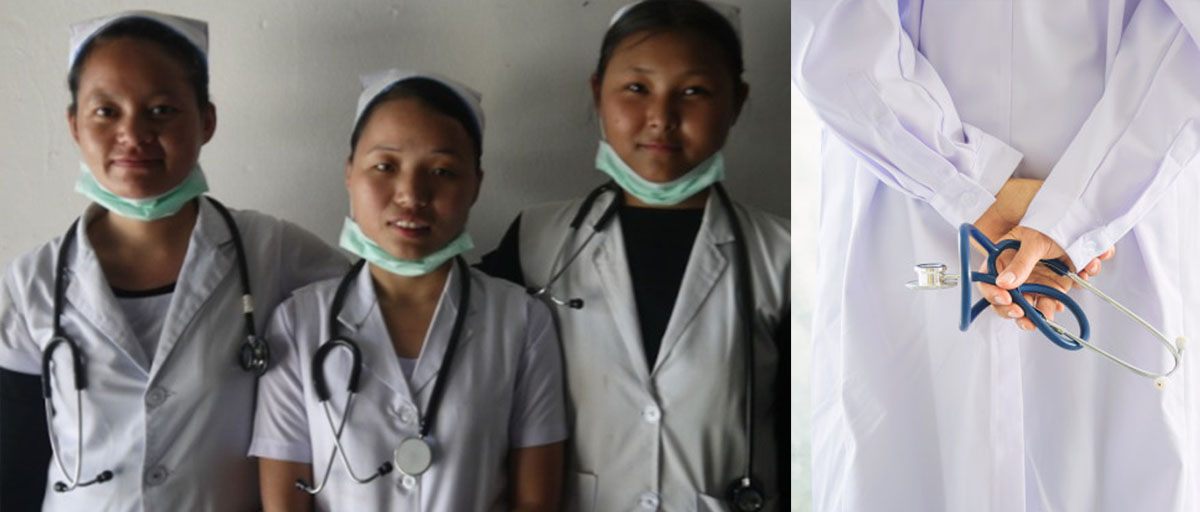
“We are committed to lead kindly light to serve the society,” univocally quipped three young local girls, who were assisting smilingly in blood donation camp at Hills College of Teachers’ Education on Thursday.
They were Ahnu Dao (Pasighat), Ade Dubi and Bomniya Yigam (Daporijo), trainee nurses of Arunachal Nursing School (ANS) of Naharlagun, deployed for the humanitarian service.
On being told nursing is not a job but a lifelong sacrifice for others, their replies was surprising – “Right from mother to sisters, wives to daughters all serve in their respective families. “What is new in it?” they questioned to leave me speechless.
What will you do, once married? – Their reply was equally surprising. “So what, it is a part of life. The new family members would also come under the purviews of service.
Their replies reflected their commitment to nursing, most essential to be a nurse, and proved that local girls have accepted the reality of life to serve their own people without remaining dependant on others.
When India is short of nearly two million nurses as per NDTV report on May 12, 2017, how could Arunachal Pradesh be away from this deficit? In fact, Arunachal Pradesh has a dubious distinction of poor doctors-nurses ratio.
There are 594 GNMs and 633 ANMs against total sanctioned doctors of 743 including 564 GDMOs and 179 specialists (sanctioned 275 posts) against 13.84 lakh population (2011 Census) or about 16.38 lakh in 2018.
On average, India’s nurse-to-population ratio was 1:475.14, including registered nurses and midwives and lady health visitors, according to NHP 2016 against nurse-to-patient ratio of 1:500 recommended by WHO.
“India is short of 1.94 million nurses, according to an IndiaSpend analysis of data from the Indian Nursing Council (INC) and World Health Organization (WHO). The acute shortage of nurses–attributable to low recruitment, migration, attrition and drop-outs due to poor working conditions– has experts worried.
There was a shortage of 2.5 million nurses in India In 2010, according to this WHO bulletin, when India had 1.23 million registered nurses and registered midwives, according to INC data. As of 2014, there were 1.79 million registered nurses/midwives and 786,796 auxiliary nurse midwives in India, according to INC data.
On average, India’s nurse-to-population ratio is 1:475.14, including registered nurses and midwives and lady health visitors, according to NHP 2016. However, WHO recommends a nurse-to-patient ratio of 1:500.
In the public health system, the Govt has a norm of one nurse per primary health centre and seven per community health centre. By those standards, rural India is short of more than 13,000 nurses, according to data from the rural health statistics 2016.
There has been a 130% rise in the number of sanctioned posts for nurses in rural public health centres–from 34,061 in 2005 to 78,530 in 2016. During the same period, the shortage fell from 13,352 to 13,115 nurses. Odisha, Uttar Pradesh and Uttarakhand had the maximum proportion of vacancies based on required numbers, at 64.2%, 50.5% and 48% respectively.
In Arunachal Pradesh, the ANM schools are HTRC, Pasighat; TMIHSH, Nirjuli; Khando Drowa Sangmo ANM School, Tawang; IGTAMSU School of Nursing, Ziro; Govt. ANM School, Aalo & Namsai & Martha Nursing Training School, Jairampur, the GNM schools are School of Nursing, RKM, Itanagar; ANS, Naharlagun; Zion Institute of Nursing, NIRJULI; Govt. GNM School, Pasighat; IGTAMSU School of Nursing, Ziro; GOVT School of Nursing, Daporijo and BSc nursing – North East Nursing College of Health Science, Itanagar..
There is just one allopathic government doctor available for around 11,082 people across the India, a figure more than 10 times the recommended ratio of 1:1000, Financial Express had reported on 20.06.18.
The National Health Profile-2018, released by the Central Bureau of Health Intelligence, highlighted the huge gap in availability of Govt allopathic doctors and also huge gaps between states. According to the NHP, 2018, in Bihar, one doctor serves a total population of 28,391 whereas in Delhi, the figure stands at 1:2,203. Bihar is followed by neighbouring Uttar Pradesh where the ratio is 1:19,962. The other states with the poorest ratio of doctor-population are Jharkhand (18,518), Madhya Pradesh (16,996) Chhattisgarh (15,916) and Karnataka (13,556).
Delhi tops the list, followed by NE states Arunachal Pradesh (2,417), Manipur (2,358) and Sikkim (2,437). Officials say that the better statistics for Delhi are due to the higher number of private hospitals and doctors, adding that the good performance of NE states should be attributed to lower population density.
The need of the hour is attitudinal change by law and policy makers to encash such positive attitude while fresh doctors also should be ready to serve wherever they are posted to serve their own people.
Because, responding to common demands to post doctors by MLAs, state’s first woman health minister Komoli Mosang had told on the floor of the Assembly, doctors from outside cannot be expected to serve in interior places when if our local doctors hesitate to serve.
However, another health minister CC Singpho, perturbed over demands for urban posting by doctors, was told by me to adopt Odisha Govt policy to mandatorily post to rural areas for two years to any new doctors. However, Chief Minister Naveen Patankai in 2015 announced to pay Rs 80,000 incentive per month, 100 per cent extra to their salary if they take posting in remote areas.
The Khandu Govt took bold steps to create posts including of specialists to give a new thrust to health sector. But, state’s health delivery system has miles to go! ‘Where there’s a will, there’s a way’ – If this proverb is right; there is no harm to hope for health system to improve.


 20