
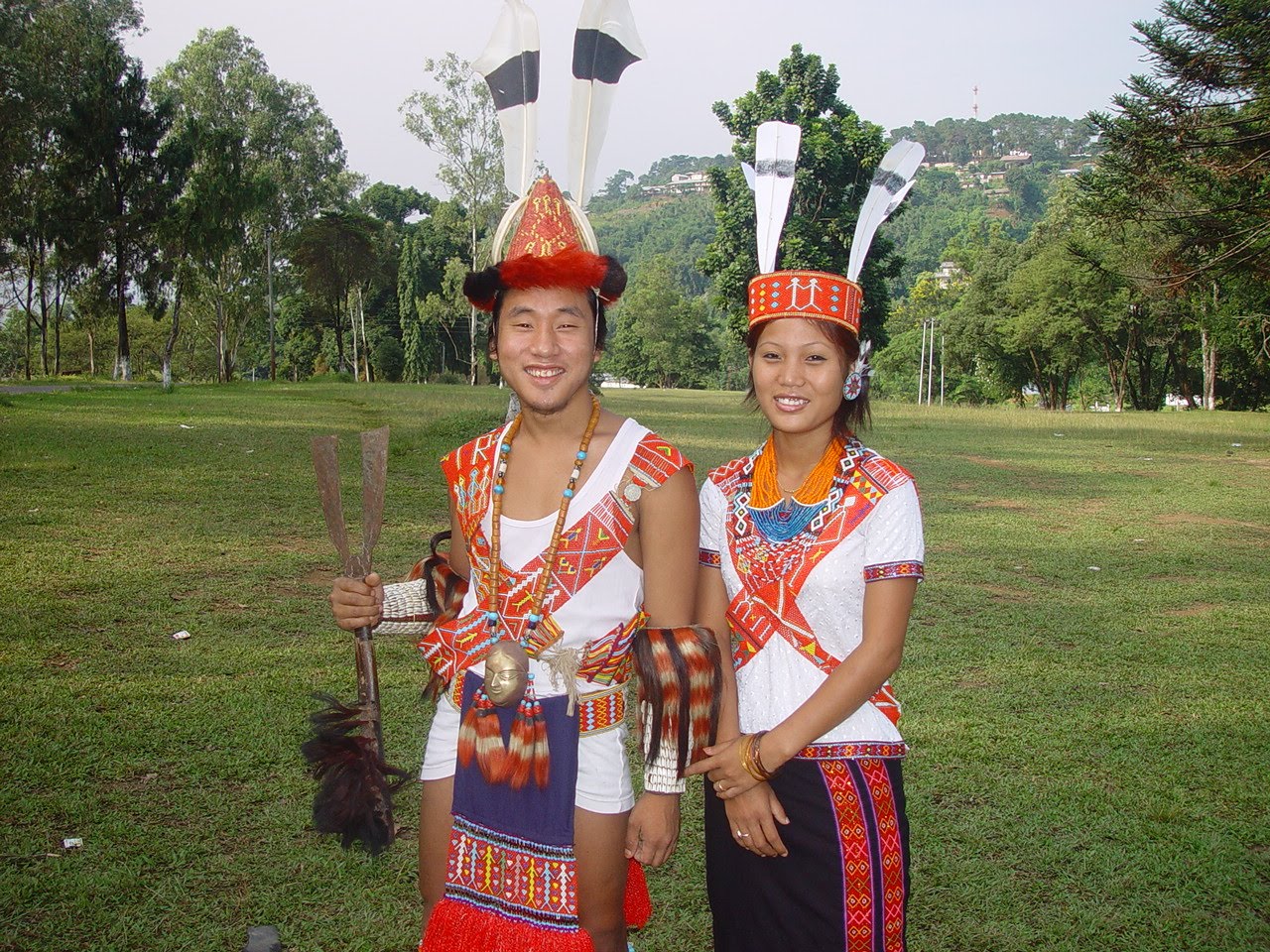
File picture of a happy Wancho couple
By Pradeep Kumar
ITANAGAR, Apr 18: Not only the economy of this predominantly tribal state of Arunachal Pradesh revolves around the women but their voters’ population stood higher than males as of total 7, 98,248 voters, females were 4,03,792 and 3,94,456 males. Moreover, 50% female zilla parishad chairpersons were elected against prevailing reservation of 33.3% during last panchayat election. TRhis is enough to prove that women alone could change the destiny of the state if given the power.
Young Arunachalee women, particularly Arunachal Pradesh Women’s Welfare Society had spearheaded a movement against traditional child marriages and polygamy and land right for them since 1988.
The once divine land Bharat that gave birth to brave Laxmi Bai, Queen of Jhansi, now very often than not witnesses women being suppressed, oppressed, tormented, defaced by acid, molested, raped and subjected to unthinkable atrocities while premature abortion of female foetus and killing of stillborn babies are reported in many parts of the country, though rare.
How and why the human values evaporated? How could such inhuman acts be perpetuated on the fairer sex? How many cases of males being tormented are reported in India? Who could torment the tormentors?
Asking females to stand up to fight for their cause is easier. But who are to listen and act, is it not the males? Will they? Where lies the fault? What is the way out? Should inhumanity continue to take upper hand when India is eying to attain the Developed Nation status by 2030?
These social stigmas surfaced again when National Youth Project (NYP) conducted training on “women safety and security”, sponsored by Vishwa Yuvak Kendra (VYK), with over 100, particularly young girls, taking part in DNGC here.
Out rightly disapproving polygamy a traditional practice in Arunachal Pradesh since ages, TRIMHS senior gynecologist Dr Bomie Tayeng said that monogamous couples derive higher level of happiness in life as per study.
But those having multiple sexual partners will get much lesser satisfaction, she told about over in a training

Love does not carry any sense when divided by a man among more than one wives, she said and exhorted the young girls to be cautious about such social phenomenon. This practice could be a passé if the young Arunachalee girls take bold steps to reject this system, she argued.
Terming human being as a sexual being, she said neither sexual suppression is medically advisable nor its excess use. Its suppression affects psychology while excess use causes physical injuries besides risk of unaccounted pregnancies and abortions, she said while explaining the intentional and unintentional physical injuries due to sexual activities, particularly at very young age.
When few raised their hands about their knowledge of condom, she said hardly 5% of women belonging to 15 to 19 years of age know about safe sex, particularly using condom. Though 50% girls in the age groups of 15 to 18 years marry in India but 23% in the age group of 15 to 24 know about safe sex and about 19% adopt it, she said, adding that is why about 20% girls suffer from mental illness in the country.
Supporting her view, Capital Complex SP Tume Amo questioned the prevailing polygamy system: Male: female ratio is 1000:938 in Arunachal and what would be the consequence if one man marries more than one girls. Will those unmarried males not commit crimes, like rape?
It reminds me the traditionalist noted author Lummer Dai, who had stirred the hornet’s nest in this tribal society in 1975 by reflecting the social dogmas and evil practices, like polygamy, child and forced marriages and slavery in his famous novel Konyar Mulya. Regrettably, things hardly changed even in 2001 as Seppa Police had rescued 16-year-old Makhya Cheda, made captive by Karbia Singhi, 50, with the help of a lappiya (a wooden shackle) for she had revolted against the age-old tradition common in this polygamous tribal society. (Published by me on 27.08.2001).
The decision of state Govt to set up all women police stations in state capital and women cells in rest was a silver lining over dark Arunachal sky. Moreover, Arunachal Pradesh State Commission for Women chairperson, presided over a national workshop on tribal women land rights at Jharkhand on August 8-9, 2006, had underscoring the need to protect the rights of women.
Should the male folks bury their faces in shame or join women to univocally raise a strong voice – End all forms of cruelty against women – lest they revolt against their male counterparts?


 20
