
By Pradeep Kumar
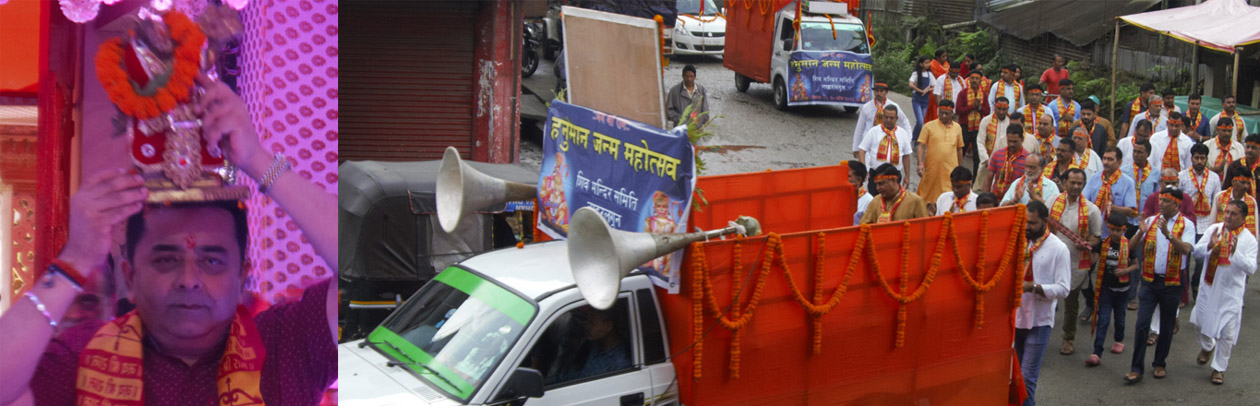
NAHARLAGUN, Apr 19: Jai Hanuman gyan gun sagar, Jai Kapisa tihun lok ujagar chant rented the air as his male and female devotees with Images of Lord Hanuman, Rama and Sita perched atop vehicles took out a procession here on Friday morning to mark birthday of Pawansuta.
Naharlagun Shiv temple wore a new look decorated by ana Das of Guwahati-based Utsab at the initiative of local Hanuman Janmothsaba Committee chairman Kamal Bajaj and president Sanjay Dewan. Special prayers were offered to Sankata Mochana (reliever of all distress).
However, songs of Kolkata-based singers Sarad Ananad, Ayushman, Ranjit Mehndi & Rahul and Allahabad’s Puja Chawla rented the air punctuated by Ram Lila by Kolkata-based Radhye Shyam dance group to the tune of five musicians tuned by Subashish Shau to appease Bajrangbali to seek his blessings. The cultural programme continued till past midnight
Lord Hanuman, known as Lord of Celibacy, and an ardent devotee of Lord Rama was one of the central characters of Hindu epic Ramayana. Son of Anjani and Kesari and Hanuman, an immortal living being to remain alive on earth until the end of current Kali Yuga (Chiranjivi), is known as son of wind-god Vayu and mentioned in Mahabharata and various Puranas and known to have been visiting Lord Jagganath temple in Puri in Odisha.
Once the sea was creating havoc for Puri. Saints were affected as meditation was very difficult om-kar sounds were drowned by roaring sound of sea. It is said that famous saint-Angirasa had led a saints’ delegation to Lord Jagannath and prayed to intervene. The Lord had asked Hanuman to prevent the sea-waves from entering Puri town. Hanuman stood at “Chakra-teerth” and prevented sea waves from causing any damage. Hanumana flies from one place to another. Thus, Lord Jagganth had chained him through Angirasa and the temple on Chakrateertha road of Puri is known as “bedi (chained) Hanuman”.
If yoga is the ability to control one’s mind then Hanuman is the quintessential yogi having a perfect mastery over his senses, achieved through a disciplined lifestyle tempered by the twin streams of celibacy and selfless devotion (bhakti). In fact, Hanuman is the ideal brahmachari (one who follows the path of Brahma) and a perfect karma yogi since he performs his actions with detachment, acting as an instrument of destiny rather than being impelled by any selfish motive.
The meaning or origin of word “Hanuman” is unclear, one interpretation means “one having a jaw (hanu) that is prominent (mant)”. This version is supported by a Puranic legend where baby Hanuman mistakes the sun for a fruit, attempts to heroically reach it, is wounded and gets a disfigured jaw. “Hanuman” name is derived from the Sanskrit words Han (“killed” or “destroyed”) and Maana (pride); means “one whose pride was destroyed”
Hanuman has many names, like Maruti, Pawansuta, Kesari Nandan & Mangalmurti also Anuman & Anjaneyar (Tamil), Hanumantha & Anjaniputra (Kannada), Hanumanthudu & Anjaneyudu (Telugu) due to linguistic variations.
Hanuman is stated by scholars to be the inspiration for the allegory-filled adventures of a monkey hero in the Xiyouji (Journey to the West), the great Chinese poetic novel influenced by the travels of Buddhist monk Xuanzang (Hsüan-tsang) to India during 602–664 CE. He was a scholar, traveller and translator who travelled to India in 7th century during early Tang Dynasty.
According to American Indologist Philip Lutgendorf, known for his studies on Hanuman, the theological significance and devotional dedication to Hanuman emerged about 1,000 years after the composition of the Ramayana, in the 2nd millennium CE, after the arrival of Islamic rule in Indian subcontinent. Bhakti movement saints, such as Samarth Ramdas expressed Hanuman as a symbol of nationalism and resistance to persecution. In the modern era, his iconography and temples have been increasingly common. He is viewed as the ideal combination of “strength, heroic initiative and assertive excellence” and “loving, emotional devotion to his personal god Rama”, as shakti and bhakti. In later literature, he has been the patron god of martial arts such as wrestling, acrobatics, as well as meditation and diligent scholarship. He symbolizes the human excellences of inner self-control, faith and service to a cause, hidden behind the first impressions of a being, who looks like an ape-man (vanara).
The earliest mention of a divine monkey, interpreted by some scholars as the proto-Hanuman, is in hymn 10.86 of the Rigveda, (1500 to 1200 BCE). The 23 verses of the hymn are a metaphorical and riddle-filled legend. It is presented as a dialogue between multiple characters: the god Indra, his wife Indrani and an energetic monkey it refers to as Vrisakapi and his wife Kapi. The hymn opens with Indrani complaining to Indra that some of the soma offerings for Indra have been allocated to the energetic and strong monkey, and the people are forgetting Indra. The king of the gods Indra responds by telling his wife that the living being (monkey) that bothers her is to be seen as a friend, and that they should make an effort to coexist peacefully. The hymn closes with all agreeing that they should come together in Indra’s house and share the wealth of the offerings.
The 135-feet tall Lord Hanuman statue in Paritala Anjaneya Temple is the tallest in the world, installed in 2003 at Paritala, about 30- km from Vijayawada in Andhra Pradesh. The 85-ft tall Lord Hanuman statue outside India is at Carapichaima, Trinidad & Tobago. Hanuman statues are found in across the world in Japan, Bali (Indonesia) besides of ancient period. (with Wikipedia inputs)


 20

