
By Pradeep Kumar
ITANAGAR, Apr 22: Power supply in Bomdila, headquarters of West Kameng district, has been snapped since April 20 last due to cyclonic storm that has been causing widespread resentment among the masses, our correspondent advocate Rinchin Khandu told on Monday evening.
However, Bomdila electricity division JE K G Agarwal while attempting to rectify the fault between Elephant point near Bhalukpong to Tippi of Balipara line of NEEPCO, while talking to Khandu over telephone said that there is less possibility of restoration of power supply to Bomdila tonight.
The powerful cyclonic storm with heavy rains had triggered landslides between Naharlagun and Nirjuli along NH-415 as witnesses by a staff of this daily around 7.30 pm though it was cleared by the highway engineers late night.
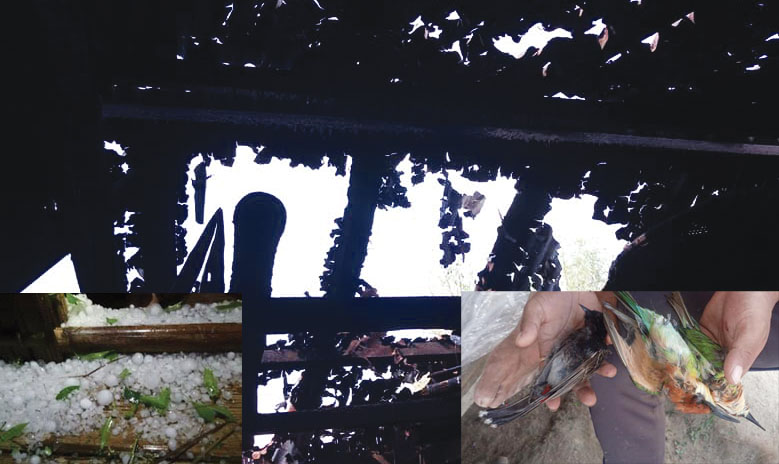
The fierce windstorm accompanied with hailstones wrecked havoc in the foothill areas along Assam-Arunachal Pradesh boundary in Bomai and Taraso under Taraso circle of Papum Pare district and Dissin-Passo and Seijosa circles of Pakke Kessang district, police sources said.
It blew of many roofs leaving large number of residents roofless while many roofs including CGI sheet-made were pierced too besides granaries, standing agriculture and horticulture crops of the areas damaged besides large number of cattle and birds also killed, Papum Pare SP Pranab Payal told this daily.
Another official report said that six villages were affected with their CGI sheet roofs and crops damaged in Dissing-Passo circle.
An official team led by ADC Tasso Gambo along with officials of Balijan & Tarasso circles, disaster management, agriculture, horticulture and other departments visited Tarasso are to assess the damages caused.
However, no relief has been announced by the state government though cyclonic storm in April-May is almost an annual feature in this Himalayan state.
This reminds me of huge hailstone, which I reported on 26.04.18 edition of this daily: 3-kg size hailstone signature of climate change: Expert
“Hailstones weighing up to 3-kg rained like hell along with rains and storm in Mayurbhanj and Balasore districts of Odisha on 31.03.18.
Such nature’s fury was never experienced in recorded memory, few septuagenarians told this editor in Bhimda, a village located along Gangahara River in Mayurbhanj district.
The wrath was so severe that hailstones weighing between 1 kg to 3 kg made numerous holes on asbestos and CGI sheet roof of most of the houses in Bhimda, said Ajay Jena, who took snaps of the hailstones and the brunt of the fury.
It caused considerable damages to lives and properties, he said, adding several villages in nearby Badasahi block of the same district and adjourning villages including Remuna in Balasore district also bore the brunt.
The children least bothered of possible danger collected the hailstone out of fun while few ventured outside to assess the damages. The residents of tribal dominated Mayurbhanj district were forced to repair their roofs forthwith to prevent free passage of the rain water into their houses. The huge hailstones also killed few domesticated animals grazing in the fields besides Rabi crops.
The same day, an old man died on the spot, his grandson and another person sustained burn injuries in lightning strike at Sarapada village under Itamati police limits in Nayagarh district.
The Nor’wester rains brought the much desired relief to people from scorching summer heat by pulling down the mercury by several notches. But the thunderstorm accompanied with hail and gusty surface wind @ 50 to 60 kmph caused never seen before damages, eyewitnesses said.
The possible impact of climate change was seen in Arunachal Pradesh, experiencing severe cold since New Year 2018 while the people of Chambang, criss-crossed by Chatey, Peri, Patee and Kurung rivers, located at a higher elevation witnessed heavy snowfall since January 04.01.18 evening, after a long long gap. Moreover, Mechuka also experienced heavy snowfall in 2018.
Severe cold this year or snowfall at Chambang and Damin were signatures of ongoing climate change process, earth scientist Prof Trilochan Singh told this editor. Climate change is the buzz word today though weather continues to change every moment while climate changes over a long period, said Prof Singh, who has been working in this state for last 43 years.
The earth existed 4.5 billion years ago though human life came into existence only about 10,000 years ago. But the climate change is a circle known as glacier phase and inter-glacier phase. The glaciers are formed in the first phase and melts in second phase due to various factors. However, the melting has not been uniform, according to scientific studies, he disclosed.
The scientists have found that present inter-glacier phase begun 11,000 years ago and continue till 18,000 years. However, because of numerous human activities having direct bearing on climate, the period may extend till 20,000 years, the scientists apprehend.
Prof Singh was a member of Gondwanaland Expedition, an international expedition from Shimla in India-top of the Himalaya to Cape Agulhas in South Africa – tip of Africa to trace the great Gondwanaland that existed as a single landmass about 250 million years ago and drifted to its present position in different continents. ‘Lucy’ fossils in Addis Ababa’s National Museum provide a link between man and the ape, he informed.
On 30.01.18, Damin, located along Indo-China border, 45-km from Kurung Kumey district HQs Koloriang in Arunachal Pradesh, had recorded snowfall for the first time after a gap of a decade forcing the people to remain indoors, Pratidin Times reporter Mintu Tamuli had said quoting Damin circle officer Honjon Perme.
On 18.03.18, an elderly tourist died reportedly for low level of oxygen near Sela Pass along Tezpur-Bhalulpong-Twang road, is a proof that this Himalayan state is experiencing tall all impacts of climate change.
Tawang is about 360-km to from Tezpur and 560-km from state capital Itanagar and 300-km to the rescued area near Sela Pass which is the highest mountain peck in Himalayan range, located at 13,700 feet above the mean sea level.
More than 300 people including locals and tourists in 100 vehicles were stuck in unexpected heavy snowfall since 17.03.18 while the male tourist, about 60 year from Mumbai died due to extreme cold and low oxygen level.
The vehicles were stuck between Ahirgarh and Sela Pass in more than two feet of snowfall in sub zero temperature while the Army personnel conducted rescue operations.
This is repetition within a gap of six days as about 680 tourists in about 320 vehicles were stuck up there on 12.03.18 following constant heavy snowfall since 05.03.18 afternoon lowering temperature to sub-zero between Ahiragarh and Sela Pass and were evacuated by Indian Army that night, Army Eastern command sources had said.


 20

