
By Pradeep Kumar
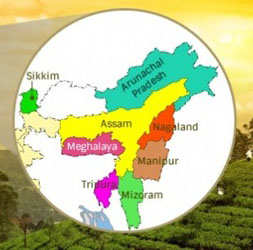
Arunachal Pradesh, Assam, Manipur, Meghalaya, Mizoram, Nagaland, Sikkim & Tripura, known as North Eastern Region (NER), while I have named Arunachal Pradesh as ‘Land of Indradhanush’ because of incredible cultural diversity while NER includes more than 250 tribes and sub-tribes which trace their ancestry to distant lands in Mongolia and Southeast Asia (website Planeta).
Spread in 262,230 sqkm representing 3.8% of national population and sharing 5,182-km international border with Tibet Autonomous Region, China, Myanmar, Bangladesh & Bhutan, almost 8% of India’s geographical area, is one of the largest salients (panhandles) in the world, linked to the main land India through 22-km Siliguri Corridor or Chicken’s Neck.
“In 1950, Assam (which included Arunachal Pradesh), NE India’s largest state, was more than 4% richer than the rest of India. Isolated and often ignored, by 1999 it was over 45% poorer, with the gap steadily widening,” according to a United Nations report. Who should be blamed for it? Is it not the secessionist movement that is squarely responsible for the poor state of affairs in the region despite its natural wealth?
“NER should be treated as single unit for its growth as it offers huge market,” Prof Atul Sarma, 13th Finance Commission member, former Arunachal University (RGU) VC & Asian Development Bank consultant had advocated. With the Centre initiating steps to tackle the insurgency menace and transportation bottleneck, the NER is drawing more and more investment which would go a long way in its speedy socio-economic development, he had said in 2009. The NER should become a single economic unit without disturbing the political boundaries of the states – was outcome of a two-day conference, “North East India: Strategic and Developmental Imperatives”, jointly organised by Institute for Defence Studies and Analyses and Special Branch, Assam Police, on July 15-16, 2013.
There are plenty examples to prove how politics divided NER united by culture – In 2003, the then Deputy Prime Minister LK Advani, in his public address at Itanagar, had described New Delhi’s veiled decision not to develop Arunachal Pradesh after the 1962 Chinese war as a ‘historical blunder’ at a public meeting at IG Park in 2003, things have changed with the change of the Centre’s attitude towards this resource-rich state.
On 10.11.05, union Panchayati Raj & Petroleum & Natural Gas (PNG) Minister Mani Shankar Aiyar had termed me an awful journalist for insisting on the hidden oil wealth in the state as the question was beyond PR ministry. The potential could make India self sufficient, he had admitted, and assured to send a central team to assess the oil wealth. But alas… he was shifted from PNG ministry.
“From 1990 onward, former Oil India Ltd chief Chudamani Ratnam had repeatedly claimed that India had a treasure trove of shale oil in Arunachal Pradesh and other parts of the NE which could produce 140 million tonnes per year for 100 years, making India a net oil exporter. New technology developed by the US to extract shale oil had made the venture prospective,” consulting editor of The Economic Times Swaminathan S Anklesaria Aiyar in his column Swaminomics on 25.09.11.
Indian geologists have identified some 28 basins for shale gas exploration. They dispute US Energy Information Administration figures, which place the reserves at 96 trillion cubic feet (tcf). One estimate by Indian scientists places potential reserves at as high as 527 tcf. Top officials said Oil India believed Dishang Shales in 120 sqkm Deomali tract alone could prove to be a major find for the company. But, state’s geology and mining department had earned Rs 102.10 crore (2013-14) and Rs 136.09 crore (2014-15) revenue.


 20
