
By Pradeep Kumar
NAHARLAGUN, June 25: Maintaining Arunachal Pradesh status as ‘Lungs of the Globe’ is a herculean task, but Arunachal Pradesh Pollution Control Board (APPCB) staff are on the job 24×7 to analyze the level of air pollution and issue directives to achieve the goal.
This Himalayan state with over 50,000 sqkm of moderate to very dense forests, equivalent to 550 million cubic metre growing stock or living assets (equivalent to 2000 million metric tons of carbon dioxide) makes it one of the 12 bio-diversity hotspots on the Earth to serve as one of the major ‘carbon sinks’ or ‘Lungs of the Universe’.
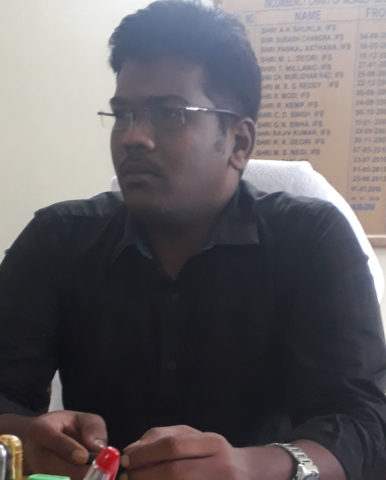 When asked about ongoing activities, APPCB member-secretary Rajthilak S said that air quality monitoring system (AQMS), under National Air Quality Monitoring Programme (NAMP), runs round the clock at Itanagar PCCF office and APPCB building here to monitor air pollution level and issue directives for maintaining the desired level.
Rajthilak, in an exclusive interview on Wednesday, said that the number of vehicles, particularly diesel-run in Capital Complex, is much higher than the population. Diesel vehicles intensify pollution of the air by generating more carbon dioxide as shown by the real time date, he said, adding the road construction activities pollute the air further which of course subsides after rains.
Hinting at plan to set up AQMS in all district headquarters to assess air quality, he said such installation would facilitate data collection directly instead of present system of physical collection. While use of plastic will be banned soon, guidelines will be issued for proper disposal of plastic and bio-medical wastes. A meeting will be conducted with hospital managers soon to ask them to comply with the guidelines strictly, he added.
Assistant environment engineer Tana Manlong, who was assisting him, said that the state Govt has proposed to set up Continuous Ambient Air Control Monitoring Station (CAACMS) at Pasighat, Namsai, Roing, Tezu and Bhalukpong for non-stop monitoring of air quality.
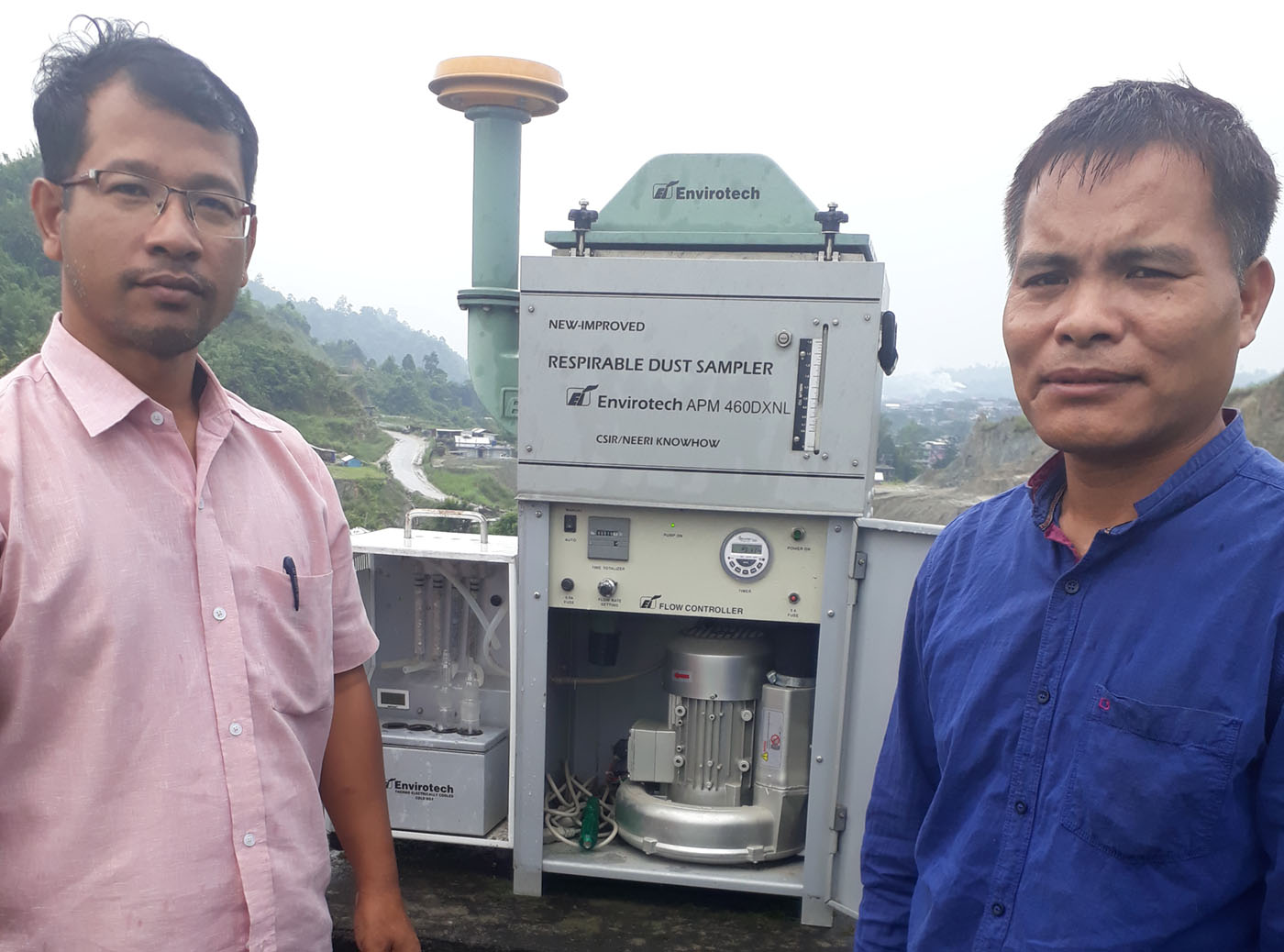
Manlong along with junior scientific assistant Dani Mobing, in-charge of collection and analysis of data to forward to Central Pollution Control Board (CPCB), later demonstrated the use of the AQMS installed on the top floor of the office.
The air quality, which depends on parameter monitor with level – particulate matter (PM)-10, sulfur dioxide (SO2)-80, nitrogen dioxide (NO2)-80, is collected weekly once (from 10 am Tuesday to 10 am Wednesday). However, collecting SO2 level every four-hourly makes the job tougher, he added.
It may be mentioned here that Arunachal and Arunachalees have been shouldering a huge responsibility as conservators of the great ecosystem through their traditions and customs as carbon serves as “a blanket of the earth to allow life to sustain”. The huge tropical, temperate and Alpine forest ranges, like ecosystem diversity along the Bhalukpong-Tawang road ecosystem, state’s natural assets, are not found anywhere else in the country.
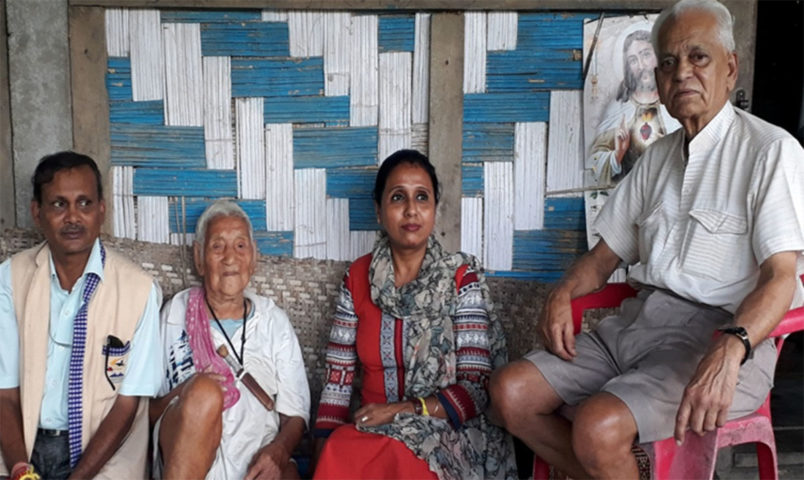
Longevity of Arunchalees proves pollution free air of Arunachal to justify its sobriquet ‘Lungs of the Globe’. super centenarian Teli Nigla – a living legend, is the best example, who lives at Jote village, 30-km away from Itanagar, and still works in the field at the age of 120. Father of former minister late T C Teli, though born in Laching Bagang village, known as Teli Talliang, under Chayang Tajo circle of East Kameng district, he had migrated with family to Itanagar en-route Pappu Valley-Sagalee-Karoi route to settle down here at a very young age.
It was great experience meeting the grand old man with NYP chairman Dr S N Subba Rao @ Bhaiji in 2017 in his house when he recalled his meeting with Bhaiji in this village in 2012 during a National Integration Youth Camp had had danced to the tune of Bhaiji’s song. Bhaiji had announced his age as 113 after seeing records.
That was why New Delhi-based National Green Tribunal (NGT) had summoned state Chief Secretary Satya Gopal for hearing recently for hearing on implementation of Solid Waste Management Rules (SWM)-2016, Plastic Waste Management Rules (PWM)-2016 and Bio-Medical Waste Management (BWM) Rules-2016. After CS explained various stages of development in implementing the above rules, the NGT had given several directions.


 20
