
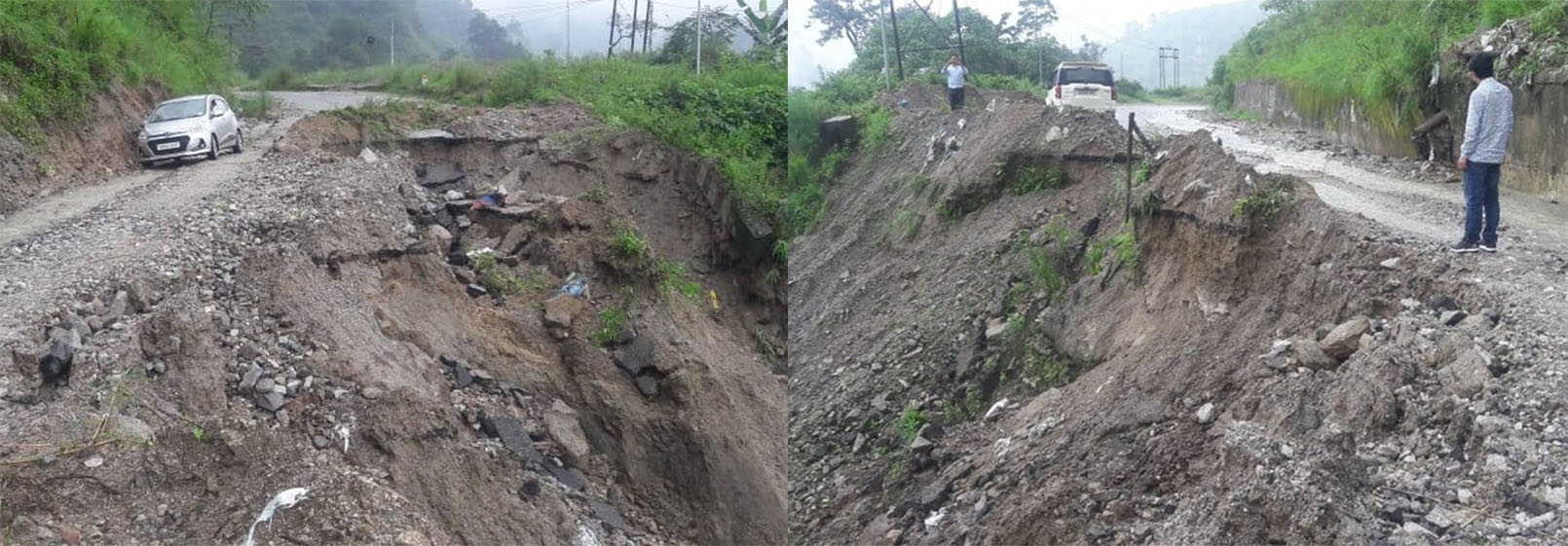
Nature’s fury turns Hoj-Potin road accident prone
GoI wasting crores on flood prone roads annually
By Pradeep Kumar
ITANAGAR, July 24: The incessant monsoon rains this year have left a trail of devastation, particularly damaging roads, culverts and bridges, most essential for communication in this land-locked state. Come rainy days, roads and highways in disappear to oblivion to be developed again, a perennial problem while state capital Itanagar still lacks an all-weather road even 72 years after India’s independence.
But why the GoI and GoAP have not been adopting disaster resilient road technology as a lasting solution is a million dollar question?
The massive erosion of Hoj-Potin road, part of ambitious Trans-Arunachal Highway, justifies the common adage ‘man proposes but god disposes’, says social activist Likha Tongum who travelled through this road on Tuesday. Repeated landslides and mudslides along this road for last one year as highlighted in local media have been creating untold sufferings for commuters of Kurung Kumey, Kra Daadi, Lower Subansiri, Kamle and Upper Subansiri districts who travel through this road.
It may be recalled that Union MoS (MoRTH) Mansukh Mandaviya had inspected Ziro-Potin road during his maiden state visit on 13.09.16 and had announced Rs 10 crore, during a press conference to renovate the dilapidated road.
Citing Darjeeling example, this editor had asked Mandaviya: “why disaster resilient roads in this landslide prone hilly areas approved by World Bank & Asian Development Bank is not adopted though visible in Darjeeling & Siliguri in West Bengal? When the Centre has been funding for building state roads why not adopt this technology?”
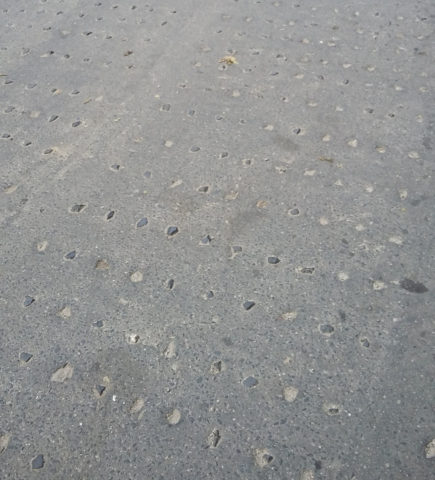
Darjeeling’s disaster resilient road
In his appreciation, Mandaviya had said that a high level conference involving international agencies, road researchers and state engineers will be conducted soon to discuss the issue threadbare to develop a mechanism soon. Mandaviya [present MoS (I/C) for Shipping] had given only political promise as the technology has not been adopted as yet in this state. After failing to find damaged portion of road in Darjeeling for three days in September 2016, I did a story and had cited the example to Mandaviya.
Increasing developmental activity in mountainous areas has aggravated the landslide hazard, like falls, topples, slides, spreads and flows of rock as well as soils and mud and are triggered by geological, morphological or human interventions. Road construction by disturbing the vulnerable ecology of these areas is one of the major causes of landslide events, writes CPWD SE D Roychowdhury.
Poor technology: Landfall disaster mitigation is still not inbuilt into road development policies mostly due to cost constraints. The technological interventions, like use of GIS for finalizing of alignment, use of geo-composites for improved drainage and rockfall protection measures, are slowly finding their way into our road construction codes and guidelines. Capacity building and documentation of experiences from early projects and monitoring of hazardous areas are some of the specific actions needed as policy, he adds.
The landslide hazard zonation Atlas of India published by Building Materials and Technology Promotion Council (BMTPC) provides a good insight into various landslides-prone areas. Road construction is closely linked to development in the mountainous regions, which generally lacks transportation infrastructure. Thus, the authorities started giving serious attention to the land slide hazards since 1950s which is contemporary with the development of the hilly regions in India – NE states, mountainous Northern states and Western Ghats.
Road construction as a development tool has been widely implemented by international development agencies, like WB, ADB, UNDP etc. in India and Nepal. The impact of developmental activities on landslide hazard and vice-a-versa has been well documented in Nepal.
Indian Road Congress (IRC) and Bureau of Indian Standards had come out with publications regarding landslide and Rock-fall Mitigation Systems. Landslide Control Guidelines, Recommended Practices for treatment of embankment and roadside slopes for erosion control, state of the art: Design and construction of Rockfall Mitigation Systems (IRC Highway Research Board – Special Report 23 – 2014), to name a few.
Such well tested technology is yet to finds its way in Arunachal. The scope for innovation in this domain especially using local materials is immense. The road construction agencies have neither the budget nor the mandate for landslide/Rockfall protection initiatives and their poor capacity, vendor-driven technology remain vulnerable to questions while unauthorized excavation, jungle clearance and building activities causing slides often for lack of engineering precautions intensify the problems.
Moreover, Union MoRTH Minister Nitin Gadkari had announced that national highways in the country will be made of concrete and will use cement instead of bitumen to reduce construction costs, after flagging off the road safety week from January 11 to 17 at New Delhi. He had played down safety concerns from cement-concrete highways by saying that tyre technology (Smart tyre technology tries to read the roads) has improved to counter such issues and said special focus on highways would be given to hilly states like Himachal Pradesh and the NE where frequent landslides occur.
He also said that based on studies done earlier which had identified 726 black spots on NHs -road locations that report large numbers of accidents – the GoI will have to spend around Rs 11,000 crore to rectify them. The GoI might hire international consultants with technologies to transplant trees instead of cutting them for building roads, he had said.
He said that the road ministry has tweaked the rules to double lane roads with movement of over 10,000 four-wheelers. Earlier this number was 15,000. “People are buying cars and traffic is increasing, so we have come up with widening of highways,” he had said, adding: “We would try that not even a single NH in the country is single lane.”
India had reacted sharply to China’s objection on President Ram Nath Kovind’s 2007 visit to Arunachal Pradesh on the ground that the NE state is an “integral and inalienable” part of the country. But development of roads to the border is still in a quandary!
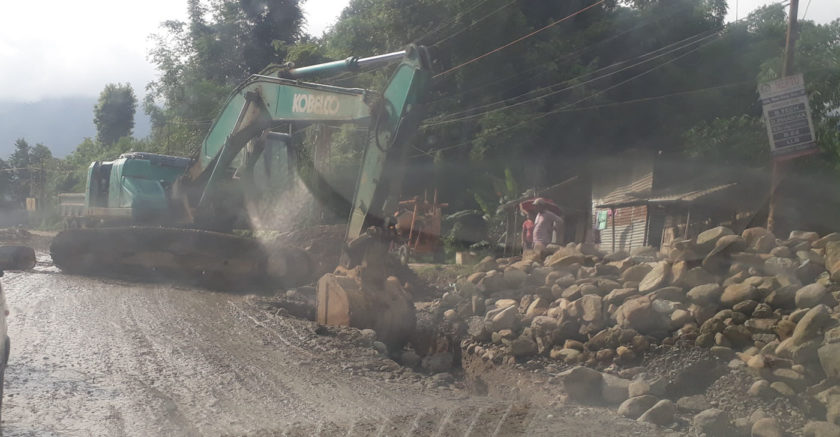
Monsoon comes annually to throw the communication network of this hilly state out of gear forcing the people remain isolated to fend for themselves. The horrible condition of capital road (NH-415) is the best example, though T K Enterprise Consortium Pvt Ltd has engaged men and machines to facilitate communication. Such sufferings will continue till those who matter give a serious thought for a lasting solution to this enigmatic problem. But when is a matter of question?


 20
