
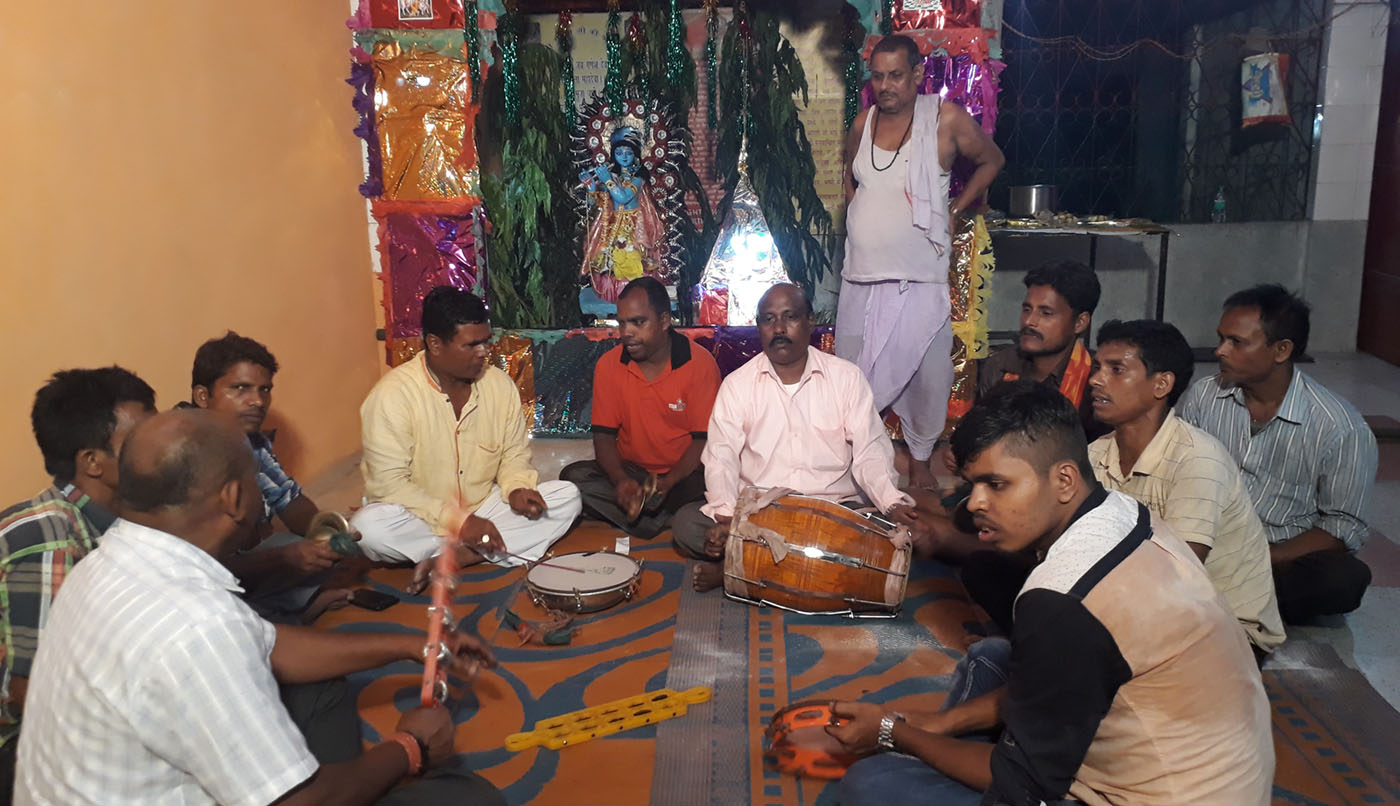
Janmashtami celebration at Naharalgun A sector Shiva temple
Beyond the Horizon
By Pradeep Kumar
Arunachal Pradesh joined rest of India in celebrating Janmashtami, birthday of Sri Krishna with great devotion and enthusiasm. Sri Krishna was born in a prison in the custody of demon king Kansa. Vasudev, his father thought of his friend Nand, King of Vrindavan, and escaped from the jail with Sri Krishna to hand over the child to him to save him from the clutch of Kansa. Krishna grew up there and finally killed King Kansa, his uncle.
The celebration of Janmashtami takes place during midnight as Sri Krishna is believed to be born on a dark, stormy and windy night to end the rule and violence of his Kansa. All over India this day is celebrated with devotional songs and dances, pujas, arti, blowing of conch while devotees rock the cradle of baby Sri Krishna. Temples and homes are wonderfully decorated and illuminated. Night long prayers are offered and religious mantras are sung in the temples. Janmashtami celebration of Mathura and Vrindavan, the places where Sri Krishna had spent his life, are very special.
“Karmanye Vadhikaraste, Ma phaleshou kada chana. Ma Karma Phala Hetur Bhurmatey Sangostva Akarmn” (You have the right to perform your actions, but you are not entitled to the fruits of the actions. Do not let the fruit be the purpose of your actions, and therefore you won’t be attached to not doing your duty).
This was the lesson given by Sri Krishna to greatest archer Arjuna during Mahabharat War or Dharma Yudhha (righteous war) as mentioned in Verse 47, Chapter II of Bhagavad Gita, which has recorded Krishna–Arjuna dialogue covering a broad range of spiritual topics, touching upon ethical dilemmas and philosophical issues that go far beyond the war.
Gita’s call for selfless action inspired many leaders of Indian independence movement, including Bal Gangadhar Tilak and Mahatma Gandhi, while Gandhi referred to Gita as his “spiritual dictionary”.
Sri Krishna, considered as one of the most powerful human incarnations of Lord Vishnu, born around 5,200 years ago in Mathura. The sole objective of his reincarnation was to free the Earth from the evils of demons. He played an important role in Mahabharata and propagated the theory of bhakti and good karma as elucidated in Bhagwat Gita.
It would be wrong not to recall Sri Krishna’s relation with this Himalayan state. Bhismaknagar, 30-km from Lower Dibang Valley district HQs Roing, is the oldest archaeological and mythological site in Arunachal Pradesh, dating back to 12th century AD. The fort was excavated during 1969-1973 which yielded terracotta plaques, decorative tiles, potteries, terracotta figurines etc. Popular legends and traditions identify the ruins of the fort as the site of capital of Raja Bhismaka, father of Rukmini, wife of Lord Krishna.
Lakshmi, took birth as Rukmini, daughter of Vidarbha King Bhismaka (Mahabharata Adi 67.156). She fell in love with Sri Krishna after hearing much about his virtue, character, charm and greatness. Rukmini’s parents wanted to marry her to Krishna but her eldest brother Rukmi strongly opposed as Krishna had killed his friend Kansa. Rukmi was an ambitious prince and he did not want to earn the wrath of Emperor Jarasandha, who was ruthless.
Rukmi proposed that she be married to his friend Shisupala, crown prince of Chedi and a cousin of Krishna. Shishupala was also close associate of Jarasandha and hence an ally of Rukmi. After learning everything, Rukmini sent her trusted servant messenger Sunanda with a letter to Krishna asking him to come to Vidarbha and kidnap her to avoid a battle where her relatives may be killed. Krishna on receiving the message in Dwarka immediately set out for Vidarbha with his elder brother Balarama.
Bhishmaka and Rukmini received the news that Krishna was coming. Bhishmaka, who secretly approved Krishna-Rukmini marriage, wished he would take Rukmini away and had built a mansion for her. On receiving message that Krishna had accepted her request, she went to the temple to offer her obeisance to Goddess Ambika, consort of Lord Shiva.
Stepping out of the temple, she saw Krishna, who soon swept her into his chariot. They both started to ride off when Shishupala noticed them. Jarasandha with his forces started chasing them. Balarama held them back, but Rukmi overtook Krishna-Rukmini near Bhadrod and fought with Krishna. When Krishna was about to kill him, Rukmini fell at Krishna’s feet and begged to spare her brother’s life. Krishna generously shaved Rukmi. Rukmi was worshipped as Gaudera by villagers since he was defeated. He was known as the God of defeat and shame.
According to folklore, Krishna came to the village of Mahadavpur Ghed after kidnapping Rukmini and got married to her at this very place. In the memory of that event, there is a temple built for Madhavrai. A celebration of this event is held at Madhavpur in memory of this marriage every year in a cultural fair. At Dwaraka, Krishna and Rukmini were welcomed with great pomp and ceremony.
In 1480, Rukmini Devi’s servant messenger is believed to have appeared in this world as Vadirajatirtha (1480–1600), the greatest saint in Madhvacharya tradition. He composed a famous work Rukminishavijay glorifying Rukmini and Krishna in 1240 verses spread over 19 chapters.
The first son of Queen Rukmini was Pradyumna, and also born of her were Charudeshna. Sudesna and the powerful Charudeha, along with Sucharu, Charugupta, Bhadracharu, Charuchandra, Vicharu and Charu, the tenth(SB 10.61.8–9). Of them, Pradyumna was the crown prince of Dwaraka.
However, after Krishan went to Gandhari to mourn death of 100 sons in Kurukshetra war, she fumed, “Shouldn’t you have averted this war with your divine will and power? Is this what you do to your own creation? I have requested you, each and every day in the past troubled times to avert this disaster. Is this how you answer my prayers? Ask your mother, Devaki, the pain of losing a child. She had seven of her children being killed at birth and now I have seen a hundred sons of mine being butchered to death” Gandhari, was shaking, her anger uncontainable.” She was shocked to hear Krishna laughing gently. Her fury vents itself out: “And you smile after all this? What a nerve you have. Listen to this, oh mocking God. If my years of Vishnu Bhakthi have been true, and if I have been true to my husband, then, may you die in 36 years from today. May Dwaraka be flooded and may every one of your Yadava kin perish by killing each other, just as you made the kins of Kuru kill one another. May the Yadavas die out…. may the Yadavas die out….”
According to legend, after Yadu massacre, exhausted Krishna was sleeping below a tree and mistaking him as a deer, hunter Jara shot an arrow that fatally injured him. Krishna forgave Jara and died. The pilgrimage site of Bhalka in Gujarat marks the location where Krishna is believed to have died. It is also known as Dehotsarga, a term that literally means the place where Krishna “gave up his body”. Rukmini, along with Jambavati and few other ladies, ascended herself on Krishna’s pyre. Krishna after his death returned to his transcendent abode directly because of his yogic concentration, says Bhagavata Purana in Book 11, chapter 3.


 20
